

ISO 27001 requirements: A brief guide
When it comes to protecting sensitive business data, ISO 27001 has become the global standard. According to a recent ISO survey, more than 70,000 companies worldwide are certified in ISO 27001. This number grows every year as enterprises and startups alike realize that information security is no longer just about IT, it is about customer trust, regulatory compliance, and long-term business growth.
For organizations exploring ISO 27001 certification, one of the biggest questions is: What exactly are the ISO 27001 requirements, and how can we meet them effectively?
This guide breaks down the core requirements in simple terms, explains why they matter, and shows how modern solutions like CyberArrow GRC can automate compliance and audits to make the journey much smoother.
- What is ISO 27001?
- Why ISO 27001 matters today
- Core ISO 27001 requirements
- 1. Establish an Information Security Management System (ISMS)
- 2. Define scope and boundaries
- 3. Leadership commitment
- 4. Risk assessment and treatment
- 5. Information security policies
- 6. Security controls (Annex A)
- 7. Competence and awareness
- 8. Documented information
- 9. Continuous monitoring and measurement
- 10. Corrective actions and improvements
- Common challenges with ISO 27001
- How CyberArrow GRC simplifies ISO 27001 compliance
- ISO 27001 certification process
- Key statistics about ISO 27001
- Practical takeaways
- Final thoughts
- FAQs
- What are the ISO 27001 requirements?
- Why is ISO 27001 important for my business?
- What documents are required for ISO 27001 compliance?
- How long does it take to meet ISO 27001 requirements?
- Who needs to follow ISO 27001 requirements?
- Is ISO 27001 certification mandatory?
- What are the challenges in meeting ISO 27001 requirements?
- How can CyberArrow GRC help with ISO 27001 requirements?
- What is a zero-touch audit for ISO 27001?
- How often should ISO 27001 audits be done?
What is ISO 27001?
ISO 27001 is an international standard for information security management systems (ISMS). It outlines the framework organizations should follow to manage risks, protect sensitive data, and continuously improve their security posture.
Unlike technical controls alone, ISO 27001 takes a risk-based approach. It looks at people, processes, and technology together. By meeting ISO 27001 requirements, companies demonstrate that they are serious about protecting information assets, whether customer data, financial records, or intellectual property.
Why ISO 27001 matters today
A few key facts highlight why ISO 27001 requirements are more relevant than ever:
- Data breaches are costly: IBM’s 2024 Cost of a Data Breach Report found the average global cost of a breach is $4.88 million.
- Customer trust is fragile: According to PwC, 85% of consumers will not do business with a company if they have security concerns.
- Regulators are strict: Many industries, from finance to healthcare, require compliance with security frameworks, and ISO 27001 is often seen as proof of meeting those expectations.
For organizations, compliance is no longer just about avoiding fines. It is about building a competitive advantage.
Core ISO 27001 requirements
The standard has a structured set of requirements that organizations must follow to achieve certification. Below is a breakdown of the most important areas.
1. Establish an Information Security Management System (ISMS)
The ISMS is the foundation. Organizations must define a systematic approach for managing security, including policies, objectives, and responsibilities. This ensures everyone understands the importance of protecting data.
2. Define scope and boundaries
ISO 27001 requires organizations to clearly document what parts of the business the ISMS will cover. This avoids confusion and helps focus resources where they matter most.
3. Leadership commitment
Top management must show leadership by approving policies, allocating resources, and making security part of the company culture. Without executive buy-in, the ISMS is unlikely to succeed.
4. Risk assessment and treatment
Organizations must identify potential threats, assess risks, and select appropriate controls to reduce those risks. This is one of the most critical ISO 27001 requirements since it drives all security decisions.
5. Information security policies
Policies define the rules for how information is managed. For example, password management, data classification, or acceptable use of company devices.
6. Security controls (Annex A)
Annex A of ISO 27001 contains 93 controls across 4 themes:
- Organizational controls.
- People controls.
- Physical controls.
- Technological controls.
These controls are not one-size-fits-all. Companies select the ones that match their risk profile.
7. Competence and awareness
Employees must be trained to understand security risks and their role in protecting information. A strong security culture reduces the chance of human error.
8. Documented information
All policies, procedures, and records must be properly documented. This ensures clarity and provides evidence during audits.
9. Continuous monitoring and measurement
Organizations must monitor their ISMS, measure effectiveness, and report findings. This includes internal audits, reviews, and performance checks.
10. Corrective actions and improvements
When issues are found, organizations must take corrective action. ISO 27001 is about continuous improvement, not just a one-time certification.
Common challenges with ISO 27001
While the requirements are clear, many companies struggle with:
- Complex documentation: Writing and maintaining policies, procedures, and risk assessments takes time.
- Manual audits: Preparing evidence for auditors can take weeks or even months.
- Keeping pace: As threats evolve, security measures must also be updated.
- Employee engagement: Without training, employees often see security as an obstacle instead of a priority.
This is where automation and modern GRC (governance, risk, and compliance) platforms play a vital role.
How CyberArrow GRC simplifies ISO 27001 compliance
CyberArrow GRC is an enterprise-grade GRC platform trusted by leading organizations. It helps automate compliance with ISO 27001 and other standards, turning a heavy process into a smooth and efficient one.
Key benefits include:
- Zero-touch audit: Automated collection and mapping of evidence means audits can be completed faster, with minimal manual work.
- Centralized dashboard: All ISO 27001 requirements, controls, and tasks are managed in one place.
- Real-time monitoring: Continuous monitoring ensures gaps are detected early, reducing risks before they grow.
- Policy automation: Build, publish, and update security policies with ease.
- Scalability: Whether you are a startup or a global enterprise, CyberArrow GRC adapts to your needs.
By using CyberArrow GRC, organizations save hundreds of hours in manual work and achieve certification readiness with far less stress.
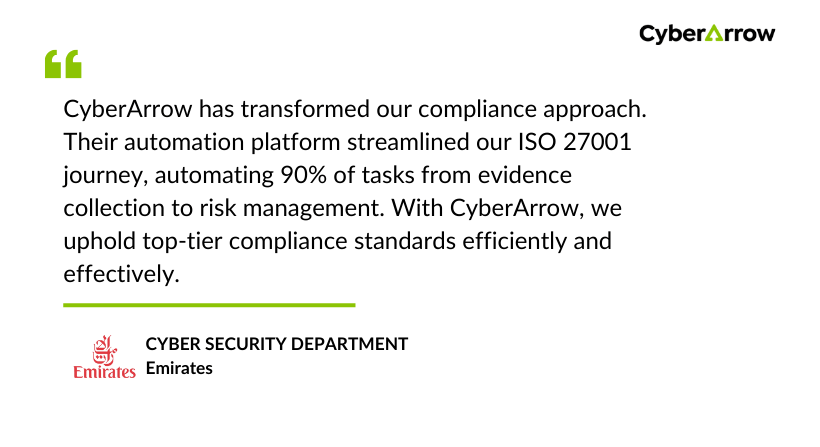
Read how Emirates enhanced Information Security by automating ISO 27001 with CyberArrow GRC.
See what Emirates has to say about CyberArrow GRC:
ISO 27001 certification process
To get certified, organizations typically follow these steps:
- Gap analysis: Assess current practices against ISO 27001 requirements.
- Implementation: Build or improve the ISMS, implement controls, and train staff.
- Internal audit: Conduct internal audits to identify and fix gaps.
- Certification audit: A third-party auditor reviews compliance and grants certification.
- Ongoing maintenance: Continue improving and monitoring the ISMS for future audits.
With a solution like CyberArrow GRC, this process becomes faster and less resource-intensive.
Key statistics about ISO 27001
- Organizations with ISO 27001 certification experience reduced breach costs by up to 48% (Ponemon Institute).
- 42% of companies say compliance is their top reason for implementing ISO 27001, while 58% cite customer trust and business opportunities.
- Companies that automate compliance processes report 60% faster audit readiness compared to manual approaches.
Practical takeaways
- ISO 27001 requirements provide a clear roadmap for managing security risks.
- Certification is not just about compliance, it strengthens brand trust and reduces costs.
- Challenges like documentation, audits, and monitoring can be simplified with automation.
- CyberArrow GRC offers a zero-touch audit approach that saves time and ensures accuracy.
Final thoughts
Meeting ISO 27001 requirements can seem like a big challenge at first. But when broken down into steps, it becomes a structured path toward stronger information security and higher business value.
Enterprises that use manual methods often find themselves buried in documents and unprepared for audits. Those that embrace automation, however, not only meet compliance with ease but also gain a competitive edge.
CyberArrow GRC makes that possible. With its automation, real-time monitoring, and zero-touch audit features, it transforms ISO 27001 compliance from a painful task into a strategic advantage.
If your organization wants to achieve ISO 27001 certification faster, more efficiently, and with full confidence, CyberArrow GRC is the solution.
FAQs
What are the ISO 27001 requirements?
ISO 27001 requirements are the rules and standards a business must follow to build a strong Information Security Management System (ISMS). They cover areas like risk management, security policies, access controls, incident response, and continuous improvement.
Why is ISO 27001 important for my business?
ISO 27001 helps protect your company’s data from cyberattacks, insider threats, and accidental loss. It also builds trust with customers, partners, and regulators. Many clients now demand ISO 27001 certification before doing business with vendors.
What documents are required for ISO 27001 compliance?
Some of the key documents include:
- Information Security Policy
- Risk Assessment and Risk Treatment Plan
- Statement of Applicability (SoA)
- Security Incident Response Plan
- Internal Audit Reports
How long does it take to meet ISO 27001 requirements?
For small to mid-sized businesses, it usually takes 3 to 6 months to prepare and implement ISO 27001. Larger companies may take up to a year, depending on how mature their security processes are.
Who needs to follow ISO 27001 requirements?
Any company that handles sensitive customer or business data can benefit from ISO 27001. It is especially valuable for industries like IT, finance, healthcare, government, and SaaS providers.
Is ISO 27001 certification mandatory?
ISO 27001 is not legally mandatory in most countries, but it is often required in contracts and vendor assessments. For many businesses, it is the fastest way to prove security readiness and avoid losing deals.
What are the challenges in meeting ISO 27001 requirements?
The main challenges include documenting processes, keeping evidence for audits, and regularly updating controls. Many businesses struggle because they try to manage compliance manually with spreadsheets.
How can CyberArrow GRC help with ISO 27001 requirements?
CyberArrow GRC automates the entire ISO 27001 compliance process. It tracks requirements, maps controls, collects audit evidence automatically, and provides a zero-touch audit approach. This saves time, reduces errors, and makes certification faster.
What is a zero-touch audit for ISO 27001?
A zero-touch audit means your company does not need to manually gather evidence for the auditor. CyberArrow GRC collects and organizes all compliance data in real-time, so the auditor can access everything directly.
How often should ISO 27001 audits be done?
Companies need a certification audit once every 3 years, along with yearly surveillance audits to prove ongoing compliance. Using CyberArrow GRC makes it easier to stay ready at all times.
