

ISO 27001 audit: A step-by-step guide
Businesses today face constant pressure to protect sensitive data. From customer records to financial transactions, even the smallest mistake can lead to huge costs. Reports show that the average cost of a data breach reached $4.45 million in 2023 (IBM Cost of Data Breach Report). This makes compliance with security standards like ISO 27001 more important than ever.
An ISO 27001 audit is one of the most trusted ways for companies to prove that they follow best practices in information security. But many organizations still see the audit as a stressful task filled with manual work, endless spreadsheets, and surprise findings.
This guide will break down the ISO 27001 audit step by step. You will learn what the audit involves, how to prepare, and how modern tools like CyberArrow GRC can automate the process with a zero-touch audit approach.
- What is ISO 27001?
- Why ISO 27001 audit matters
- Types of ISO 27001 audits
- Step-by-step guide to ISO 27001 audit
- Common challenges in ISO 27001 audits
- How CyberArrow GRC simplifies ISO 27001 audits
- Final thoughts
- FAQs
- How long does it take to get ISO 27001 certified?
- How much does an ISO 27001 audit cost?
- Do we need to audit every department?
- How often do we need an audit?
- Can CyberArrow GRC help with ISO 27001 compliance?
- What happens if we fail the audit?
- Is ISO 27001 only for IT companies?
- Is ISO 27001 only for IT companies?
What is ISO 27001?
ISO 27001 is a globally recognized standard for managing information security. It sets requirements for building an Information Security Management System (ISMS). This system helps organizations manage risks, secure assets, and protect sensitive data.
Key goals of ISO 27001 include:
- Identifying risks to information.
- Putting security controls in place.
- Ensuring business continuity.
- Building trust with customers and regulators.
Companies of all sizes adopt ISO 27001. In fact, more than 70,000 organizations worldwide are certified according to ISO surveys.
Why ISO 27001 audit matters
An ISO 27001 audit is not just about checking a box. It brings clear benefits:
- Customer trust: Clients prefer working with businesses that prove security commitment.
- Regulatory compliance: Many industries require ISO 27001 certification to meet data protection rules.
- Competitive advantage: Certification can help win contracts and partnerships.
- Reduced risk: Regular audits help spot gaps before attackers do.
Research shows that organizations with ISO 27001 certification are 50% less likely to experience a major breach (British Standards Institute).
Types of ISO 27001 audits
Before diving into the steps, it’s important to know the two main types of audits:
Internal audit:
- Performed by your own team or an independent internal auditor.
- Ensures your ISMS meets ISO 27001 requirements.
- Helps prepare for external audits.
External audit:
- Performed by a certified external auditor.
- Required for ISO 27001 certification.
- Usually carried out in two stages: Stage 1 (documentation review) and Stage 2 (implementation check).
Step-by-step guide to ISO 27001 audit
Step 1: Define the scope
Decide what parts of your business the ISMS will cover. For example, will it include all departments, or just IT and finance? A clear scope prevents confusion later.
Step 2: Review documentation
Auditors check policies, procedures, risk assessments, and security controls. Make sure your ISMS documentation is updated and easy to follow.
Step 3: Conduct risk assessment
Risk assessment is the backbone of ISO 27001. You must identify threats, vulnerabilities, and the likelihood of risks happening. Based on this, you design controls.
Step 4: Implement controls
Annex A of ISO 27001 lists 93 controls, including access management, encryption, logging, and supplier security. You don’t need to apply all, but you must justify your choices.
Step 5: Train employees
Employees are often the weakest link in security. Training ensures staff understand their roles and responsibilities under the ISMS.
Step 6: Perform an internal audit
Before the external audit, conduct an internal audit to test readiness. This helps identify gaps in advance.
Step 7: Management review
Leadership should review ISMS performance. This shows auditors that security is taken seriously at the top level.
Step 8: Stage 1 external audit
The auditor checks your ISMS documentation. They ensure policies exist, risks are assessed, and controls are planned.
Step 9: Stage 2 external audit
The auditor tests how well your ISMS works in practice. They interview staff, check systems, and review evidence of controls.
Step 10: Certification and surveillance audits
If successful, you receive ISO 27001 certification. But it doesn’t stop there. You must go through surveillance audits every year and a full recertification every three years.
Common challenges in ISO 27001 audits
- Manual work: Many companies still use spreadsheets for evidence tracking.
- Documentation gaps: Missing or outdated policies can lead to non-conformities.
- Employee awareness: Lack of training often causes audit failures.
- Time and cost: Traditional audits require months of preparation.
According to ISMS.online, 40% of organizations fail their first ISO 27001 audit attempt because of poor preparation and manual processes.
How CyberArrow GRC simplifies ISO 27001 audits
Instead of treating the audit as a yearly burden, organizations can make it a smooth and automated process with the right tools. This is where CyberArrow GRC stands out.
CyberArrow GRC is a next-generation Governance, Risk, and Compliance platform trusted by leading enterprises. It transforms ISO 27001 compliance from a manual headache into a zero-touch audit experience.
Here is how it helps:
- Automated evidence collection: Connects with your systems to pull audit evidence in real time.
- Pre-mapped controls: Maps your ISMS directly to ISO 27001 requirements, saving hours of work.
- Continuous monitoring: Tracks compliance 24/7, so you stay ready for audits any time.
- Zero-touch audit: Provides auditors with secure, read-only access to evidence. This reduces audit preparation time by up to 70%.
- Single dashboard: View risks, policies, and compliance status in one place.
With CyberArrow GRC, your ISO 27001 audit becomes faster, easier, and more reliable. Instead of scrambling at the last minute, your organization can focus on growth while staying compliant.
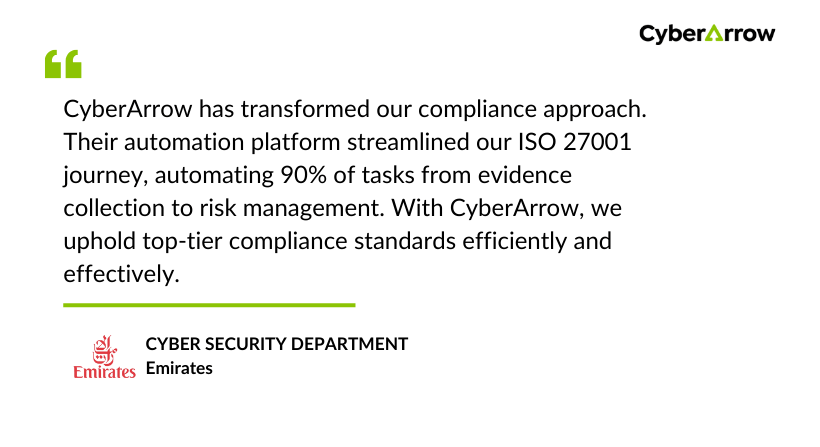
Read how Emirates enhanced Information Security by automating ISO 27001 with CyberArrow GRC.
See what Emirates has to say about CyberArrow GRC:
Final thoughts
An ISO 27001 audit is one of the most effective ways to prove your company takes information security seriously. While the process can seem complex, breaking it down step by step makes it manageable. From defining scope to achieving certification, preparation is key.
However, relying on manual tools is risky and time-consuming. Smart organizations are moving towards automated compliance platforms to save time, reduce human error, and ensure ongoing readiness.
CyberArrow GRC is designed for exactly this purpose. With its zero-touch audit approach, your company can go from struggling with compliance to using it as a competitive advantage.
If your goal is to pass the ISO 27001 audit with confidence and keep improving security every year, CyberArrow GRC is the best choice.
FAQs
How long does it take to get ISO 27001 certified?
On average, it takes 3–6 months for small and mid-size businesses, and 6–12 months for larger organizations.
How much does an ISO 27001 audit cost?
Costs vary based on company size and complexity but typically range between $10,000 and $50,000, including preparation and audit fees.
Do we need to audit every department?
Only the departments and processes included in your ISMS scope will be audited.
How often do we need an audit?
After initial certification, you will face annual surveillance audits and a full recertification audit every three years.
Can CyberArrow GRC help with ISO 27001 compliance?
Yes. CyberArrow GRC automates the compliance process with real-time monitoring, evidence collection, and a zero-touch audit approach to make certification faster and easier.
What happens if we fail the audit?
If major nonconformities are found, you will need to fix them and go through a follow-up audit before certification can be granted.
Is ISO 27001 only for IT companies?
No. ISO 27001 is suitable for any business that handles sensitive information, including healthcare, finance, manufacturing, and retail.
Is ISO 27001 only for IT companies?
No. ISO 27001 is suitable for any business that handles sensitive information, including healthcare, finance, manufacturing, and retail.
