

HIPAA breach notification rule | Explained
Healthcare organizations handle vast amounts of sensitive patient information, making them prime targets for cyberattacks and data breaches. To address this, HIPAA (Health Insurance Portability and Accountability Act) established the breach notification rule, which requires covered entities and business associates to notify affected individuals and regulatory authorities when a breach occurs.
This rule plays a crucial role in protecting patient privacy and ensuring that organizations take accountability for security incidents. However, complying with the breach notification rule can be complex, requiring organizations to navigate strict reporting timelines, assess breach severity, and ensure proper documentation.
CyberArrow GRC simplifies HIPAA compliance by automating breach tracking, risk assessments, and reporting, reducing the administrative burden on healthcare organizations.
In this guide, we will explore:
- What is the HIPAA breach notification rule
- Who must comply with it
- Types of HIPAA breaches
- Reporting requirements and penalties
- How CyberArrow GRC streamlines compliance
What is the HIPAA breach notification rule?
The HIPAA breach notification rule was introduced as part of the HITECH Act (Health Information Technology for Economic and Clinical Health Act) in 2009. It requires healthcare organizations to notify individuals, regulatory agencies, and, in some cases, the media when a breach of protected health information (PHI) occurs.
Under this rule, a breach is defined as the unauthorized access, use, or disclosure of PHI, which compromises its security and privacy. However, not all security incidents qualify as breaches. The breach notification rule includes a risk assessment process to determine if an incident requires reporting.
Who must comply with the HIPAA breach notification rule?
The rule applies to two main groups:
1. Covered entities
Organizations that process or store PHI as part of healthcare services, including:
- Healthcare providers (hospitals, clinics, pharmacies, doctors, dentists)
- Health plans (insurance companies, HMOs, government health programs like Medicare and Medicaid)
- Healthcare clearinghouses (entities that process health information for billing and claims)
2. Business associates
Third-party vendors and service providers that handle PHI on behalf of covered entities, such as:
- Cloud storage providers
- IT service companies
- Billing and claims processors
- Medical transcription services
If a business associate experiences a breach, they must notify the covered entity, which is then responsible for reporting it to affected individuals and regulators.
Types of HIPAA breaches
There are two main categories of breaches under the HIPAA breach notification rule:
1. Minor breaches (Affecting fewer than 500 individuals)
- Must be reported to affected individuals within 60 days of discovery.
- Must be reported to the Department of Health and Human Services (HHS) within 60 days of the end of the calendar year.
- Does not require public notification through media outlets.
2. Major breaches (Affecting 500 or more individuals)
- Must be reported to affected individuals and HHS within 60 days.
- If the breach impacts a specific state or region, a major media outlet must also be informed.
- Requires immediate corrective action to minimize further damage.
HIPAA breach notification requirements
If an organization experiences a breach of PHI, it must follow strict reporting guidelines.
These include:
1. Individual notification
All affected individuals must receive a written notice via first-class mail or email (if they have agreed to electronic communication). This notice must include:
- A description of what happened (including the date of the breach and the date it was discovered).
- The type of information exposed (e.g., Social Security numbers, medical history, financial data).
- Steps individuals can take to protect themselves (such as credit monitoring or fraud alerts).
- What the organization is doing to investigate and prevent future breaches.
- Contact information for affected individuals to ask questions.
2. HHS notification
All breaches must be reported to the U.S. Department of Health and Human Services (HHS):
- Minor breaches (affecting fewer than 500 people) – Reported annually via the HHS breach portal.
- Major breaches (affecting 500+ people) – Reported within 60 days of discovery.
3. Media notification (For major breaches)
For breaches affecting 500 or more people in a state or region, organizations must notify prominent media outlets. This ensures that individuals who may have been affected but did not receive a direct notification are still informed.
Penalties for violating the HIPAA breach notification rule
Failure to comply with the breach notification rule can result in severe financial penalties. The fines are categorized based on the level of negligence:
| Violation Level | Description | Fine Per Violation | Annual Cap |
| Tier 1 | Organization was unaware of the breach | $100 – $50,000 | $1.5 million |
| Tier 2 | Reasonable cause but no willful neglect | $1,000 – $50,000 | $1.5 million |
| Tier 2 | Willful neglect but corrected | $10,000 – $50,000 | $1.5 million |
| Tier 4 | Willful neglect with no correction | $50,000 per violation | No limit |
Aside from financial penalties, non-compliance can lead to:
- Loss of reputation and trust in the organization.
- Legal action from affected individuals.
- Government investigations and audits.
How CyberArrow GRC helps with HIPAA compliance
Staying compliant with HIPAA regulations requires continuous monitoring, risk assessments, and proper documentation. Managing these tasks manually can be time-consuming and prone to errors. CyberArrow GRC simplifies compliance by offering:
1. Cross-standard mapping for simplified compliance
- Reduces duplication of efforts by mapping security controls across multiple regulations.
- Ensures a unified approach to risk management across different standards.
2. Continuous compliance monitoring
- Automates compliance tracking to ensure all HIPAA requirements are met.
- Identifies compliance gaps and provides recommendations for remediation.
- Generates real-time reports to keep organizations audit-ready at all times.
3. Automated risk management and assessments
- Streamlines risk identification and mitigation with built-in risk assessment tools.
- Provides a structured approach to evaluating threats and vulnerabilities.
- Helps organizations proactively manage security risks before they lead to compliance violations.
4. Pre-approved HIPAA compliance templates
- Includes pre-built policy and procedure templates that align with HIPAA regulations.
- Reduces administrative burden by providing ready-to-use compliance documentation.
- Ensures organizations have all necessary documentation for audits and inspections.
With CyberArrow GRC, organizations can simplify HIPAA compliance, reduce manual work, and stay continuously audit-ready by leveraging automation, cross-standard mapping, and proactive risk management.
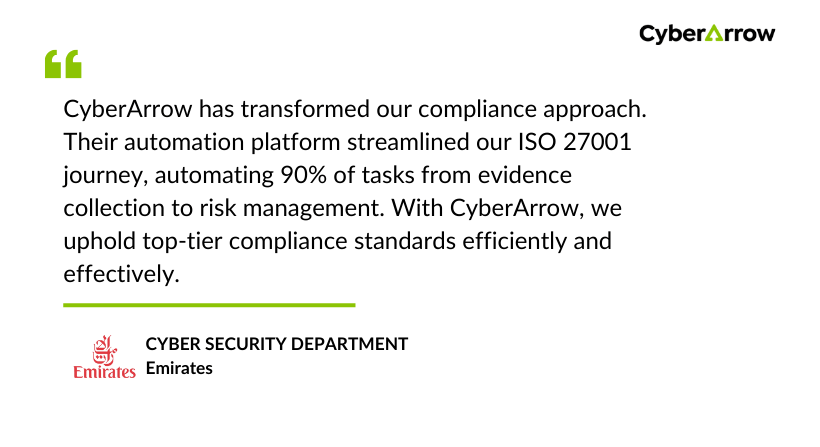
See what a global brand like Emirates has to say about CyberArrow GRC:
FAQs
What is considered a HIPAA breach?
A HIPAA breach occurs when protected health information (PHI) is accessed, used, or disclosed without authorization, potentially compromising patient privacy.
How long do organizations have to report a HIPAA breach?
Minor breaches (less than 500 individuals) – Reported annually.
Major breaches (500+ individuals) – Reported within 60 days.
How can CyberArrow GRC help with HIPAA compliance?
CyberArrow GRC automates breach tracking, compliance reporting, and risk assessments, making it easier for organizations to stay compliant with HIPAA regulations.
