Healthcare compliance certifications: How to get started?
Healthcare compliance certifications are critical for professionals looking to excel in the healthcare industry. These certifications demonstrate your knowledge and commitment to following legal and ethical standards that govern healthcare operations. As healthcare continues to evolve with more regulations and standards, certification gives you a competitive edge and ensures your organization stays compliant with healthcare laws.
In this blog, we’ll walk you through everything you need about healthcare compliance certifications, from the types available to the steps required to get certified.
Whether you’re new to the field or looking to enhance your credentials, this guide will help you understand how to get started.
- What are healthcare compliance certifications?
- Types of healthcare compliance certifications
- Why healthcare compliance certifications matter
- How to get certified in healthcare compliance: step-by-step guide
- Top healthcare compliance certification providers
- Benefits of healthcare compliance certifications
- Automate healthcare compliance with CyberArrow GRC
What are healthcare compliance certifications?
Healthcare compliance certifications are professional designations that validate your understanding of healthcare regulations, laws, and ethical standards. These certifications demonstrate your ability to manage compliance programs within healthcare organizations, focusing on key issues such as privacy, ethics, and risk management.
These certifications are essential for healthcare professionals in regulatory roles, compliance management, or leadership positions. Having a certification can improve job prospects, increase earning potential, and demonstrate a commitment to upholding healthcare standards.
Types of healthcare compliance certifications
There are several healthcare compliance certifications to choose from, depending on your career goals and focus areas.
Here are some of the most common certifications in the industry:
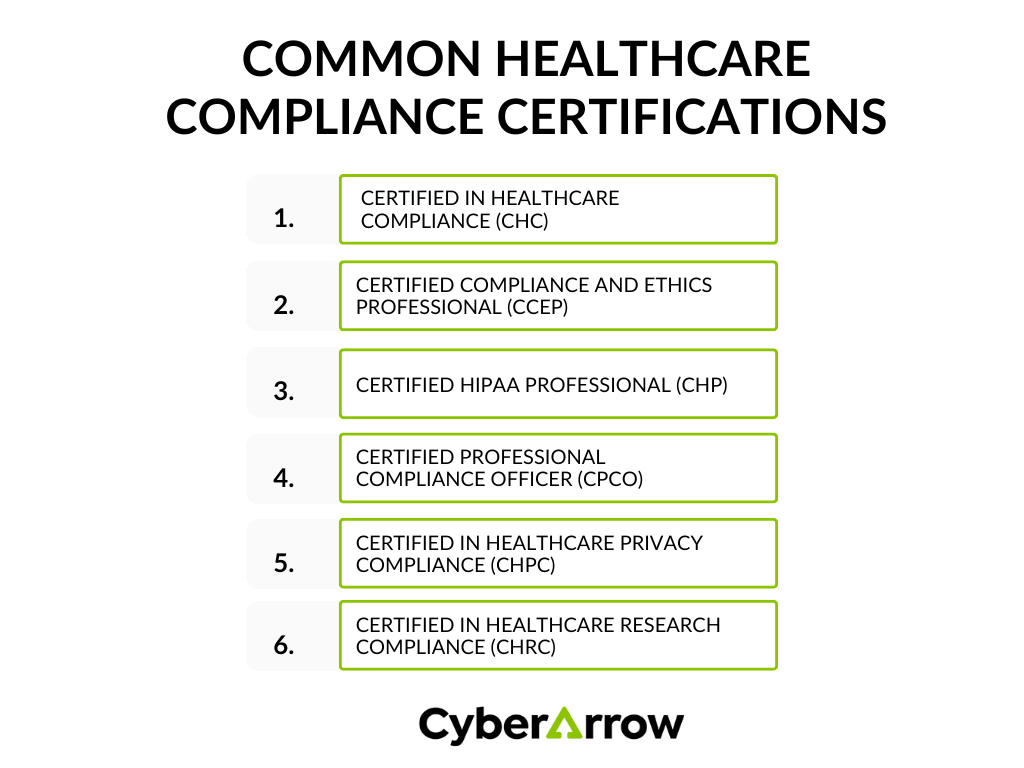
Certified in Healthcare Compliance (CHC): The CHC certification is offered by the Compliance Certification Board (CCB). It is a highly respected credential that covers legal and ethical frameworks in healthcare. With a CHC certification, you are well-prepared to manage complex healthcare compliance issues.
Certified Compliance and Ethics Professional (CCEP): This certification, also provided by CCB, is suitable for professionals managing compliance and ethics programs. It is relevant not only in healthcare but also in other sectors, making it a versatile option.
Certified HIPAA Professional (CHP): This certification is for individuals responsible for ensuring that healthcare organizations comply with the Health Insurance Portability and Accountability Act (HIPAA). It focuses on the confidentiality and security of patient data.
Certified Professional Compliance Officer (CPCO): Offered by the American Academy of Professional Coders (AAPC), the CPCO certification focuses on various healthcare regulations, including fraud prevention and ethical medical coding.
Certified in Healthcare Privacy Compliance (CHPC): This credential, provided by the CCB, focuses specifically on privacy issues in healthcare, such as safeguarding patient information in line with HIPAA regulations.
Certified in Healthcare Research Compliance (CHRC): For those involved in healthcare research, the CHRC certification offered by the Health Care Compliance Association (HCCA) addresses the unique compliance requirements of healthcare research projects.
Quick link: What are PHI and ePHI?
Why healthcare compliance certifications matter
Healthcare compliance certifications are not just badges of honor; they are necessary for managing the complex regulatory requirements in healthcare. These certifications ensure that you know how to help your organization avoid costly fines, breaches, and legal penalties. Additionally, certifications improve your career prospects, enabling you to qualify for higher-paying roles and leadership positions within healthcare compliance.
Many healthcare organizations require or prefer candidates with certifications because it shows you are dedicated to maintaining the highest standards of compliance.
How to get certified in healthcare compliance: step-by-step guide
Each certification has its requirements and processes, but most healthcare compliance certifications follow similar steps.
Here’s a general roadmap for obtaining your certification:
1. Meet the eligibility requirements
Most certifications have education and experience requirements. For example, many healthcare compliance certifications require a bachelor’s degree and at least one year of experience working in healthcare compliance or a related field. Be sure to review the specific requirements for the certification you are pursuing.
2. Complete necessary training
Some certifications may require you to complete specific courses or training programs. For example, the CCB offers review courses that prepare you for their certifications, such as CHC or CHPC. Training programs will cover essential topics like healthcare laws, regulations, and compliance program management.
3. Apply for the certification exam
Once you meet the eligibility requirements, you can apply for the certification exam. This typically involves submitting your qualifications and paying an application fee. Make sure to gather all the required documentation to avoid delays in your application process.
4. Prepare for the exam
You can prepare for the certification exam by studying recommended materials, taking review courses, or engaging in self-study. Most certification bodies provide a list of resources or offer official exam preparation courses.
5. Take the certification exam
The certification exam is designed to test your knowledge of healthcare compliance topics. You’ll need to pass the exam to obtain the certification. Exams are usually proctored, and you’ll need to schedule a time to take them either in person or online.
6. Maintain your certification
After earning your certification, you’ll need to maintain it by completing continuing education credits. This ensures that you stay up-to-date with the latest compliance standards and regulations. Most certifications require you to renew your credential every few years.
Quick link: CyberArrow for the life sciences industry
Top healthcare compliance certification providers
Several organizations offer healthcare compliance certifications. Here are a few of the top providers:
- Compliance Certification Board (CCB): Offers CHC, CHPC, and CHRC certifications.
- American Academy of Professional Coders (AAPC): Provides the CPCO certification.
- Health Care Compliance Association (HCCA): Offers various compliance certifications.
- Practice Management Institute: Provides certifications like Certified Medical Compliance Officer (CMCO).
Benefits of healthcare compliance certifications
- Increased job opportunities: Healthcare compliance certifications open doors to higher-paying jobs and leadership roles in the healthcare industry.
- Industry recognition: A certification proves that you have the expertise to manage healthcare compliance effectively, which can lead to career advancement.
- Enhanced skills: You’ll gain a deeper understanding of healthcare regulations, ethics, and risk management through certification programs.
- Better compliance management: With a certification, you can help your organization avoid fines, penalties, and breaches by ensuring compliance with healthcare laws.
Automate healthcare compliance with CyberArrow GRC
Achieving healthcare compliance certifications is crucial for organizations in the healthcare sector. The process can be intricate and time-consuming, but automation can make it much simpler and more efficient.
Why choose CyberArrow GRC for healthcare compliance?
With CyberArrow GRC, you can automate up to 80% of your compliance efforts, enabling you to meet certification requirements swiftly and effectively.
- Streamlined compliance processes: Automate documentation and tracking for certifications like HIPAA, reducing manual efforts and errors.
- Real-time compliance monitoring: Keep tabs on your compliance status with intuitive dashboards that provide real-time insights.
- Employee training programs: Ensure your team is well-informed with CyberArrow’s HIPAA training modules tailored for healthcare staff.
- Audit-ready reporting: Generate comprehensive reports to demonstrate compliance and stay prepared for any audits.
- Customizable workflows: Tailor workflows to fit your organization’s specific needs, improving efficiency and accountability.
A regional healthcare provider implemented CyberArrow GRC to enhance its compliance with HIPAA and other healthcare regulations. By automating their compliance processes, they reduced manual efforts by 80%, streamlined documentation, and achieved certification in record time.
See what our clients have to say about CyberArrow GRC: