

A vishing risk assessment guide for companies (template and steps)
Vishing, aka voice phishing, is one of the fastest-growing forms of social engineering attacks, especially as remote work and VoIP systems make spoofed calls almost impossible to distinguish from genuine ones. Employees can receive calls that sound legitimate, come from trusted caller IDs, and imitate banks, service providers, executives, or even IT helpdesks.
One unguarded conversation can lead to credential compromise, fund transfers, or unauthorized system access.
This guide talks about vishing risk and how to conduct a vishing risk assessment, evaluate exposure, build internal controls, and assign ownership.
- Why should organizations care about vishing?
- How to conduct a vishing risk assessment (step-by-step)
- 1. Identify vishing-exposed roles and communication points
- 2. Analyze past incidents and near misses
- 3. Develop vishing-specific risk scenarios
- 4. Score likelihood and impact using a tailored risk matrix
- 5. Define control measures specific to vishing attack vectors
- 6. Establish reporting, ownership, and auditability
- Practical vishing risk scoring template
- KRIs for vishing (measurable indicators)
- Vishing risk mitigation controls
- Strengthen vishing resilience with CyberArrow Awareness Platform
- FAQs
Why should organizations care about vishing?
Unlike phishing emails, vishing is harder to detect and filter automatically. A skilled attacker can:
- Impersonate senior leadership or a familiar third-party vendor.
- Pressure employees into disclosing credentials or transferring money.
- Extract sensitive details without triggering security systems.
- Exploit trust and urgency through real-time interaction.
This makes vishing not only a cyber security concern but also a people-and-process-level risk, requiring structured assessment and proactive controls.
How to conduct a vishing risk assessment (step-by-step)
A vishing risk assessment should go beyond generic social engineering controls. Below is a framework that corporate security and compliance teams can follow.
1. Identify vishing-exposed roles and communication points
Start by mapping where and how verbal communication occurs within your organization.
Consider:
- Teams interacting with external vendors (procurement, finance, HR).
- Customer support & helpdesks handling public inbound calls.
- Executives and assistants with decision authority.
- Remote workers using personal phone numbers.
- Teams with access to credentials, payments, or sensitive data.
Example: Payroll team, AP department, customer support, and vendor onboarding teams flagged as high-exposure groups.
2. Analyze past incidents and near misses
Look beyond successful attacks; near-miss calls provide valuable insight.
Collect data from:
- IT service desk call logs.
- Employee-reported suspicious calls.
- Failed credential-harvesting attempts.
- Bank or finance escalation alerts.
Track patterns such as caller tone, scripts used, urgency tactics, and update risk scoring models accordingly.
3. Develop vishing-specific risk scenarios
Instead of generic threats, create scenario-based risks tied to real decision points.
Example:
| Scenario | Potential loss |
| Fake CFO requesting urgent wire transfer. | Financial theft and reputation damage. |
| Fake IT support requesting VPN credentials. | Unauthorized access to internal systems. |
| Fraudulent vendor account update call. | Invoice manipulation and data exposure. |
| Customer impersonation seeking account reset. | Identity theft and compliance breach. |
These scenarios will feed directly into your risk scoring and risk control measures.
4. Score likelihood and impact using a tailored risk matrix
Generic cyber risk matrices don’t always capture voice-based urgency manipulation. Create a scoring model:
Likelihood scale example:
- 5 = Weekly attempts.
- 3 = Monthly attempts.
- 1 = Rare or no attempted contact.
Impact scale example:
- 5 = Direct financial transfer access.
- 3 = Credential exposure requiring reset.
- 1 = No system access, minor disruption.
Risk Score = Likelihood × Impact
Example score: IT helpdesk credential request (L=4 × I=5 = 20 — critical risk)
5. Define control measures specific to vishing attack vectors
Controls should be mapped to people, process, and technology. Review controls quarterly and test using red-team simulations where feasible.
| Control category | Controls |
| People | Live simulation training, call-script awareness, refusal protocols. |
| Process | Verification callbacks, dual authorization for fund transfer, and incident reporting workflows. |
| Technology | VoIP monitoring, caller-ID verification tools, and call-recording audit trail. |
6. Establish reporting, ownership, and auditability
Assign a clear risk owner and control owner for each scenario. Ownership ensures visibility, tracking of remediation, and accountability.
Example format:
| Risk | Risk owner | Control owner | Review frequency |
| Credential disclosure through vishing | CISO | IT service desk lead | Monthly |
| Vendor payment fraud | Finance director | Procure-to-pay Ops | Quarterly |
Practical vishing risk scoring template
A structured scoring model makes vishing risk assessment measurable instead of subjective. Below is a scoring template that security and compliance teams can adopt immediately.
| Likelihood score | Description | Example indicator |
| 1 — Rare | No historical attempts, low exposure | Internal-only team with no phone contact |
| 2 — Unlikely | Infrequent suspicious calls | Annual or isolated attempted calls |
| 3 — Possible | Periodic attempts or past near-misses | Monthly unsolicited vendor-sounding calls |
| 4 — Likely | Multiple incidents per quarter | Finance team receives repeated payment request scams |
| 5 — Almost Certain | Ongoing active attempts | Credential-harvesting calls reported weekly or more frequently |
| Impact score | Description | Example indicator |
| 1 — Low | No data/system access risk | General inquiry handled via script |
| 2 — Moderate | Exposure of sensitive info requiring a reset | Account credential disclosure |
| 3 — Critical | Direct financial or system compromise | Wire transfer executed / domain access gained |
Risk Score = Likelihood × Impact
- Score 1–5 = Low risk (monitor quarterly)
- Score 6–15 = Medium risk (apply targeted controls)
- Score 16–25 = High risk (immediate mitigation required)
KRIs for vishing (measurable indicators)
Key risk indicators (KRIs) allow organizations to track exposure trends in real time. These should be monitored monthly and reviewed against thresholds.
| KRI | What it indicates | Target benchmark |
| Number of suspicious call reports submitted | Detection awareness and reporting culture strength. | Increasing reports may indicate higher attack activity or better awareness. |
| Failed vishing simulation rate | Employee vulnerability to voice phishing | Aim for < 10% failure rate after quarterly simulations |
| Average time to detect and report a vishing attempt | Detection efficiency and escalation responsiveness | < 15 minutes for high-risk functions (finance/IT) |
| Percentage of employees trained specifically against vishing | Organizational preparedness | 100% for sensitive roles (finance, IT, HR, executives) |
| VoIP spoofing attempts detected via monitoring tools | External threat activity | Review spikes immediately, which may signal targeted campaigns. |
Vishing risk mitigation controls
A strong vishing defense requires more than training; it needs layered controls across people, process, and technology.
Quick link: How to identify vishing scams over the phone
1. Technical controls
Reduce spoofing risk and enable traceability.
- VoIP spoofing detection tools.
- Caller ID authentication (STIR/SHAKEN protocols).
- Call logging + recording for auditability.
- Integration alerts for unusual outbound payment activity.
2. Procedural controls
Ensure requests are verified before information or funds are released.
- Callback verification for payment or credential requests.
- Mandatory dual-authorization for financial approvals.
- Standard response scripts for unknown callers.
- Incident reporting workflow tied to risk scoring.
3. Training-forward controls
Real behavior change requires human-level readiness.
- Quarterly vishing simulation calls.
- Micro-learning instead of annual one-time sessions.
- High-risk role targeted awareness training.
- “Refuse, verify, report” response model embedded into SOPs.
Strengthen vishing resilience with CyberArrow Awareness Platform
Human error is the root of most vishing incidents, but the right awareness program can turn employees into your strongest line of defense. CyberArrow Awareness Platform helps organizations educate, test, and measure workforce resilience against voice-based phishing at scale.
- Interactive and engaging cyber awareness courses, built for different regions and languages.
- Easy customization and seamless integration with Active Directory.
- Progress dashboards for users, departments, and enterprise-wide visibility.
- Real-world phishing simulation module to assess behavioral readiness.
- Exportable reports for compliance reviews, management updates, and KPIs.
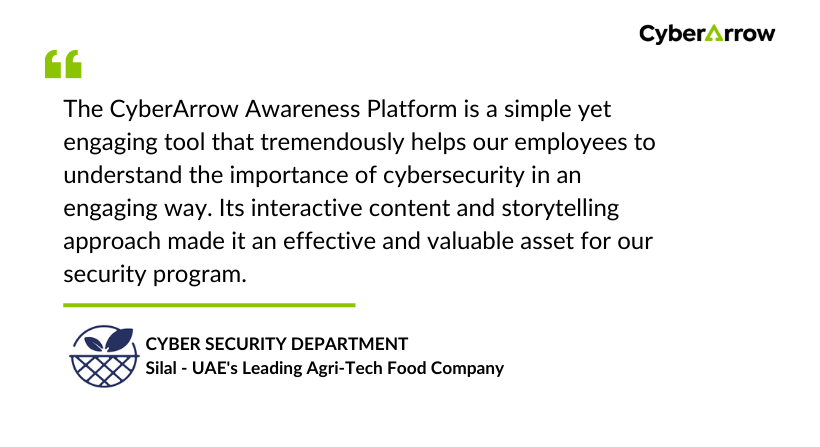
See what our clients have to say about CyberArrow Awareness Platform:
FAQs
What is vishing, and why should companies assess it?
Vishing is a type of phone-based social engineering attack aimed at stealing sensitive information. Assessing vishing risks helps companies identify vulnerabilities, train employees, and implement controls to reduce potential losses.
What are the key metrics for measuring vishing risk?
Important indicators include the number of suspicious call reports, failed simulation rates, time to detect and respond, and the percentage of employees trained. Monitoring these helps track the effectiveness of mitigation efforts.
How can companies mitigate vishing risks?
Mitigation involves a multi-layered approach: technical solutions like caller authentication, procedural controls such as verification workflows, and training programs to raise employee awareness and readiness.
