


What is advanced threat detection? A detailed guide
Cyber threats have become more complex than ever before. Attackers no longer rely only on simple malware or basic phishing tricks. They now use advanced techniques that are hard to detect with traditional security tools. These include stealthy attacks, zero-day exploits, fileless malware, lateral movement, and long-term persistence inside networks.
This is why advanced threat detection is now a core requirement for every security team. It helps organizations detect modern threats that bypass traditional tools, identify suspicious behavior early, and respond before damage occurs.
This guide explains what advanced threat detection is, how it works, the methods and tools behind it, challenges faced by security teams, and how CyberArrow GRC supports organizations by managing compliance and strengthening the overall security program.
- What is advanced threat detection?
- Why advanced threat detection matters today
- Key components of advanced threat detection
- How advanced threat detection works
- Common threats detected by advanced tools
- Challenges of advanced threat detection
- Why advanced threat detection should be part of a GRC program
- How CyberArrow GRC supports advanced threat detection
- Conclusion
- FAQs
What is advanced threat detection?
Advanced threat detection is the process of identifying complex cyber attacks that are difficult to detect with basic security tools. It focuses on threats that use smart techniques to hide inside systems and networks.
These threats often avoid detection by:
- Using fileless malware.
- Moving laterally between systems.
- Exploiting unknown vulnerabilities.
- Using stolen credentials.
- Blending with normal activity.
Advanced threat detection looks beyond simple signatures and focuses on behavior, patterns, and anomalies. It uses analytics, machine learning, threat intelligence, and deep visibility to find attacks early.
Why advanced threat detection matters today
Modern networks are larger and more connected than ever. Organizations use cloud platforms, remote work, IoT devices, mobile apps, and distributed systems. Each one increases the attack surface and creates new risks.
Advanced threat detection is important because:
- Attackers often stay hidden for long periods. Traditional tools cannot detect them.
- Threats evolve fast. Signature-based detection cannot keep up.
- Insider threats are harder to detect without behavior monitoring.
- Cloud environments require deeper visibility.
- Compliance standards demand stronger monitoring and detection.
Without advanced threat detection, organizations may not notice an attack until the damage is already done.
Key components of advanced threat detection
Advanced threat detection uses several methods and technologies to identify suspicious behavior. Each one provides a different layer of visibility.
1. Behavioral analytics
Behavioral analytics focuses on how users and systems normally behave. When behavior changes, it may indicate a threat.
Examples include:
- Sudden large data transfers.
- Logins at unusual times.
- Accessing sensitive systems without reason.
- Multiple failed login attempts.
- New processes running without approval.
Behavioral analytics helps find threats even when no signature exists.
2. Machine learning detection
Machine learning helps detect threats by analyzing large amounts of data and identifying patterns.
Machine learning models can:
- Learn what normal activity looks like.
- Identify outliers and rare events.
- Detect anomalies in network traffic.
- Flag unusual system behavior.
Machine learning improves detection accuracy and reduces false positives.
3. Threat intelligence integration
Threat intelligence provides information about known attackers, malware, and current attack patterns.
Advanced threat detection tools use threat intelligence to:
- Block known malicious IP addresses.
- Detect command and control traffic.
- Identify known exploit attempts.
- Add context to alerts.
Threat intelligence helps organizations stay updated on real-world threats.
4. Deep network visibility
Advanced threat detection tools inspect network traffic at a deeper level.
They analyze:
- Packet headers.
- Flow data.
- DNS queries.
- Encrypted traffic metadata.
- Connection patterns.
Deep visibility helps detect lateral movement, data exfiltration, and hidden communication.
5. Endpoint detection and response (EDR)
EDR tools monitor endpoints such as laptops, servers, and cloud instances.
EDR helps detect:
- Malware behavior.
- Unauthorized access.
- Suspicious processes.
- Fileless attacks.
- Privilege escalation.
EDR is essential for advanced threat detection on devices.
6. Security information and event management (SIEM)
SIEM platforms collect logs from many sources and correlate events.
SIEM provides:
- Centralized monitoring.
- Real-time alerts.
- Incident investigation tools.
- Long-term log storage.
SIEM helps detect threats by connecting data from across the organization.
7. User and entity behavior analytics (UEBA)
UEBA focuses on user behavior to detect insider threats.
It identifies:
- Unusual login patterns.
- Abnormal file access.
- Sudden privilege changes.
- Risky actions.
UEBA is essential for environments with many users.
How advanced threat detection works
Advanced threat detection follows a structured approach that includes monitoring, analysis, and response.
1. Continuous monitoring
Security tools collect data from:
- Endpoints.
- Firewalls.
- Cloud systems.
- Identity platforms.
- Applications.
- Networks.
This data is critical for spotting patterns and anomalies.
2. Data correlation
Once collected, the data is analyzed to find connections.
For example:
- Failed logins plus new admin access.
- Unusual outbound traffic plus file changes.
- DNS requests plus suspicious connections.
Correlation helps detect multi-step attacks.
3. Anomaly detection
Advanced threat detection tools look for activities that do not match standard behavior.
Examples include:
- Sudden CPU spikes.
- Unknown processes.
- New open ports.
- Unusual database queries.
These anomalies help identify hidden attackers.
4. Alert generation
When a threat is detected, the system sends alerts to security teams.
Alerts include:
- Severity level.
- Affected systems.
- Event timeline.
- Possible attacker methods.
Clear alerts help teams respond faster.
5. Investigation and response
Security teams investigate the alert to confirm the threat.
They may:
- Isolate affected systems.
- Block malicious traffic.
- Reset passwords.
- Remove malware.
- Patch vulnerabilities.
The goal is to stop the attack quickly.
Common threats detected by advanced tools
Advanced threat detection helps identify many types of threats, such as:
- Zero-day exploits.
- Fileless malware.
- Advanced persistent threats.
- Credential abuse.
- Data exfiltration.
- Ransomware behavior.
- Insider misuse.
- Supply chain attacks.
These threats often evade traditional tools, making advanced detection necessary.
Challenges of advanced threat detection
Despite its value, advanced threat detection has challenges:
- Large amounts of data make analysis difficult.
- Skilled staff is required.
- Complex environments create more noise.
- False positives can slow down the response.
- Encrypted traffic makes inspection harder.
Strong governance and structured processes help reduce these challenges.
Why advanced threat detection should be part of a GRC program
Detecting threats is important, but organizations also need a strong GRC framework to manage:
- Policies.
- Controls.
- Risks.
- Audit evidence.
- Incident documentation.
- Compliance requirements.
Advanced threat detection identifies problems. A GRC program ensures that organizations act on them. This is where CyberArrow GRC plays a key role.
How CyberArrow GRC supports advanced threat detection
CyberArrow GRC does not replace threat detection tools, but it strengthens the governance and compliance layer around them.
Policy management
CyberArrow manages all security policies, including threat detection and response policies.
Risk management
CyberArrow logs risks identified during threat investigations and tracks treatment plans.
Control mapping
CyberArrow helps map detection practices to standards such as ISO 27001, SOC 2, PCI DSS, HIPAA, and NIST.
Evidence collection
CyberArrow stores detection logs, reports, and compliance evidence in an organized system.
Audit readiness
CyberArrow organizes documentation for internal and external audits.
Task automation
CyberArrow assigns and tracks tasks connected to threat response and mitigation.
CyberArrow GRC turns advanced detection insights into structured improvements across the organization.
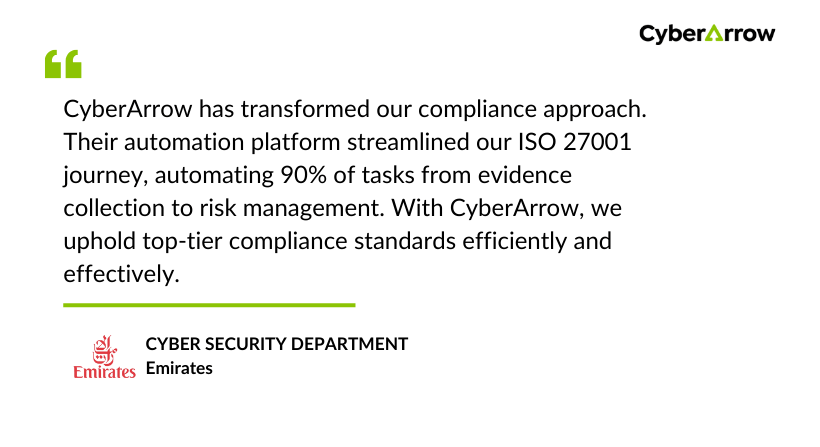
See what our clients have to say about CyberArrow GRC:
Conclusion
Advanced threat detection is essential for every organization that wants to stay ahead of modern cyber attacks. It provides deep visibility, detects unknown threats, and helps security teams respond faster. With techniques such as behavioral analytics, machine learning, EDR, UEBA, and threat intelligence, advanced detection offers a strong defense against complex attacks.
But technology alone is not enough. Organizations need a full GRC program to manage policies, risks, controls, evidence, and compliance requirements linked to security operations.
CyberArrow GRC provides this foundation. It helps companies turn detection results into clear governance steps, create audit-ready documentation, and build a strong and compliant security posture.
If your organization wants a powerful combination of detection technology and structured governance, CyberArrow GRC is the best platform to support that journey.
FAQs
What is advanced threat detection used for?
Advanced threat detection is used to find complex cyber attacks that traditional tools miss. It identifies hidden threats such as zero-day exploits, fileless malware, insider misuse, and unusual system behavior. It helps security teams detect attacks early and respond quickly.
How is advanced threat detection different from basic antivirus or firewalls?
Basic antivirus and firewalls rely mostly on signatures and known patterns. Advanced threat detection looks at behavior, anomalies, machine learning insights, and deep network visibility. This helps detect new threats that have no known signature.
What tools support advanced threat detection?
Common tools include EDR platforms, SIEM systems, UEBA tools, threat intelligence feeds, network monitoring tools, and behavioral analytics systems. These tools work together to collect data, detect anomalies, and investigate attacks.
Why is advanced threat detection important for cloud environments?
Cloud systems change often, and attackers target misconfigurations, access keys, and container workloads. Advanced threat detection helps monitor cloud activity, detect unusual use of credentials, track API calls, and identify suspicious actions across cloud platforms.
How does CyberArrow GRC support advanced threat detection programs?
CyberArrow GRC manages the governance and compliance layer around threat detection. It helps track risks, update controls, manage policies, store investigation evidence, support audits, and automate compliance tasks. This helps organizations turn detection findings into long-term security improvements.
