


ERM framework: The complete guide to enterprise risk management
Every organization faces risks, financial losses, data breaches, compliance failures, and even natural disasters. What separates successful organizations from the rest is not the absence of risk, but how they manage it.
That is where the ERM framework, or Enterprise Risk Management framework, becomes essential. It helps organizations identify, assess, and respond to risks in a structured and proactive way.
In this detailed guide, you will learn what the ERM framework is, how it works, its key components, and how modern platforms like CyberArrow ERM simplify and automate the entire process.
- What is an ERM framework?
- Why the ERM framework matters
- Key components of an ERM framework
- Common ERM framework models
- How the ERM framework works in practice
- Challenges of traditional risk management
- The role of automation in ERM frameworks
- Benefits of using CyberArrow ERM
- Building a future-ready ERM program
- Final thoughts
- FAQs
What is an ERM framework?
The ERM framework is a structured approach to managing all types of risks that can affect an organization’s ability to achieve its goals.
It covers everything from operational and strategic risks to compliance and cyber security challenges. Instead of handling risks separately, the ERM framework creates a unified system that gives leadership a complete view of potential threats and opportunities.
It helps organizations:
- Identify risks early.
- Evaluate their potential impact.
- Decide how to respond.
- Monitor performance continuously.
ERM transforms risk management from a defensive measure into a growth enabler.
Why the ERM framework matters
In today’s fast-moving business world, risks are becoming more complex. According to PwC, 65% of executives believe that effective risk management directly improves business performance.
A well-structured ERM framework helps organizations:
- Reduce unexpected losses.
- Improve decision-making.
- Strengthen compliance with standards like SOX, ISO 31000, and COSO.
- Build stakeholder confidence.
- Align risk strategy with business goals.
When used correctly, ERM becomes a powerful tool for sustainable growth and long-term stability.
Key components of an ERM framework
The COSO ERM model and ISO 31000 standard are the two most recognized ERM frameworks worldwide. Both highlight several key components that guide organizations in managing risks effectively.
1. Governance and culture
Strong leadership sets the foundation. This includes defining roles, responsibilities, and a culture where every employee understands their part in managing risks.
2. Strategy and objective setting
Risk management must be tied to the company’s goals. Leadership defines the organization’s risk appetite and aligns it with business objectives.
3. Risk identification
Organizations must identify internal and external factors that could impact performance. Examples include financial instability, cyberattacks, or regulatory changes.
4. Risk assessment
After identifying risks, organizations must assess their likelihood and impact. This helps prioritize which risks need immediate attention.
5. Risk response
Companies decide how to handle each risk. The response can include avoiding, reducing, transferring, or accepting the risk based on its potential impact.
6. Control activities
This step involves implementing safeguards such as policies, approval workflows, or automated system checks to keep risks under control.
7. Information and communication
Transparent communication ensures everyone is aware of risks, control measures, and mitigation updates.
8. Monitoring and review
Risks change over time, so continuous monitoring ensures that risk controls remain effective and up to date.
Common ERM framework models
COSO ERM framework
Developed by the Committee of Sponsoring Organizations (COSO), this framework focuses on aligning risk management with strategy, governance, and performance. It emphasizes integrating risk awareness into every decision-making process.
ISO 31000 framework
The ISO 31000 standard provides international guidelines for effective risk management. It promotes continuous improvement, customization, and integration of risk management across all business areas.
Both frameworks share a common goal to make risk management systematic, consistent, and organization-wide.
How the ERM framework works in practice
Let’s take an example.
A financial institution uses an ERM framework to manage risks around fraud, compliance, and data security. By mapping risks across departments, the organization gains better visibility and can prevent issues before they occur.
In the same way, a healthcare provider might apply ERM principles to protect patient data and ensure compliance with healthcare regulations.
An effective ERM framework doesn’t just reduce threats. It also helps identify opportunities like new markets or innovative technologies that come from managing uncertainty with confidence.
Challenges of traditional risk management
Many organizations still rely on manual spreadsheets, emails, and disconnected systems to track risks. This creates several problems:
- Limited visibility across departments.
- Duplicate or inconsistent data.
- Missed deadlines for compliance audits.
- Increased human error.
- Lack of real-time insights.
As regulatory requirements grow, manual risk management becomes time-consuming and expensive. This is why many organizations are turning to automated ERM platforms that centralize and simplify the process.
The role of automation in ERM frameworks
Automation transforms ERM from a reactive task into a proactive strategy. It enables organizations to monitor, report, and mitigate risks more efficiently.
With automation, teams can:
- Collect and update risk data in real time.
- Track controls and compliance frameworks from a single dashboard.
- Get instant alerts when risks change.
- Generate audit-ready reports with one click.
Automating ERM not only reduces human error but also saves time and resources while improving accuracy.
How CyberArrow ERM simplifies risk management
CyberArrow ERM is a modern solution that helps organizations automate enterprise risk management and simplify GRC compliance.
Here’s what makes it stand out:
- Unified dashboard: View all risks, controls, and compliance metrics in one place.
- Automated compliance: Easily map, track, and test controls for continuous compliance.
- Real-time reporting: Generate audit-ready reports instantly.
- AI-driven risk insights: Identify trends, forecast potential risks, and take preventive action.
- Zero-touch audits: Reduce manual audit efforts by automating evidence collection and tracking.
With CyberArrow ERM, organizations can shift from static spreadsheets to dynamic, intelligent risk management systems that improve speed, accuracy, and control.
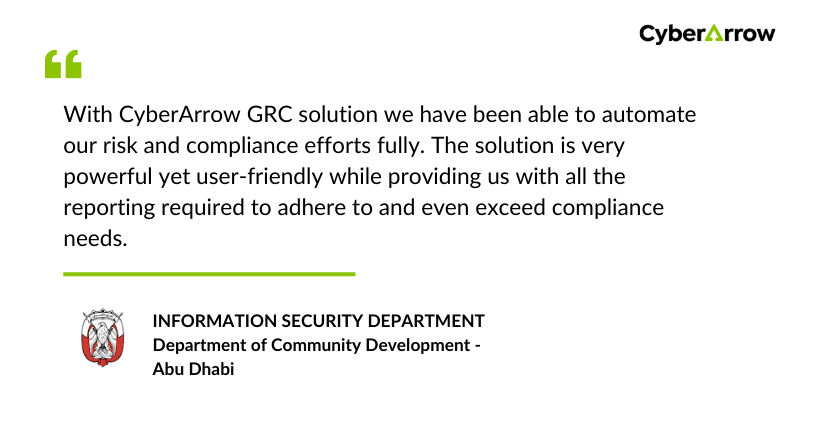
See what DCD – Abu Dhabi has to say about CyberArrow GRC:
Benefits of using CyberArrow ERM
Organizations that implement CyberArrow ERM report:
- 60% reduction in manual audit time.
- 40% faster compliance reviews.
- Improved decision-making with real-time data.
- Greater alignment between business strategy and risk management.
CyberArrow ERM helps organizations not only comply with regulatory requirements but also build a stronger foundation for sustainable growth.
Building a future-ready ERM program
To succeed in the future, organizations must see ERM as more than a compliance requirement. It is a strategic capability that protects value, drives performance, and builds resilience.
With automation, data intelligence, and continuous monitoring, companies can stay ahead of emerging risks and regulatory shifts.
That is exactly what CyberArrow ERM empowers organizations to do: manage risks smarter, faster, and with complete confidence.
Final thoughts
The ERM framework is the backbone of modern governance. It ensures that risk management is not just a department’s responsibility but a company-wide practice.
When paired with automation tools like CyberArrow ERM, it becomes a powerful system for achieving compliance, reducing risk, and ensuring business continuity.
In a world where risks are constant, CyberArrow gives organizations the visibility, speed, and confidence to move forward securely.
FAQs
What is an ERM framework?
An ERM framework (Enterprise Risk Management framework) is a structured approach that helps organizations identify, assess, and manage potential risks. It creates a unified system that improves decision-making, supports compliance, and strengthens overall business resilience.
Why is an ERM framework important for businesses?
An ERM framework helps businesses anticipate and manage risks before they impact operations. It ensures compliance with standards like SOX, ISO 31000, and COSO, improves stakeholder confidence, and aligns risk management with business strategy.
What are the main components of an ERM framework?
The main components include risk identification, risk assessment, control activities, communication, and continuous monitoring. Together, these steps create a complete cycle for managing and reducing risk across all business areas.
How does automation improve the ERM framework?
Automation simplifies and strengthens the ERM framework by providing real-time visibility into risks, automating reporting, and reducing human error. It helps organizations respond faster to emerging risks while ensuring compliance with frameworks such as SOX.
How does CyberArrow ERM help automate SOX compliance?
CyberArrow ERM automates SOX compliance by mapping, testing, and tracking internal controls from a single dashboard. It eliminates manual work, generates audit-ready reports, and offers AI-driven insights to make compliance faster, easier, and more accurate.
