What is the Generally Accepted Compliance Practice (GACP) framework and how to implement it
Building a strong culture of compliance has become a business essential rather than an afterthought. While many global frameworks guide organizations on governance and risk management, African institutions needed a standard that reflects their regional realities and regulatory environments. That’s when the Generally Accepted Compliance Practice (GACP) framework was made.
Developed by the Compliance Institute Southern Africa (CISA), GACP provides organizations with practical guidance to structure, manage, and improve their compliance functions.
This article explores what the framework is, its key principles, and how organizations can effectively implement it to strengthen governance and ethical conduct.
What is the Generally Accepted Compliance Practice (GACP) framework?
The GACP framework is a set of principles and practices to guide organizations in establishing and maintaining effective compliance programs. Rather than serving as a certification or rigid standard, it acts as a best-practice guideline to promote consistent and ethical compliance management across African industries.
GACP helps organizations align compliance strategies with business objectives, manage regulatory risks more efficiently, and foster a culture of integrity. It bridges the gap between global compliance expectations and local regulatory realities, offering a structured yet adaptable framework.
Objectives and principles of GACP Africa
The GACP framework aims to create a unified approach to compliance that enhances governance and accountability. Its core objectives include:
- Standardizing compliance practices: Ensures organizations across sectors follow comparable standards, enabling better benchmarking and oversight.
- Embedding compliance into governance: Positions compliance as a key component of corporate governance rather than an isolated function.
- Encouraging ethical leadership: Promotes a tone-at-the-top culture where leaders model ethical and compliant behavior.
- Enhancing regulatory trust: Builds stronger relationships with regulators through transparency and consistent reporting.
- Supporting continuous improvement: Encourages organizations to evolve their compliance systems as laws and risks change.
How to implement the GACP framework
Implementing GACP Africa effectively requires commitment, structure, and practical steps that connect compliance goals with business operations. Below is a seven-step approach that organizations can follow.
1. Assess your current compliance maturity
Evaluate your existing compliance processes. Identify strengths, weaknesses, and areas that fall short of GACP principles. For example, a financial institution might discover gaps in anti-money-laundering monitoring or employee training programs.
2. Align internal policies with GACP principles
Review and update policies so they reflect the governance, risk, and ethical expectations outlined in the framework. Map each GACP requirement to an internal control or procedure to ensure proper alignment.
3. Define roles and responsibilities
Clear accountability is key to an effective compliance function. Assign defined roles to compliance officers, department heads, and senior management. Establish reporting lines to ensure oversight flows from operational teams to the board.
4. Develop a compliance risk assessment process
Conduct a formal Risk and Control Self-Assessment (RCSA) to identify areas where non-compliance could occur. Evaluate both regulatory and reputational risks. For instance, a healthcare provider may assess risks related to patient data protection or licensing requirements.
5. Implement compliance monitoring tools
Use technology to automate evidence collection, control testing, and audit tracking. Integrating a GRC platform like CyberArrow can help streamline documentation, reduce manual reporting, and ensure continuous oversight.
6. Train employees and communicate regularly
Ensure everyone in the organization understands compliance expectations. Conduct regular workshops, share updates on regulatory changes, and promote a culture of ethical awareness through transparent communication.
7. Review, audit, and improve
Treat compliance as a living system. Schedule internal audits, review performance metrics, and act on feedback to improve the program continuously. The goal is to create a cycle of review and enhancement that supports long-term compliance maturity.
Benefits of adopting the GACP framework
Adopting the GACP framework offers both strategic and operational advantages:
- Encourages organizations to integrate compliance into decision-making at every level.
- Provides a structured way to identify, assess, and mitigate compliance risks.
- Demonstrates a proactive commitment to ethical practices and regulatory integrity.
- Streamlines policy documentation and reporting, making audits and reviews more efficient.
- Helps organizations meet both local and international compliance expectations while retaining regional relevance.
GACP FAQs
What does GACP stand for?
GACP stands for Generally Accepted Compliance Practice. It’s a framework developed by the Compliance Institute Southern Africa to guide organizations in building effective compliance systems.
Is GACP Africa a certification?
No, GACP Africa is not a certification. It’s a best-practice framework that provides guidance on establishing and improving compliance programs.
Who can adopt GACP Africa?
Any organization, regardless of size or industry, can adopt GACP. It is particularly valuable for African institutions seeking to align with international standards while addressing regional compliance challenges.
How does GACP differ from ISO 37301?
ISO 37301 is a global standard for compliance management systems, while GACP Africa is a region-specific framework tailored to African legal and regulatory contexts. Organizations can use both in harmony for stronger compliance maturity.
Simplify your GACP implementation with CyberArrow
GACP framework implementation doesn’t have to be a long or complex process. CyberArrow helps organizations automate up to 90% of the work required to implement and maintain compliance.
Here’s how CyberArrow supports your GACP journey:
- Accelerate GACP implementation with powerful automations and cross-standard mappings to ISO frameworks.
- Get expert GRC support from a dedicated virtual officer through chat or scheduled calls.
- Work closely with a team of compliance professionals who guide you through every step of your implementation.
- Automate evidence collection and compliance tracking with 80+ integrations and auditor-approved document templates.
- Manage risks efficiently using pre-mapped risks and mitigations across GACP and other frameworks.
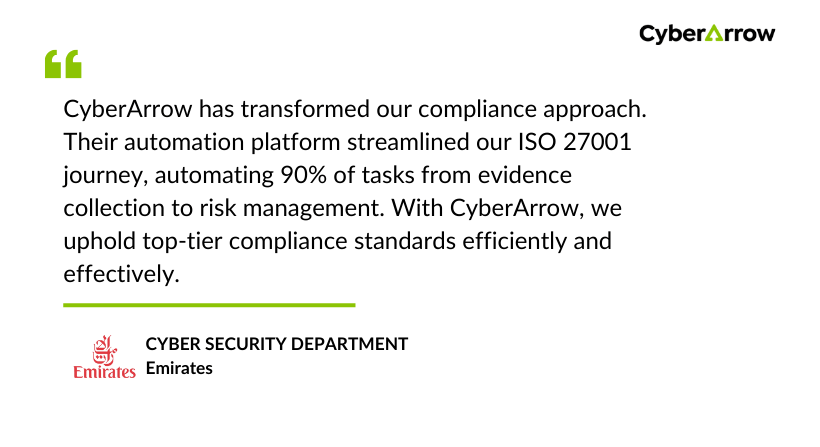
Join leading organizations like Emirates, Bupa, and Nahdi that trust CyberArrow to simplify compliance and deliver real-time risk insights.
See what Emirates has to say about CyberArrow GRC: