What is an AI governance framework and why does your organization need one?
AI systems are becoming a core part of how businesses operate, from customer service and hiring to risk management and decision-making. However, as these systems become increasingly complex and influential, so do the risks: biased outputs, regulatory violations, a lack of transparency, and unintended consequences that can harm both users and the brand’s reputation.
That’s why the demand for a clear, structured AI governance framework is rapidly increasing. Organizations can no longer afford to treat AI as a black box. They require defined policies, controls, and oversight to ensure that their AI systems are trustworthy, accountable, and compliant throughout their development, deployment, and beyond.
In this article, we’ll explain what an AI governance framework is, why it matters for modern enterprises, and how you can build one that aligns with your operational and ethical goals.
- What is an AI governance framework?
- Why AI governance is becoming essential
- How to build an effective AI governance framework
- 1. Define ownership and accountability across the AI lifecycle
- 2. Build AI-specific risk controls and thresholds
- 3. Standardize documentation and traceability
- 4. Build explainability into model development
- 5. Integrate governance into MLOps pipelines
- 6. Align governance with business strategy and ethics
- 7. Create a feedback loop for continuous improvement
- AI governance frameworks and emerging regulations
- Strengthen your AI governance with CyberArrow
What is an AI governance framework?
An AI governance framework is a set of policies, processes, and tools that guide the responsible use of AI within an organization. It outlines who is accountable for AI decisions, how risks are assessed, how data is managed, and what checks are in place to ensure fairness, transparency, and compliance.
Rather than being a one-size-fits-all solution, an effective AI governance framework should align with the company’s unique goals, risk profile, and regulatory environment.
Quick read: What is enterprise AI GRC, and why it matters for modern organizations
Why AI governance is becoming essential
As AI becomes more advanced, it also becomes harder to understand, manage, and control. Organizations face increasing pressure from regulators, stakeholders, and the public to ensure their AI systems are safe, fair, and accountable.
Several high-profile cases have shown how AI can go wrong, from biased hiring algorithms to models that unintentionally leak sensitive data. These risks, combined with a growing patchwork of AI regulations (like the EU AI Act and ISO 42001), make governance not just important, but necessary.
Without a structured approach to AI governance, organizations risk legal penalties, reputational damage, and operational failures.
A well-designed AI governance framework can unlock great value for your business. Here’s how:
- Increased transparency: Governance practices help organizations understand how AI models are built, trained, and make decisions, boosting internal clarity and external trust.
- Better compliance: With the right controls in place, organizations can confidently meet data privacy, fairness, and safety requirements across jurisdictions.
- Stronger model performance and reliability: Governance ensures continuous monitoring, version control, and auditability, leading to better AI lifecycle management.
- Faster deployment with fewer surprises: When responsibilities, risks, and safeguards are clearly defined, teams can scale AI faster while minimizing operational disruptions.
- Improved stakeholder confidence: Whether you’re working with regulators, customers, or your board, demonstrating robust AI governance signals responsibility and maturity.
How to build an effective AI governance framework
Implementing AI governance isn’t about drafting a policy and moving on. It’s about embedding responsibility, control, and oversight into every stage of your AI lifecycle, from data collection to model deployment.
Quick link: What is the EU AI Act?
Below are some steps to build an AI governance framework that’s both practical and future-ready:
1. Define ownership and accountability across the AI lifecycle
One of the most common governance gaps is unclear ownership. Who’s responsible for the fairness of the model? Who approves changes? Governance starts with assigning roles across data, model, and business teams.
Assign a model steward to oversee algorithmic transparency and bias testing, a data officer for input data quality, and a compliance lead to sign off on regulatory alignment. These roles must be documented and auditable.
2. Build AI-specific risk controls and thresholds
Traditional risk frameworks don’t always apply to AI. Organizations should identify what unique risks apply to their AI use cases, like hallucinations in generative models, data drift, or black-box decision-making, and define what levels are acceptable.
For instance, when building a customer support chatbot, you can set predefined thresholds for toxicity detection in outputs and require human review if confidence levels drop below 70% on sensitive topics.
3. Standardize documentation and traceability
Governance isn’t possible without visibility. Every model should be accompanied by standardized documentation, including training data sources, testing metrics, assumptions, known limitations, and intended use cases.
Use model cards, datasheets, and lineage diagrams to maintain clarity. These tools should live in a centralized repository accessible to auditors, legal, and development teams alike.
Learn: What is corporate governance?
4. Build explainability into model development
Stakeholders, from business leads to regulators, will ask why a model made a certain decision. Even if you’re using complex models, techniques like LIME, SHAP, or decision trees can help provide understandable outputs.
For example, in financial services, supplement neural network predictions with interpretable surrogate models for high-stakes decisions like loan denials or fraud detection.
5. Integrate governance into MLOps pipelines
Waiting until production to check for bias or compliance is too late. Instead, embed governance checkpoints directly into your development workflows.
Use automated testing pipelines to check for drift, fairness, and explainability before deployment. Flag models that fail thresholds and block deployment until they are reviewed.
6. Align governance with business strategy and ethics
AI governance should reflect your organization’s goals and values. If your company prioritizes inclusion or sustainability, ensure your AI systems are aligned with those principles.
For instance, a hiring platform should explicitly incorporate fairness audits and diverse datasets, not just to comply with the law, but to support broader diversity, equity, and inclusion (DEI) goals.
Quick read: What is IT governance?
7. Create a feedback loop for continuous improvement
Governance isn’t static. As new regulations emerge, user behaviors shift, and models evolve, your governance framework must adapt. Build in mechanisms for regular reviews and feedback.
Schedule quarterly governance reviews, use performance dashboards to monitor key indicators, and involve cross-functional teams in feedback cycles.
AI governance frameworks and emerging regulations
As AI adoption grows, so does the need for clear rules to ensure responsible development and use. While organizations can design their own AI governance practices, they are increasingly influenced by formal standards and regulatory efforts. These include:
1. NIST AI Risk Management Framework (AI RMF)
Similar to NIST AI RMF, this framework helps organizations manage AI risks through four core functions: map, measure, manage, and govern. It encourages building AI systems that are trustworthy, explainable, and aligned with societal values.
Best for: Organizations looking to establish a structured, risk-aware governance model, especially in regulated industries like finance or healthcare.
2. EU AI Act
The EU AI Act is the world’s first comprehensive regulation on AI. It classifies AI systems into risk levels: unacceptable, high, limited, and minimal. High-risk systems must meet strict requirements, including transparency, documentation, human oversight, and cyber security measures.
Best for: Companies operating in or targeting EU markets. Early alignment is key to avoiding penalties and ensuring product readiness.
3. ISO/IEC 42001
This newly introduced international standard provides a management system specifically for AI. ISO 42001 helps organizations implement governance principles such as transparency, accountability, and lifecycle risk management within their existing ISO frameworks.
Best for: Enterprises already using ISO standards (like ISO 27001 or ISO 9001) and looking to integrate AI governance formally.
Strengthen your AI governance with CyberArrow
Managing AI risks and compliance requires a unified approach to governance, risk, and compliance (GRC).
CyberArrow GRC platform helps organizations streamline AI governance by providing:
- Centralized risk assessment and management.
- Continuous monitoring of AI compliance controls.
- Automated policy management and audit readiness.
- Integrated reporting for internal teams and regulators.
- Customizable workflows aligned with your industry needs.
Empower your team to build responsible, compliant AI systems with confidence with enterprise AI GRC.
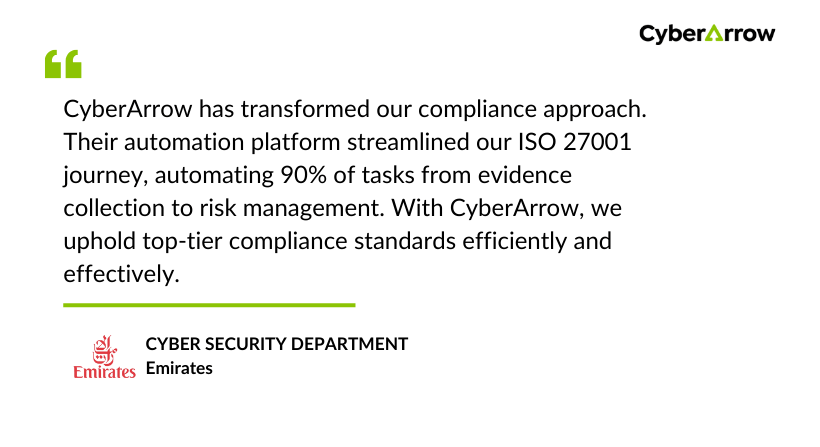
See what global brands like Emirates has to say about CyberArrow GRC: