


How to prevent physical security breaches from tailgating
Most people think cyber threats only happen online, like emails, viruses, or fake websites. But some of the most dangerous attacks happen in real life. One of these is tailgating, and it can lead to serious physical data breaches.
Tailgating might sound simple, but it’s one of the easiest ways for attackers to get inside your office, server room, or data center. Once inside, they can steal devices, install malware, or take sensitive documents.
In this blog, we’ll cover:
- What tailgating is.
- How does it lead to physical data breaches.
- Real-life examples of tailgating attacks.
- How to stop tailgating with training and smart systems.
- How CyberArrow Awareness Platform can help build a strong human firewall in your organization.
Let’s start with the basics.
What is tailgating?
Tailgating (also called “piggybacking”) is when someone sneaks into a secure area by following an authorized person. They may:
- Pretend to be an employee who “forgot their badge”.
- Carry heavy items so that someone holds the door open for them.
- Dress like a cleaner, technician, or delivery person.
- Simply act friendly and confident.
It plays on human behavior, kindness, politeness, or distraction.
Why tailgating is a big problem
Tailgating is not just a harmless mistake. It can lead to physical data breaches like:
- Theft of company laptops or USBs.
- Access to servers or network devices.
- Manual installation of malware.
- Theft of printed documents or ID badges.
- Spying or taking photos of confidential information.
These attacks often go unnoticed until it’s too late.
Real-life examples of tailgating breaches
1. Health provider office – Data theft
A man in business clothes walked into a healthcare provider’s office by following a nurse. He claimed to have a meeting with IT. Once inside, he accessed a vacant desk, connected a USB device, and downloaded hundreds of patient records.
Impact:
- Exposure of private health data.
- Legal issues and fines under HIPAA.
- Loss of trust from patients.
2. Corporate office – Device tampering
An attacker dressed as a delivery driver entered a corporate building by walking in behind an employee with a key card. He placed a device under a conference room table. That device was later found to be a wireless keylogger.
Impact:
- Stolen passwords.
- Remote access to internal systems.
- Data leak investigation costing thousands.
3. University – Lab access breach
A stranger followed a student into a secure science lab, pretending to be new to campus. The lab stored sensitive research data. No one challenged him, and later, critical research devices were reported stolen.
Impact:
- Years of lost research.
- University’s reputation is damaged.
- Investigation and recovery costs.
How tailgating happens in the workplace
| Scenario | Description |
| Busy entrances | People rush in and out, holding doors open for others. |
| Friendly culture | Staff avoid confrontation or don’t want to appear rude. |
| Lack of training | Employees don’t know what tailgating is or how to handle it. |
| No physical barriers | Entry points have no turnstiles, gates, or key card systems. |
Quick link: How to implement a vendor risk management program?
Why physical data breaches matter
Many people focus on digital threats, but physical data breaches can be just as dangerous, sometimes even worse.
Here’s what’s at risk:
- Confidential data: Access to printed reports, whiteboards, or physical files.
- Devices: Theft or tampering with laptops, hard drives, or USBs.
- Servers & networks: Entry into server rooms can lead to full control of systems.
- Compliance violations: Failing to protect physical data can break laws like GDPR or HIPAA.
- Reputation: Clients and customers may lose trust if they think your office is easy to breach.
How to prevent tailgating
Let’s break it down step-by-step.
1. Train employees to be alert
Most tailgating cases happen because people don’t know the risks.
That’s where cyber security awareness training comes in. Employees should learn:
- What tailgating looks like.
- How to stop and question suspicious behavior.
- When to report an incident.
- Why physical access is just as dangerous as cyber access.
With training, employees learn it’s okay to say:
“Excuse me, do you have an access badge?”
“Let me get someone from security to help you.”
“Please swipe your card to enter.”
2. Use access control systems
Install physical security systems like:
- Key card readers or biometric scanners.
- Turnstiles or speed gates at main entrances.
- Separate visitor check-in areas with escorts.
- Time-limited access badges for guests.
Don’t allow one card swipe to open doors for multiple people. Use systems that only allow one person per entry.
3. Install surveillance and monitoring
Use cameras to monitor entrances and hallways. If something happens, you’ll have a record. Even better, combine camera footage with access logs so you can track who entered and when.
4. Design physical barriers
Make tailgating physically harder. For example:
- Doors that close quickly.
- Locked stairwells or elevators.
- Double-door entry systems (mantraps).
- Reception desks with a clear sight of entrances.
5. Empower security staff
Train security guards and front desk staff to:
- Watch for tailgating.
- Challenge people without badges.
- Escort visitors properly.
- Report all incidents.
Make sure there’s a clear policy for how to handle these situations, with no confusion.
Quick link: How social engineers manipulate human behavior
How CyberArrow Awareness Platform helps
No matter how strong your locks or cameras are, your people are your first line of defense.
The CyberArrow Awareness Platform helps your staff become human firewalls against threats like tailgating and physical data breaches.
Targeted employee training
- Easy-to-understand lessons on tailgating, phishing, social engineering, and more.
- Role-specific modules (e.g., reception, IT, management).
- Interactive videos and quizzes that keep employees engaged.
Simulated security tests
- Test how employees react in real-life situations.
- Reinforce training with practical examples.
- Track results and give personalized feedback.
Dashboard and reporting
- View your organization’s security awareness levels.
- Identify risky departments or behaviors.
- Get compliance-ready reports for audits.
Awareness campaigns
- Posters, emails, reminders, and micro-lessons.
- Keep security top-of-mind every day.
- Encourage a security-first culture.
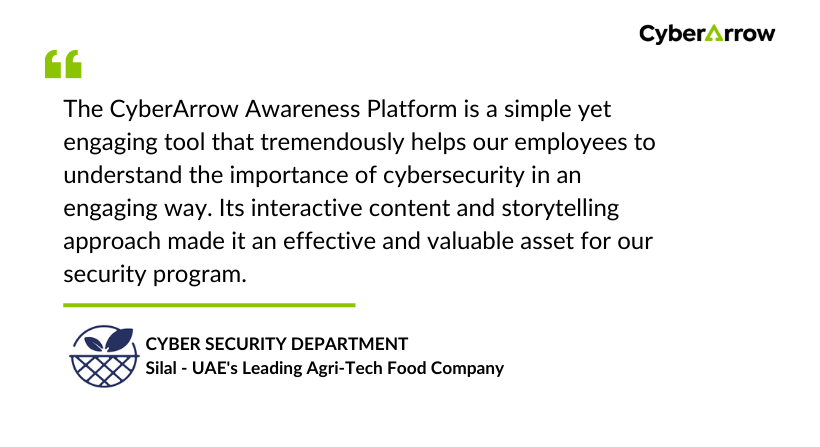
Read how CyberArrow awareness platform increased security awareness among Silal’s employees.
See what Silal has to say about CyberArrow Awareness Platform:
Key takeaways: Don’t let kindness create risk
Tailgating uses human kindness against us. But with the right tools and training, we can protect our physical and digital environments.
Here’s how to reduce your risk of physical data breaches:
- Train employees to recognize and report tailgating.
- Use access controls and barriers.
- Empower your security team.
- Continuously test and improve awareness with CyberArrow.
Final thoughts
Cyber security isn’t just about firewalls and passwords. It’s about people. When someone walks into your building without permission, they might walk out with your company’s most valuable data.
That’s why we built the CyberArrow Awareness Platform to train your team, test their awareness, and stop threats before they start.
