

How social engineers manipulate human behavior
Cybercriminals don’t always rely on hacking computers. Sometimes, they just trick people.
That’s what social engineers do. They don’t break into systems, they break into minds.
In this blog, we’ll explain how social engineers manipulate human behavior, why these attacks are so dangerous, and how you can protect your organization using tools like the CyberArrow Awareness Platform.
Let’s break it down.
- What is social engineering?
- Why social engineering works
- Common techniques used by social engineers
- The human brain and social engineering
- Social engineering is getting smarter
- The cost of social engineering attacks
- The solution: Build a human firewall
- How CyberArrow Awareness Platform stops social engineers
- Final thoughts
What is social engineering?
Social engineering is a method used by cyber attackers to trick people into giving up confidential information or access to systems.
Instead of attacking machines, social engineers target humans. They know that people are often the weakest link in cyber security.
They use tricks to make people:
- Click dangerous links.
- Share login credentials.
- Download infected files.
- Transfer money to fake accounts.
And often, these tricks work not because people are careless, but because social engineers are very good at manipulating emotions.
Why social engineering works
Social engineers are like con artists. They study human behavior, psychology, and emotions. Then they use that knowledge to create believable lies.
Here are some reasons why these attacks are so successful:
1. People trust easily
Most people want to be helpful and polite. Social engineers use this to their advantage. For example, they might pretend to be an IT technician asking for login details.
2. Fear and urgency
Many social engineering attacks create a sense of urgency. For example:
“Your account will be locked in 10 minutes. Click here to reset your password.”
Fear makes people act fast without thinking clearly.
3. Lack of training
If employees are not trained on cyber risks, they won’t know what signs to look for. This makes it easier for social engineers to trick them.
4. Real-looking attacks
Social engineers often use emails that look real, websites that look real, and phone calls that sound real. Without awareness, it’s hard to tell the difference.
Common techniques used by social engineers
Here are some of the most common methods social engineers use to manipulate behavior:
1. Phishing
Phishing is the most common form of social engineering. It often comes in emails that look like they’re from trusted sources (like banks or IT departments).
These emails ask users to:
- Click on a link.
- Download a file.
- Enter their username and password.
Once you do this, the attacker gets access to your information.
Real-life Example:
An employee receives an email that looks like it’s from Microsoft asking to “confirm your credentials.” They click the link, enter their login, and give away access to sensitive files.
2. Pretexting
Pretexting is when an attacker creates a fake scenario to get someone to share information.
For example:
“Hi, I’m from payroll. We’re updating bank details. Can you confirm your account number?”
The attacker builds trust using a made-up story. Victims don’t realize they’re being tricked.
3. Baiting
This involves offering something tempting, like a gift card or download, but it’s a trap.
The user might:
- Download malware.
- Give away credentials.
- Install spyware unknowingly.
Think of it like a fisherman using bait to catch a fish. The bait looks good, but it’s dangerous.
4. Tailgating
Tailgating happens when someone physically follows an authorized person into a secure area.
They might say:
“I forgot my badge, can you let me in?”
Once inside, they can access computers, USB ports, and other sensitive assets.
5. Quid pro quo
This method offers a service in exchange for information.
For example:
“We’re conducting a survey. Complete it and get a free voucher.”
The attacker uses the promise of a reward to gain data.
Quick link: How to prevent physical security breaches from tailgating
The human brain and social engineering
To understand why people fall for social engineering, let’s look at some basic human behaviors social engineers target:
1. Authority
People often obey people who seem like they’re in charge. Attackers might pretend to be CEOs, IT administrators, or law enforcement.
2. Curiosity
Humans are curious by nature. A file named “salary_increase_details.pdf” might be hard to ignore.
3. Greed
“Win a free iPhone!” messages can tempt people into clicking links or filling out forms.
4. Fear of Missing Out (FOMO)
Limited-time offers, urgent security updates, and threats of account closure make people act fast.
5. Reciprocity
If someone does a favor, people often want to return it. Social engineers use this by being helpful before asking for something.
Social engineering is getting smarter
Social engineering isn’t new, but it’s evolving. Attackers now use:
- AI to create more realistic emails.
- Deepfake audio or video.
- Public information from social media.
- Language and tone that match real company communication.
As technology grows, so do the tricks.
This makes human awareness more important than ever.
Quick link: What is a rootkit? Types & prevention
The cost of social engineering attacks
Social engineering is expensive not just in money, but in trust and reputation.
Here’s what a single attack can cost:
- Financial losses (bank fraud, wire transfers, etc.)
- Damage to brand reputation.
- Data breaches.
- Legal consequences and compliance issues.
- Downtime and recovery costs.
Many successful attacks start with just one employee clicking the wrong link.
Quick link: Wendy’s credit card breach: Timeline, failures, and key lessons for businesses
The solution: Build a human firewall
Your antivirus won’t stop a person from giving out their password.
Firewalls and software are important, but the strongest defense is your people. That’s why training your employees is critical.
And the best way to do that? Use the CyberArrow Awareness Platform.
How CyberArrow Awareness Platform stops social engineers
CyberArrow Awareness Platform helps companies train their staff to spot and stop social engineering attacks before damage is done.
Let’s look at how it works:
1. Automated cyber security awareness training
CyberArrow offers ready-made courses that are:
- Easy to understand.
- Based on real attack examples.
- Focused on everyday employee tasks.
Training can be scheduled, tracked, and managed automatically. No manual follow-ups needed.
2. Simulated phishing campaigns
The platform lets you run fake phishing emails across your team to test how well they respond.
You’ll know:
- Who clicked the link?
- Who reported it?
- Who needs more training?
These simulations turn real threats into learning experiences.
3. Real-time reporting and analytics
CyberArrow gives you a dashboard where you can:
- Track training progress.
- See improvement over time.
- Identify weak spots in your team.
This helps your security team make smart decisions fast.
4. Content tailored to your industry
CyberArrow customizes the learning material based on your industry.
Whether you’re in banking, healthcare, energy, or retail, your team will learn exactly what threats they face daily.
5. Builds a culture of security
The platform doesn’t just train employees, it changes how they think.
You create a team that:
- Think before clicking.
- Questions unexpected requests.
- Reports suspicious activity.
Over time, this builds a human firewall that is hard to break.
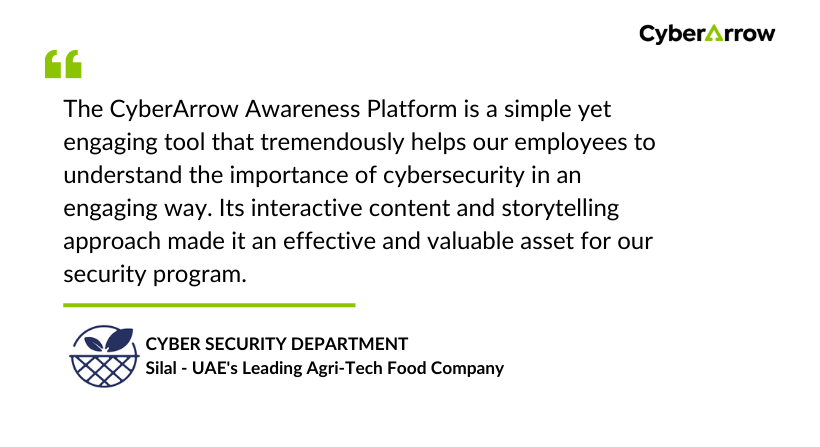
Read how CyberArrow awareness platform increased security awareness among Silal’s employees.
See what Silal has to say about CyberArrow Awareness Platform:
Final thoughts
Social engineers don’t hack systems, they hack minds. They use trust, urgency, and fear to trick people into making mistakes. And one small mistake can cause major damage.
That’s why training your people is the first and most important step in protecting your company.
