


A complete guide to ISO 27005: Requirements & implementation
In today’s digital landscape, organizations face numerous threats to their information security. Effectively managing these risks is crucial to protecting sensitive data and maintaining stakeholder trust. ISO 27005 is an international standard that provides guidelines for information security risk management, supporting the broader ISO 27001 framework.
This comprehensive guide explores the requirements and implementation of ISO 27005 and demonstrates how CyberArrow GRC can automate compliance efforts, particularly through its cross-mapping capabilities across multiple frameworks like ISO and NIST.
What is ISO 27005?
ISO 27005 offers a structured approach to identifying, assessing, and managing information security risks. It complements ISO 27001 by providing detailed guidance on the risk management process essential for establishing an effective Information Security Management System (ISMS).
Key components of ISO 27005
- Risk identification: Recognizing potential threats and vulnerabilities that could impact information assets.
- Risk assessment: Evaluating the likelihood and impact of identified risks to prioritize them effectively.
- Risk treatment: Determining appropriate measures to mitigate, transfer, accept, or avoid risks.
- Risk acceptance: Formally acknowledging residual risks after treatment.
- Risk communication and consultation: Engaging stakeholders to ensure a shared understanding of risks and decisions.
- Risk monitoring and review: Continuously monitoring risk factors and the effectiveness of treatments, making adjustments as necessary.
By following these steps, organizations can create a proactive risk management culture that aligns with their business objectives.
Quick link: A complete guide to ISO 27002
Implementing ISO 27005
Implementing ISO 27005 involves a series of structured steps:
Establish the context: Define the scope of the risk management process, considering the organization’s objectives, regulatory environment, and stakeholder expectations.
Conduct risk assessment:
- Risk identification: Catalog information assets and identify potential threats and vulnerabilities.
- Risk analysis: Assess the potential impact and likelihood of identified risks.
- Risk evaluation: Prioritize risks based on their severity and the organization’s risk appetite.
Risk treatment: Develop and implement strategies to mitigate identified risks, such as deploying security controls or transferring risks through insurance.
Monitor and review: Regularly review risk assessments and treatments to ensure their continued effectiveness and relevance.
Communication and consultation: Maintain open lines of communication with stakeholders throughout the risk management process to ensure transparency and collective understanding.
This systematic approach helps organizations manage their information security risks effectively and maintain compliance with ISO 27001 requirements.
Challenges in implementing ISO 27005
Organizations may encounter several challenges when implementing ISO 27005:
- Resource constraints: Allocating sufficient time, personnel, and budget to conduct thorough risk assessments and implement treatments can be demanding.
- Complexity of risk assessment: Accurately identifying and evaluating risks requires specialized knowledge and expertise.
- Keeping up with evolving threats: The dynamic nature of cyber threats necessitates continuous monitoring and updating of risk management strategies.
Addressing these challenges requires a combination of skilled personnel, robust processes, and effective tools.
How CyberArrow GRC facilitates ISO 27005 compliance
CyberArrow GRC is a comprehensive Governance, Risk, and Compliance platform designed to streamline the implementation and management of standards like ISO 27005. By automating key aspects of the risk management process, CyberArrow GRC helps organizations overcome common challenges associated with ISO 27005 compliance.
Key features of CyberArrow GRC
- Automated risk assessments: CyberArrow GRC automates the identification and evaluation of information security risks, reducing the need for manual processes and minimizing human error.
- Centralized risk register: The platform provides a centralized repository for documenting and tracking all identified risks, treatments, and monitoring activities, ensuring transparency and accountability.
- Real-time monitoring and alerts: CyberArrow GRC offers continuous monitoring of risk factors and sends real-time alerts for any significant changes, enabling prompt responses.
- Comprehensive reporting: The platform generates detailed reports on risk assessments, treatment plans, and compliance status, facilitating informed decision-making and demonstrating compliance to stakeholders.
Cross-mapping across multiple frameworks
One of the standout features of CyberArrow GRC is its ability to cross-map controls and requirements across multiple frameworks, including various ISO standards and NIST guidelines. This functionality allows organizations to:
- Streamline compliance efforts: By identifying overlapping requirements among different frameworks, CyberArrow GRC enables organizations to address multiple compliance obligations simultaneously, reducing duplication of effort.
- Enhance risk visibility: Cross-mapping provides a holistic view of the organization’s risk landscape, facilitating more effective risk management strategies.
- Simplify audits: With mapped controls, organizations can more easily demonstrate compliance with multiple standards during audits, saving time and resources.
By leveraging CyberArrow GRC’s cross-mapping capabilities, organizations can achieve a more integrated and efficient approach to managing information security risks and compliance requirements.
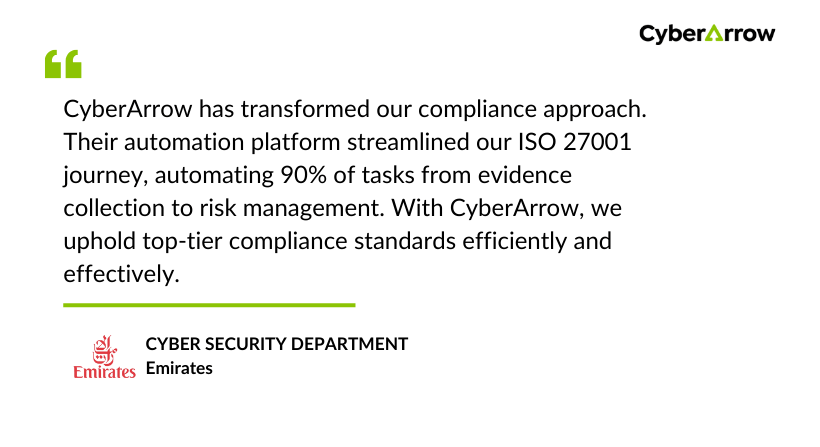
Read how Emirates enhanced Information Security by automating ISO 27001 with CyberArrow GRC.
See what Emirates has to say about CyberArrow GRC:
CyberArrow GRC offers automation and cross-mapping features that simplify compliance with ISO 27005 and other frameworks, enabling organizations to manage risks more effectively and efficiently.
FAQs
What is ISO 27005, and how is it different from ISO 27001?
ISO 27005 is a standard that gives detailed guidelines for managing information security risks. It supports ISO 27001, which is the main framework for building an Information Security Management System (ISMS). While ISO 27001 outlines what needs to be done, ISO 27005 focuses on how to manage risks that can affect your information security.
Is ISO 27005 mandatory for ISO 27001 certification?
No, ISO 27005 is not mandatory for ISO 27001 certification. But it is highly recommended. It helps organizations meet ISO 27001’s risk management requirements in a structured and smart way. Using ISO 27005 makes it easier to perform risk assessments and build strong security controls.
How can CyberArrow GRC help with ISO 27005 implementation?
CyberArrow GRC makes it easier to implement ISO 27005 by automating risk assessments, tracking risk treatments, and offering built-in templates. It also supports cross-mapping with other standards like ISO 27001, ISO 27002, and NIST, which saves time and improves accuracy. It helps you stay compliant without dealing with messy spreadsheets or manual updates.
