

A complete guide to ISO 15408: Requirements & implementation
In today’s digital landscape, ensuring the security of information technology (IT) products is paramount. Organizations and consumers seek assurance that the IT products they use are robust against potential threats. This is where ISO 15408, commonly known as the Common Criteria for Information Technology Security Evaluation, comes into play. This international standard provides a framework for evaluating IT products’ security features and capabilities, ensuring they meet defined security requirements.
In this comprehensive guide, we’ll delve into the intricacies of ISO 15408, its requirements, implementation strategies, and how tools like CyberArrow GRC can streamline and automate the compliance process.
What is ISO 15408?
ISO 15408 is an international standard that establishes a common framework for evaluating the security properties of IT products. It ensures that products undergo rigorous testing and meet specific security criteria, fostering confidence among users and stakeholders. The standard is structured into several key components:
- Protection profiles (PPs): These are implementation-independent sets of security requirements for a category of products. They serve as templates, allowing consumers and regulatory bodies to define standardized security needs for specific product types.
- Security targets (STs): Prepared by vendors, these documents specify the security features of their particular product and how it meets the requirements outlined in relevant Protection Profiles.
- Evaluation assurance levels (EALs): Ranging from EAL1 to EAL7, these levels indicate the depth and rigor of the evaluation process. Higher EALs represent more comprehensive evaluations, with EAL7 being the most stringent.
By adhering to these components, ISO 15408 provides a structured framework for evaluating and certifying the security of IT products, ensuring they meet internationally recognized standards.
Importance of ISO 15408
Implementing ISO 15408 is vital for several reasons:
- Global recognition: As an international standard, ISO 15408 is recognized worldwide, facilitating mutual recognition of evaluations across different countries. This global acceptance streamlines the certification process for vendors aiming to market their products internationally.
- Assurance of security: The standard assures that IT products have undergone rigorous and repeatable evaluations, ensuring they meet defined security requirements. This builds trust among users and stakeholders regarding the product’s security capabilities.
- Facilitates procurement: Organizations can rely on ISO 15408 certifications to make informed decisions when procuring IT products, knowing that certified products adhere to established security standards. This reduces the risk associated with integrating new products into existing systems.
By adopting ISO 15408, organizations demonstrate a commitment to maintaining high-security standards, which is crucial in today’s threat landscape.
Implementing ISO 15408
Implementing ISO 15408 involves a systematic approach to ensure that IT products meet the required security standards. The process includes:
- Define security requirements: Identify and document the security needs of the IT product in a Protection Profile (PP) or Security Target (ST). This step involves understanding potential threats and specifying the necessary security functions to mitigate them.
- Develop the product: Design and build the IT product incorporating the identified security requirements. This phase requires close collaboration between security experts and development teams to ensure that security is integrated into the product from the outset.
- Conduct evaluation: Engage an accredited evaluation facility to assess the product against the defined security requirements. The evaluation examines both the design and implementation of security functions to ensure they meet the specified criteria.
- Obtain certification: Upon successful evaluation, obtain certification that the product meets the security standards set forth in ISO 15408. This certification serves as formal recognition of the product’s security capabilities.
This structured approach ensures that IT products are developed and evaluated in a manner that aligns with internationally recognized security standards, thereby enhancing their credibility and marketability.
Challenges in implementing ISO 15408
Organizations may encounter several challenges when implementing ISO 15408:
- Complexity of evaluation: The evaluation process can be intricate and time-consuming, requiring detailed documentation and rigorous testing. This complexity can pose challenges, especially for organizations with limited experience in security evaluations.
- Resource intensive: Achieving higher Evaluation Assurance Levels (EALs) necessitates significant resources, including time, financial investment, and specialized expertise. Organizations must be prepared to allocate these resources to attain the desired assurance level.
- Keeping up with standards: Staying updated with the latest versions of the standard and understanding the changes can be challenging. Continuous education and engagement with the standards community are essential to remain compliant.
Addressing these challenges requires careful planning, resource allocation, and a commitment to ongoing education and improvement.
How CyberArrow GRC facilitates ISO 15408 compliance
CyberArrow GRC is a comprehensive Governance, Risk, and Compliance platform designed to streamline the implementation and management of standards like ISO 15408. By automating key aspects of the compliance process, CyberArrow GRC helps organizations overcome common challenges associated with ISO 15408.
Key Features of CyberArrow GRC
- Automated compliance management: CyberArrow GRC automates the tracking and management of compliance tasks, reducing the need for manual processes and minimizing human error.
- Centralized documentation: The platform provides a centralized repository for all compliance-related documents, ensuring easy access and organization.
- Real-time monitoring and alerts: CyberArrow GRC offers continuous monitoring of compliance status and sends real-time alerts for any deviations, enabling prompt corrective actions.
- Comprehensive reporting: The platform generates detailed reports on compliance status, facilitating informed decision-making and demonstrating compliance to stakeholders.
Cross-Mapping Across Multiple Frameworks
One of the standout features of CyberArrow GRC is its ability to cross-map controls and requirements across multiple frameworks, including various ISO standards and NIST guidelines. This functionality allows organizations to:
- Streamline compliance efforts: By identifying overlapping requirements among different frameworks, CyberArrow GRC enables organizations to address multiple compliance obligations simultaneously, reducing duplication of effort.
- Enhance risk visibility: Cross-mapping provides a holistic view of the organization’s risk landscape, facilitating more effective risk management strategies.
- Simplify audits: With mapped controls, organizations can more easily demonstrate compliance with multiple standards during audits, saving time and resources.
Benefits of using CyberArrow GRC for ISO 15408 compliance
CyberArrow GRC is more than just a tool, it’s a solution that simplifies and strengthens your entire compliance journey. Here’s how your organization benefits when managing ISO 15408 with CyberArrow GRC:
Saves time and resources: Manual compliance tracking often leads to errors and delays. With CyberArrow’s automation, teams can reduce administrative tasks and spend more time focusing on real security improvements.
Boosts accuracy: With built-in frameworks, mapped controls, and customizable templates, you’re less likely to miss important requirements. This helps reduce the risk of failed audits or gaps in compliance.
Supports scalability: As your business grows or changes, so do your compliance needs. CyberArrow GRC supports scaling with ease—whether you’re onboarding new systems, expanding to new markets, or adopting additional standards.
Improves collaboration across teams: Information security isn’t just IT’s responsibility. CyberArrow offers role-based access and automated workflows that help teams—from security to legal to HR—stay aligned on compliance efforts.
Centralizes documentation: Storing, managing, and retrieving compliance-related evidence is easier with CyberArrow. You can store all audit logs, risk assessments, and control evaluations in one place, making internal and external audits stress-free.
ISO 15408 in the bigger compliance picture
While ISO 15408 focuses on security evaluations of IT products, it often works alongside other standards like:
- ISO 27001/27002: These help build a strong ISMS (Information Security Management System).
- ISO 27005: Supports risk management.
- NIST CSF and SP 800-53: Provide a broader security and privacy framework, especially for U.S.-based systems or government contractors.
Read how Emirates enhanced Information Security by automating ISO 27001 with CyberArrow GRC.
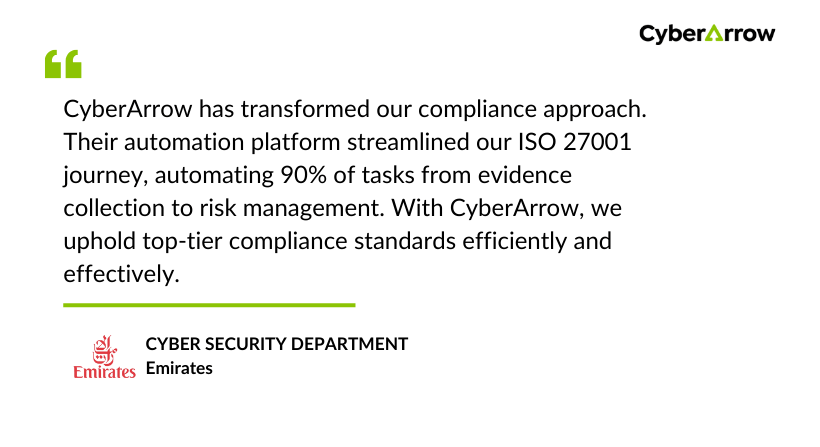
See what Emirates has to say about CyberArrow GRC:
CyberArrow GRC’s cross-mapping feature is key here. It allows you to manage ISO 15408 while also linking relevant controls across ISO 27001, NIST, and even privacy standards like GDPR or UAE IA. This saves you from redoing work and strengthens overall security governance.
FAQs
What is ISO 15408?
ISO 15408 is an international standard for evaluating the security of IT products and systems. It is also known as the Common Criteria. It helps ensure that software, hardware, and systems meet a certain level of trustworthiness and are evaluated in a structured, repeatable way.
Who needs to comply with ISO 15408?
Organizations that develop or supply IT products—especially to government or military entities—may need to follow ISO 15408. This includes hardware makers, software developers, and cloud service providers who want to prove their products meet international security standards.
How does CyberArrow help with ISO 15408 compliance?
CyberArrow GRC helps businesses automate ISO 15408 compliance by offering built-in frameworks, pre-approved templates, and cross-mapping to other standards. This saves time, improves accuracy, and ensures you’re always audit-ready.
