A complete guide to ISO 27002: Requirements & implementation
In an era where data breaches and cyber threats are escalating, safeguarding sensitive information has become paramount for organizations globally. The International Organization for Standardization (ISO) offers a suite of standards to assist organizations in managing information security effectively. Among these, ISO 27002 stands out as a comprehensive guide for implementing information security controls.
This article delves into the essentials of ISO 27002, its requirements, implementation strategies, and how tools like CyberArrow GRC can streamline compliance through automation and cross-mapping features across multiple frameworks.
Understanding ISO 27002
ISO 27002 is an international standard that provides guidelines and best practices for information security management. It serves as a reference for selecting, implementing, and managing controls to address various information security risks. While ISO 27001 outlines the requirements for establishing an Information Security Management System (ISMS), ISO 27002 offers detailed guidance on the individual controls that can be employed to mitigate information security risks.
Key components of ISO 27002
The standard encompasses a broad range of controls categorized into several domains, each focusing on a specific aspect of information security:
- Information security policies: Development and maintenance of policies that provide management direction and support for information security in accordance with business requirements and relevant laws and regulations.
- Organization of information security: Establishment of a management framework to initiate and control the implementation and operation of information security within the organization.
- Human resource security: Ensuring that employees and contractors understand their responsibilities and are suitable for the roles they are considered for, reducing the risk of human error, theft, fraud, or misuse of facilities.
- Asset management: Identification and management of organizational assets to ensure that information receives an appropriate level of protection.
- Access control: Limiting access to information and information processing facilities to authorized users only, thereby protecting against unauthorized access and potential breaches.
- Cryptography: Use of cryptographic techniques to ensure the confidentiality, integrity, and authenticity of information.
- Physical and environmental security: Preventing unauthorized physical access, damage, and interference to the organization’s information and information processing facilities.
- Operations security: Ensuring the correct and secure operations of information processing facilities, including protection against malware and management of technical vulnerabilities.
- Communications security: Protecting information in the network and its supporting information processing facilities to prevent unauthorized access and ensure the integrity of communications.
- System acquisition, development, and maintenance: Integrating information security into the organization’s systems across their entire lifecycle, from acquisition and development to maintenance.
- Supplier relationships: Ensuring that agreements with suppliers include requirements to address the information security risks associated with supplier access to the organization’s assets.
- Information security incident management: Establishing processes to ensure a consistent and effective approach to the management of information security incidents, including communication on security events and weaknesses.
- Information security aspects of business continuity management: Embedding information security continuity into the organization’s business continuity management systems to protect critical business processes during disruptions.
- Compliance: Identifying and meeting applicable legal, regulatory, and contractual requirements related to information security and ensuring adherence to internal policies and standards.
Each of these domains contains specific controls designed to address various aspects of information security, providing organizations with a robust framework to protect their information assets.
Implementing ISO 27002 controls
Implementing the controls outlined in ISO 27002 involves a systematic approach:
- Risk assessment: Begin by conducting a thorough risk assessment to identify and evaluate information security risks specific to your organization. This will help in selecting appropriate controls to mitigate identified risks.
- Control selection: Based on the risk assessment, select controls from ISO 27002 that are relevant to your organization’s risk profile and business needs. Not all controls may be applicable, so it’s essential to choose those that address your specific risks.
- Policy development: Develop and document information security policies that reflect the chosen controls and provide clear guidelines for their implementation and management.
- Implementation: Deploy the selected controls in accordance with the developed policies. This may involve technical solutions, procedural changes, and administrative measures.
- Training and awareness: Educate employees and relevant stakeholders about the implemented controls, their responsibilities, and the importance of information security to ensure effective adoption and compliance.
- Monitoring and review: Continuously monitor the effectiveness of the implemented controls and conduct regular reviews to identify areas for improvement and ensure ongoing compliance.
- Continuous improvement: Use the insights gained from monitoring and reviews to make necessary adjustments and enhancements to the information security controls and policies.
Implementing ISO 27002 controls is an ongoing process that requires commitment from all levels of the organization to adapt to evolving security threats and business changes.
Quick link: A complete guide to ISO 27005
ISO 27002 vs. ISO 27001
Many people confuse ISO 27002 with ISO 27001. While they are related, they serve different purposes:
- ISO 27001 is the standard that sets out the requirements for an Information Security Management System (ISMS).
- ISO 27002 supports ISO 27001 by providing detailed guidance on how to implement the controls listed in Annex A of ISO 27001.
Think of ISO 27001 as the “what” and ISO 27002 as the “how.”
Benefits of ISO 27002 for businesses
Here’s why ISO 27002 is important for businesses of all sizes:
- Risk reduction: Helps reduce the chances of data breaches and security incidents.
- Customer trust: Shows customers and partners that you take information security seriously.
- Operational efficiency: Improves processes and workflows, making your business more secure and efficient.
- Reputation protection: Prevents damage to your brand and business reputation caused by cyber attacks.
Challenges in implementing ISO 27002
Organizations may encounter several challenges when implementing ISO 27002 controls:
- Resource allocation: Implementing and maintaining information security controls requires dedicated resources, including personnel, time, and budget. Organizations may struggle to allocate sufficient resources, especially if they lack in-house expertise.
- Complexity of controls: Some controls may be complex and require specialized knowledge to implement effectively. Understanding and applying these controls can be challenging without the right expertise.
- Integration with existing processes: Aligning new security controls with existing business processes and systems can be difficult, particularly if there are legacy systems involved. Ensuring seamless integration is crucial for maintaining operational efficiency.
- Keeping up with changes: The information security landscape is continually evolving, and standards like ISO 27002 are updated to reflect new threats and technologies. Staying current with these changes and updating controls accordingly can be demanding.
Quick link: A complete guide to ISO 15408
How CyberArrow GRC supports ISO 27002 compliance
Manually tracking and implementing ISO 27002 controls can be hard. That’s where CyberArrow GRC makes the process simpler, smarter, and faster.
Automate ISO 27002 compliance
CyberArrow GRC helps you:
- Automate control implementation.
- Manage policies and procedures from a single dashboard.
- Track compliance with real-time updates and alerts.
- Conduct internal audits easily.
Cross-mapping across frameworks
One standout feature of CyberArrow GRC is cross-mapping. This means if you’re also following ISO 27001, NIST CSF, or other frameworks, CyberArrow will automatically match similar controls. This reduces duplicate work and saves time. You don’t need to manage multiple frameworks separately — CyberArrow does the mapping for you.
For example:
- A control in ISO 27002 related to access control might also exist in NIST CSF. With CyberArrow, you only need to implement it once, and it will be marked compliant across both frameworks.
Easy collaboration
CyberArrow allows teams to collaborate in real time. Whether it’s your compliance team, IT staff, or external auditors, everyone can stay on the same page. Role-based access ensures the right people see the right data.
Reporting made easy
Need to show proof of compliance? CyberArrow gives you easy-to-understand reports and dashboards. These are helpful during audits or when presenting to executives.
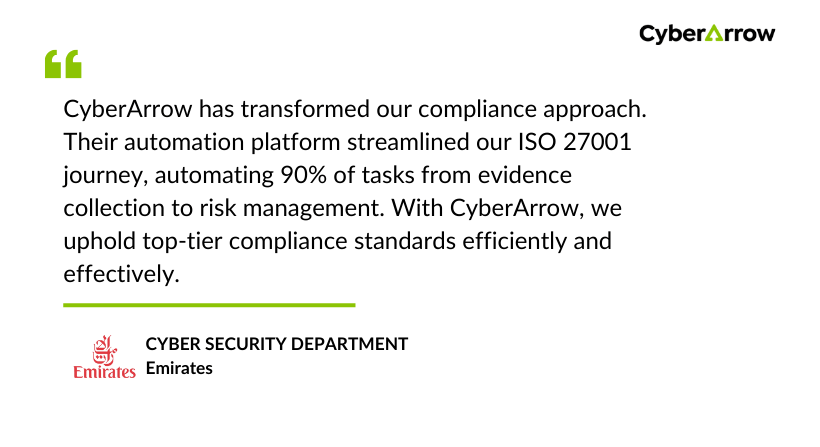
Read how Emirates enhanced Information Security by automating ISO 27001 with CyberArrow GRC.
See what Emirates has to say about CyberArrow GRC: