

US cyber security laws: A detailed guide
Cyber threats are increasing rapidly, making cyber security compliance a top priority for organizations in the United States. To protect sensitive data, prevent breaches, and ensure consumer privacy, the US government has implemented several cyber security laws. These laws regulate data protection, cyber security frameworks, and compliance requirements for businesses handling personal or sensitive information.
Whether you run a small business or a multinational corporation, understanding US cyber security laws is essential to avoid legal penalties and safeguard your organization from cyber risks. However, compliance can be challenging, especially with evolving regulations.
This guide will cover all major US cyber security laws, explaining their requirements and impact on businesses. You’ll also learn how CyberArrow GRC can help automate compliance, ensuring your company stays secure and compliant without manual effort.
- Why are US cyber security laws important?
- Key US cyber security laws you need to know
- 1. The Cybersecurity Information Sharing Act (CISA) – 2015
- 2. The Federal Information Security Modernization Act (FISMA) – 2002 & 2014
- 3. The California Consumer Privacy Act (CCPA) – 2018
- 4. The Health Insurance Portability and Accountability Act (HIPAA) – 1996
- 5. The Gramm-Leach-Bliley Act (GLBA) – 1999
- 6. Federal Risk and Authorization Management Program (FedRAMP)
- 7. Defense Federal Acquisition Regulation Supplement (DFARS)
- How CyberArrow GRC helps businesses automate cyber security compliance
- FAQs
Why are US cyber security laws important?
Cyber security laws aim to:
- Protect consumer data from theft, misuse, and unauthorized access.
- Regulate businesses handling personal, financial, and healthcare information.
- Establish cyber security standards for companies to follow.
- Reduce financial losses caused by cyberattacks and data breaches.
- Ensure national security by protecting critical infrastructure from cyber threats.
Failure to comply with these laws can result in hefty fines, lawsuits, and reputational damage. That’s why businesses must take cyber security compliance seriously.
Key US cyber security laws you need to know
Several federal and state-level cyber security laws regulate data security in the US. Here are the most important ones:
1. The Cybersecurity Information Sharing Act (CISA) – 2015
The Cybersecurity Information Sharing Act (CISA) was introduced to encourage businesses and government agencies to share cyber security threat information. The goal is to improve the country’s overall cyber security posture by allowing organizations to report and receive threat intelligence without legal consequences.
Who needs to comply?
- Government agencies
- Private companies
- Critical infrastructure providers
Key requirements:
- Organizations must share cyber threat data with the Department of Homeland Security (DHS).
- Businesses get legal protection for sharing cyber security-related information.
Penalties for non-compliance:
No direct penalties, but failing to share critical threat intelligence may increase cyber risks for businesses.
2. The Federal Information Security Modernization Act (FISMA) – 2002 & 2014
FISMA establishes cyber security standards for federal agencies and their contractors. It ensures that government systems remain secure against cyber threats.
Who needs to comply?
- Federal agencies
- Government contractors and subcontractors
Key requirements:
- Agencies must implement risk-based security programs.
- Continuous monitoring of IT systems is mandatory.
- Annual cyber security audits are required.
Penalties for non-compliance:
Organizations risk losing government contracts and funding if they fail to comply.
3. The California Consumer Privacy Act (CCPA) – 2018
CCPA is one of the strictest state-level data privacy laws, giving California residents greater control over their personal data.
Who needs to comply?
- Businesses that collect or process California residents’ data and meet any of these criteria:
- Annual revenue exceeds $25 million
- Processes data of 50,000+ consumers, households, or devices
- Generates 50% or more revenue from selling personal data
Key requirements:
- Consumers must be able to opt out of data collection.
- Companies must disclose data collection practices and allow consumers to delete their data.
- Businesses must implement strong security measures to protect personal information.
Penalties for non-compliance:
Fines of $2,500 per violation or $7,500 per intentional violation.
4. The Health Insurance Portability and Accountability Act (HIPAA) – 1996
HIPAA protects patient health information (PHI) and ensures secure handling of medical records.
Who needs to comply?
- Healthcare providers
- Health insurance companies
- Business associates handling PHI
Key requirements:
- Organizations must follow the privacy rule, security rule, and breach notification rule.
- Access controls, encryption, and risk assessments are mandatory.
Penalties for non-compliance:
Fines range from $100 to $50,000 per violation, with a maximum penalty of $1.5 million per year.
5. The Gramm-Leach-Bliley Act (GLBA) – 1999
GLBA ensures that financial institutions protect consumer financial data.
Who needs to comply?
- Banks
- Insurance companies
- Mortgage lenders
- Financial advisors
Key requirements:
- Businesses must implement a written data security policy.
- Customers must be informed about data collection and sharing practices.
- Access controls and encryption are required.
Penalties for non-compliance:
Fines up to $100,000 per violation for institutions and $10,000 per violation for individuals.
6. Federal Risk and Authorization Management Program (FedRAMP)
FedRAMP is a government-wide cyber security framework designed to standardize security for cloud service providers (CSPs) working with US federal agencies. Any cloud provider that wants to offer services to the government must meet FedRAMP certification requirements.
Who needs to comply?
- Cloud service providers (CSPs) working with US federal agencies.
- Businesses handling government data in cloud environments.
- Companies providing SaaS, IaaS, or PaaS solutions to federal agencies.
Key requirements:
- Cloud providers must adhere to NIST 800-53 security controls.
- Continuous monitoring and vulnerability assessments must be implemented.
- Independent security assessments and audits are required.
- Implementation of encryption, multi-factor authentication (MFA), and access controls.
Penalties for non-compliance:
- Loss of government contracts and funding.
- Ineligibility for federal partnerships.
- Reputational damage, reducing business opportunities.
7. Defense Federal Acquisition Regulation Supplement (DFARS)
DFARS is a set of cyber security requirements for defense contractors working with the US Department of Defense (DoD). It ensures that companies handling Controlled Unclassified Information (CUI) implement strong security measures.
Who needs to comply?
- Contractors and subcontractors working with the DoD.
- Businesses handling Controlled Unclassified Information (CUI).
- Manufacturers, software providers, and service firms in the defense sector.
Key requirements:
- Organizations must comply with NIST SP 800-171 security standards.
- Access controls, encryption, and incident response plans are mandatory.
- Cyber incidents must be reported to the DoD within 72 hours.
- Regular security assessments and third-party audits are required.
Penalties for non-compliance:
- Loss of DoD contracts and exclusion from future bidding.
- Hefty fines and legal penalties.
- Reputational damage, affecting future partnerships.
Quick link: Risk intelligence: A complete guide
How CyberArrow GRC helps businesses automate cyber security compliance
Managing multiple cyber security laws manually is time-consuming and prone to errors. CyberArrow GRC simplifies compliance by automating risk management, cyber security assessments, and reporting.
Key features of CyberArrow GRC for compliance automation:
- Automated compliance assessments: CyberArrow GRC continuously monitors your organization’s compliance status and provides real-time updates.
- Centralized compliance dashboard: Manage all cyber security laws in one unified platform without handling separate reports manually.
- Automated policy implementation: The system helps enforce security policies that align with regulations like CCPA, HIPAA, and FISMA.
- Risk identification & threat monitoring: With CyberArrow ERM, businesses can detect vulnerabilities, assess risks, and automate mitigation strategies.
- Audit-ready reports: Generate compliance reports for regulatory audits instantly, saving time and ensuring accuracy.
By using CyberArrow GRC, businesses can reduce compliance risks, prevent cyberattacks, and avoid regulatory penalties.
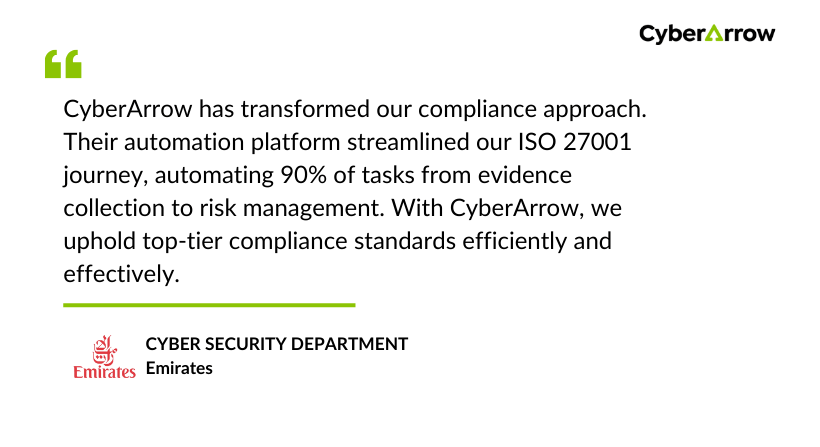
Read how Emirates enhanced Information Security by automating ISO 27001 with CyberArrow GRC.
See what Emirates has to say about CyberArrow GRC:
FAQs
What are the most important US cyber security laws for businesses?
Major US cyber security laws include CISA, FISMA, HIPAA, CCPA, and GLBA. These laws regulate data security and privacy for businesses handling sensitive information.
How can businesses comply with US cyber security laws?
Organizations must implement strong cyber security measures, conduct risk assessments, and follow compliance regulations. Automating compliance with CyberArrow GRC makes the process easier.
What are the penalties for non-compliance with US cyber security laws?
Penalties vary by law but can include fines, legal action, loss of business licenses, and reputational damage. For example, HIPAA violations can cost up to $1.5 million per year.
