Healthcare cyber security compliance in 2026: Key trends and risks
The healthcare industry remains one of the biggest targets for cybercriminals. In 2024 alone, global healthcare data breaches exposed over 185 million patient records. Moreover, ransomware attacks on hospitals surged by 7%, with 67% of institutions impacted in the past year, up from 60% in 2023.

With increasing threats and evolving regulations, healthcare cyber security compliance is no longer just about checking boxes—it’s about survival. Organizations that fail to adapt risk financial penalties, patient safety, and trust.
So, what’s shaping healthcare cyber security compliance in 2026? Let’s explore the key trends and risks that organizations must prepare for.
Key trends in healthcare cyber security compliance
Cyber threats in healthcare are growing, and keeping up with cyber security compliance is more important than ever. New regulations, AI-driven attacks, and the rise of connected medical devices are changing how organizations protect patient data.
In 2026, healthcare providers must strengthen their security measures and stay ahead of emerging risks. Here are the key trends shaping healthcare cyber security compliance this year.
1. AI-powered cyber threats are on the rise
Artificial intelligence (AI) has transformed cyber security, but it’s also making cyberattacks more sophisticated. Hackers now use AI to automate phishing campaigns, identify system vulnerabilities, and bypass traditional security defenses.
Did you know 60% of participants were tricked by AI-generated phishing messages in 2024, making them just as effective as those written by human experts?
Healthcare providers are turning to AI-driven security solutions to combat AI-driven threats, such as real-time anomaly detection and automated threat response.
2. AI-driven data privacy and security
With healthcare systems becoming more interconnected, data privacy risks are increasing. Sensitive patient data is shared across platforms, making strong security measures essential. AI plays a dual role; while it introduces new risks, it also helps organizations detect fraud, enforce access controls, and automate compliance monitoring.
AI-powered tools can analyze spending patterns, flag suspicious activities, and streamline compliance efforts.
To stay compliant, healthcare organizations must invest in AI-driven security, encryption, and automated compliance solutions like CyberArrow to safeguard patient data and meet evolving regulatory standards.
3. Stricter regulations and compliance enforcement
Governments and regulators worldwide are tightening healthcare cyber security requirements. In 2026, we are seeing:
- New HIPAA amendments focusing on stricter data security and updated HIPAA Privacy Rule.
- The EU’s NIS2 directive, which expands cyber security compliance obligations for healthcare providers.
4. Zero trust security is becoming the new standard
With 74% of healthcare breaches caused by compromised credentials, the traditional perimeter-based security model is failing. In response, more organizations are adopting Zero Trust Architecture (ZTA), which follows a “never trust, always verify” approach.
Key components of Zero Trust in healthcare:
- Multi-factor authentication (MFA) for all employees.
- Continuous monitoring of network activity.
- Least privilege access for sensitive medical data.
Healthcare providers must integrate Zero Trust strategies to comply with modern security regulations and prevent unauthorized access.
5. Medical device security is under scrutiny
Connected medical devices (IoT) are critical to patient care, but they’re also major security risks. Studies show that 53% of IoT devices in hospitals have known vulnerabilities, making them easy targets for hackers.
To stay compliant, healthcare organizations must ensure continuous monitoring, regular patching, and segmentation of medical devices.
Biggest risks facing healthcare cyber security in 2026
Here is a list of risks the healthcare industry will face in 2026:
1. Ransomware attacks disrupting patient care
Ransomware remains the biggest cyber security threat to healthcare. Attackers don’t just steal data; they shut down hospital systems, delay surgeries, and demand millions in ransom.
How to mitigate this risk?
- Frequent data backups and offline storage.
- HIPAA Employee training to prevent phishing-based infections.
- Network segmentation to isolate critical systems.
2. Third-party vendor risks
Healthcare organizations rely on multiple third-party vendors, from cloud storage providers to electronic health record (EHR) systems. However, third-party breaches are responsible for 55% of healthcare data leaks.
To ensure compliance, organizations must enforce strict third-party security policies, such as:
- Regular security assessments of vendors.
- Contracts that include cyber security liability clauses.
- Continuous monitoring of third-party access to sensitive data.
3. Insider threats and employee negligence
Human error remains a leading cause of healthcare data breaches. Employees click on phishing links, use weak passwords, or accidentally expose patient records.
How to reduce insider risk?
- Regular cyber security awareness training.
- Strong password policies and MFA enforcement.
- Role-based access control to limit data exposure.
4. Failure to comply with evolving regulations
As regulations get stricter, failing to comply can result in heavy fines and reputational damage. Healthcare providers must stay updated on HIPAA, GDPR, NIS2, and other global cyber security frameworks.
How to stay compliant?
- Conduct regular cyber security audits.
- Implement automated compliance monitoring tools.
- Appoint a Chief Information Security Officer (CISO) to oversee compliance efforts.
Strengthen healthcare cyber security compliance with CyberArrow
Healthcare cyber security compliance in 2026 is more than just meeting regulations—it’s about actively preventing cyber threats that put patient safety at risk.
Key takeaways:
- AI-driven threats are making cyberattacks more sophisticated.
- Zero Trust and stricter regulations are shaping compliance efforts.
- Ransomware, third-party risks, and insider threats are major challenges.
Staying ahead requires modern security strategies, continuous compliance monitoring, and proactive risk management.
CyberArrow simplifies healthcare cyber security compliance by automating security controls, monitoring risks, and ensuring adherence to regulations like HIPAA and GDPR. It helps healthcare organizations stay secure and compliant without the manual burden.
Why choose CyberArrow?
- Automated compliance management: Streamlines compliance with frameworks like HIPAA, GDPR, and NIS2.
- Real-time risk monitoring: Continuously tracks compliance risks and gaps.
- Automated evidence collection: Reduces manual work by gathering compliance evidence automatically.
- Security awareness training: Educates employees on cyber security best practices to reduce human error.
- Comprehensive audit reporting: Generates detailed compliance reports for audits and regulatory checks.
- Customizable security policies: Helps organizations implement and enforce security policies tailored to their needs.
- Dedicated compliance support: Provides expert guidance to navigate evolving cyber security regulations.
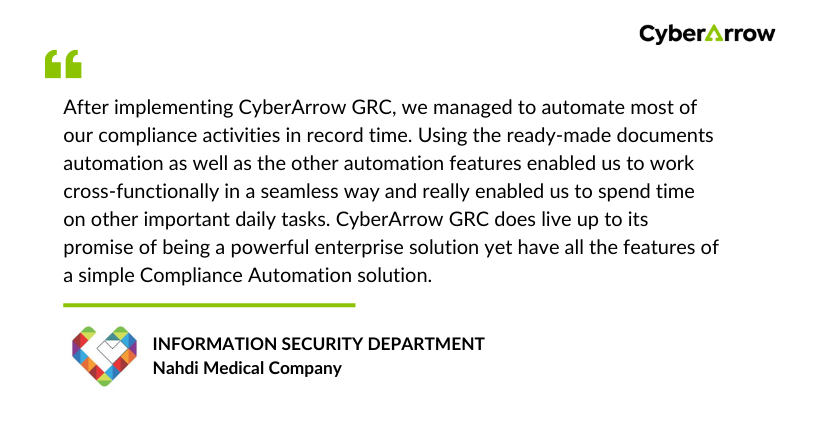
See what healthcare companies like Nahdi Medical say about CyberArrow: