

Cyber security policy compliance: A practical guide to building and automating policies
Every organization has cyber security policies. But do they actually enforce them? That’s the real question.
Many companies create security policies, update them occasionally, and assume they’re compliant. But policies on paper don’t mean much unless they’re properly implemented, monitored, and audited.
Having a cyber security policy isn’t enough; what matters is whether it’s actually followed. Cyber security policy compliance ensures that security rules aren’t written down but are actively enforced, monitored, and validated through audits. It helps turn policies into actionable, measurable security practices that withstand scrutiny.
And the challenge? Managing cyber security policy compliance manually is inefficient, error-prone, and nearly impossible at scale. That’s why automation is becoming the key to effective policy enforcement.
In this article, we’ll explore how to build a strong cyber security policy, the challenges of compliance, and why automation is the only sustainable solution.
What is cyber security policy compliance?
Cyber security policy compliance ensures that an organization follows and enforces security policies that align with regulatory, industry, and internal requirements.
It’s a structured approach to:
- Defining security policies that cover access control, data protection, incident response, and more.
- Enforcing policies through technical controls, employee training, and audits.
- Ensuring alignment with compliance frameworks like ISO 27001, SOC 2, GDPR, HIPAA, and PCI DSS.
- Demonstrating compliance during security audits through documentation and evidence.
Without policy compliance, even the best-written cyber security policies are just words on paper.
Steps to build a cyber security policy that ensures compliance
A well-structured cyber security policy is the foundation of compliance. Here’s how to build one:
1. Identify compliance requirements and security objectives
Before drafting policies, determine what compliance standards apply to your organization. Are you handling credit card data? Then PCI DSS matters. Are you operating in Europe? GDPR applies.
At the same time, define your internal security objectives. Compliance is the minimum standard, but strong cyber security goes beyond that. Identify key security risks and set goals for risk reduction, data protection, and access control.
2. Develop clear and enforceable policies
Policies shouldn’t be vague documents filled with legal jargon. They should be specific, actionable, and easy to follow.
Key areas to cover in cyber security policies:
- Access control: Who gets access to what data and under what conditions?
- Password policies: Minimum requirements, MFA enforcement, and reset protocols.
- Incident response: Steps to take when a security breach occurs.
- Data protection: How data is stored, encrypted, and shared.
- Third-party security: Security standards for vendors and partners.
Policies should also include consequences for non-compliance to ensure accountability.
3. Assign responsibilities and integrate policies into workflows
A cyber security policy is only effective if people understand and follow it. Assign clear responsibilities for implementation:
- IT teams enforce technical controls.
- Compliance teams ensure policies meet legal requirements.
- HR trains employees on security best practices.
Security policies should be integrated into daily workflows so they don’t feel like extra work. For example, if employees need MFA to log into internal tools, it should be an automated requirement, not an optional guideline.
4. Train employees and conduct awareness programs
Human error is one of the biggest compliance risks. Employees often unintentionally violate security policies simply because they don’t know the rules.
Effective training should include:
- Regular security awareness programs on phishing, social engineering, and data protection.
- Role-based security training for employees handling sensitive information.
- Simulated phishing tests to assess and improve employee responses.
When employees understand cyber security policies, compliance becomes a natural part of their work rather than an afterthought.
5. Implement continuous monitoring and audits
Cyber security policies aren’t “set and forget” documents. They need continuous monitoring to ensure compliance.
This includes:
- Automated compliance tracking to identify policy violations in real time.
- Regular security audits to verify compliance with internal and regulatory standards.
- Incident reports and logs to track policy violations and corrective actions.
However, manually tracking and auditing cyber security policy compliance is time-consuming and prone to errors. That’s why automation is crucial.
The role of automation in cyber security policy compliance
Most cyber security policy compliance failures happen because of inconsistencies, human errors, and manual oversight. Automation eliminates these risks by ensuring policies are consistently enforced, monitored, and updated.
How automation transforms cyber security policy compliance?
1. Centralized policy management
Instead of managing policies through multiple disconnected documents and spreadsheets, compliance automation platforms like CyberArrow provide a centralized dashboard to create, enforce, and update policies in one place.
2. Automated compliance tracking and real-time alerts
Manual policy enforcement relies on periodic audits, which means violations might go unnoticed for months. Automated compliance tracking ensures that:
- Policy violations are detected in real-time.
- Security teams receive instant alerts about non-compliance.
- Corrective actions are triggered automatically.
This helps organizations prevent compliance failures rather than react to them.
3. Streamlined evidence collection for audits
One of the biggest compliance challenges is proving that policies are enforced. Manually collecting audit evidence is a tedious process. Automation tools like CyberArrow simplify this by:
- Collecting security logs and compliance data automatically.
- Generating real-time compliance reports.
- Providing an audit trail for every policy enforcement action.
This makes passing cyber security compliance audits faster, easier, and more reliable.
4. Continuous updates and adaptation to new regulations
Regulatory compliance is constantly evolving. Automation platforms track regulatory updates and adapt policies accordingly instead of manually updating policies every time a regulation changes.
For example, CyberArrow automatically aligns cyber security policies with frameworks like ISO 27001, SOC 2, and GDPR, ensuring businesses stay compliant without manual effort.
Simplify cyber security policy compliance with CyberArrow
Cyber security policy compliance isn’t just about having security guidelines; it’s about consistently enforcing, monitoring, and proving compliance. Doing this manually is inefficient, error-prone, and unsustainable. That’s why automation is the key to effective cyber security policy compliance.
With CyberArrow regulatory compliance software, organizations can:
- Centralize policy management for easier updates and enforcement.
- Automate compliance tracking to detect violations instantly.
- Streamline audit preparation by automatically collecting evidence.
- Ensure continuous compliance with changing regulations.
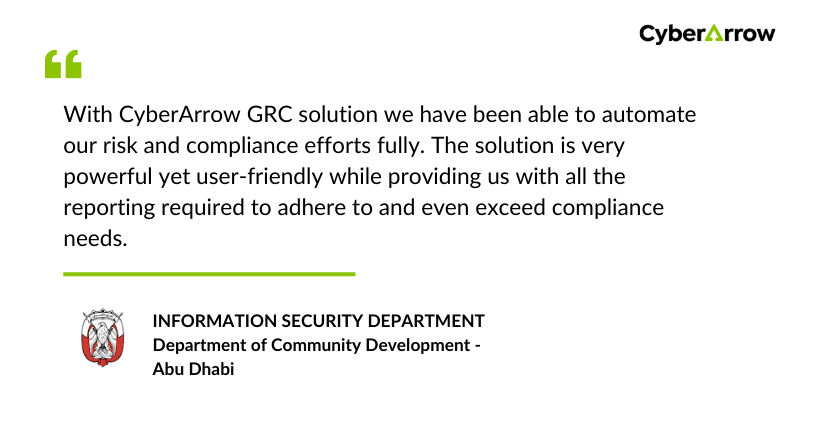
See what government entities like DCD – Abu Dhabi say about CyberArrow GRC:
If you’re looking to simplify cyber security policy compliance and eliminate manual inefficiencies, it’s time to explore CyberArrow.
