Cyber security regulatory compliance: What it is and why it matters
Cyber threats are evolving, and businesses must protect sensitive data and follow legal requirements. Cyber security regulatory compliance ensures that organizations implement the proper security measures to prevent data breaches, cyberattacks, and unauthorized access while meeting industry and government standards.
Failing to comply with cyber security regulations can lead to financial penalties, reputational damage, and legal consequences. Different industries and regions have specific cyber security compliance frameworks, making it essential for businesses to understand which regulations apply to them.
This article covers the fundamentals of cyber security compliance, why it’s essential, and key regulations businesses need to follow.
- What is cyber security regulatory compliance?
- Regulatory compliance vs. cyber security: What’s the difference?
- Why cyber security regulatory compliance matters
- Key cyber security regulations businesses need to follow
- How to achieve cyber security compliance
- Simplify cyber security compliance with CyberArrow
What is cyber security regulatory compliance?
Cyber security regulatory compliance refers to an organization’s ability to meet specific legal, industry, or contractual requirements related to data protection and security. These regulations ensure businesses implement adequate security controls to prevent cyberattacks, data breaches, and unauthorized access to sensitive information.
Failure to comply with cyber security regulations can lead to severe consequences, including hefty fines, legal action, reputational damage, and loss of business opportunities.
Regulatory compliance vs. cyber security: What’s the difference?
While cyber security protects data and systems from cyber threats, regulatory compliance ensures that organizations follow specific security regulations. In other words:
- Cyber security: Measures to protect data and systems (e.g., firewalls, encryption, threat detection).
- Compliance: Following laws and standards to prove security measures are in place (e.g., SOC 2, GDPR, PCI DSS).
A company can have cyber security measures in place but still be non-compliant if it doesn’t meet regulatory requirements. Likewise, it can be compliant but still vulnerable to cyber threats if its security measures are weak.
Why cyber security regulatory compliance matters
Cyber security regulatory compliance isn’t just about checking a box but protecting businesses, customers, and stakeholders from cyber risks. Here’s why it matters:
1. Protects sensitive data
Compliance regulations often require businesses to encrypt data, implement access controls, and monitor systems for suspicious activity. This helps prevent data breaches that could expose sensitive information such as financial records, personal details, and trade secrets.
Example: A healthcare provider handling patient records must comply with HIPAA (Health Insurance Portability and Accountability Act) to ensure patient confidentiality and prevent data leaks.
2. Avoids legal and financial penalties
Non-compliance can result in severe fines and legal consequences. Regulatory bodies impose penalties to ensure businesses take security seriously.
Example: Under GDPR (General Data Protection Regulation), companies that fail to protect user data can be fined up to €20 million or 4% of their global annual revenue, whichever is higher.
3. Builds trust with customers and partners
Customers are more likely to do business with companies that take security and compliance seriously. Cyber security regulatory compliance demonstrates that an organization follows best practices for data protection, making it a competitive advantage.
Example: E-commerce websites that comply with PCI DSS (Payment Card Industry Data Security Standard) assure customers that their payment information is secure, increasing trust and sales.
4. Strengthens cyber security posture
Regulatory compliance encourages businesses to implement robust security measures that reduce the risk of cyber threats such as ransomware, phishing, and insider attacks.
Example: A financial institution complying with ISO 27001 (an international standard for information security) must establish strict access controls, perform regular security audits, and continuously monitor threats. These practices enhance overall security.
5. Ensures business continuity
Cyberattacks and non-compliance penalties can disrupt business operations. Following cyber security regulations helps organizations maintain operations, even in cyber incidents.
Example: A cloud service provider complying with SOC 2 ensures that security controls are in place to protect client data, reducing the risk of downtime or service disruptions.
Key cyber security regulations businesses need to follow
Different industries and regions have specific cyber security compliance requirements. Here are some of the most important ones:
1. GDPR (General Data Protection Regulation)
- Applies to businesses handling the personal data of EU citizens.
- Organizations must obtain user consent for data collection, provide data breach notifications, and allow users to request data deletion.
- Non-compliance penalties can reach up to €20 million or 4% of annual revenue.
2. HIPAA (Health Insurance Portability and Accountability Act)
- Protects sensitive patient data in the healthcare industry (U.S.).
- Requires healthcare providers and their partners to implement strict security measures to prevent unauthorized access.
3. PCI DSS (Payment Card Industry Data Security Standard)
- Applies to any business that processes, stores, or transmits payment card information.
- Requires encryption, network monitoring, and access controls to secure cardholder data.
4. ISO 27001
- An international standard for information security management systems (ISMS).
- Helps businesses implement a structured approach to security, covering risk assessments, access controls, and security monitoring.
5. SOC 2 (Service Organization Control 2)
- Relevant for technology and cloud service providers.
- Focuses on security, availability, processing integrity, confidentiality, and customer data privacy.
How to achieve cyber security compliance
Cyber security regulatory compliance requires a strategic approach. Here’s how businesses can ensure they meet regulatory requirements:
1. Identify relevant compliance requirements
Not all regulations apply to every business. Companies should determine which cyber security laws and industry standards they must follow based on their industry, location, and customer base.
2. Conduct a risk assessment
Organizations should evaluate their security risks, identify vulnerabilities, and determine what controls must be implemented to meet compliance standards.
3. Implement security controls
This includes types of cyber security measures such as:
- Data encryption to protect sensitive information.
- Access controls to restrict unauthorized access.
- Multi-factor authentication (MFA) for stronger login security.
- Regular security audits to detect vulnerabilities.
- Incident response plans to handle data breaches effectively.
4. Train employees on cyber security policies
Human error is a leading cause of data breaches. Regular security awareness training ensures employees understand compliance policies and recognize threats like phishing scams.
5. Monitor and document compliance efforts
Organizations should continuously track compliance status, document security measures, and conduct periodic audits to demonstrate adherence to regulations.
6. Automate compliance management
Compliance automation tools like CyberArrow GRC can help businesses streamline compliance by automating risk assessments, security audits, policy enforcement, and evidence collection. This reduces manual work and ensures continuous compliance.
Simplify cyber security compliance with CyberArrow
Cyber security regulatory compliance is essential for businesses looking to protect data, avoid legal trouble, and build customer trust. While compliance may seem complex, following best practices, such as conducting risk assessments, implementing strong security controls, and leveraging automation, can make the process more manageable.
CyberArrow is a compliance automation platform that helps businesses streamline security processes, reduce manual work, and comply with regulations like ISO 27001, SOC 2, GDPR, PCI DSS, and more.
Why choose CyberArrow?
- Automate compliance workflows: Reduce manual effort with automated evidence collection, risk assessments, and policy enforcement.
- Simplify security audits: Generate reports and track compliance progress in real time.
- Monitor compliance status: Get insights into your security posture with a user-friendly dashboard.
- Enhance risk management: Identify, assess, and mitigate compliance risks with built-in risk assessment tools.
- Centralize security documentation: Keep all compliance policies, security controls, and audit logs in one place.
- Receive expert support: Access dedicated compliance specialists to guide you through regulatory requirements.
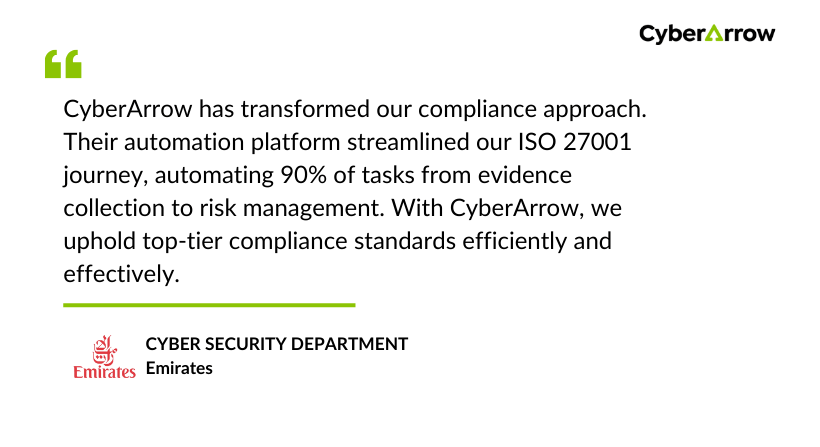
See what companies like Emirates say about CyberArrow: