

What is GDPR compliant? How to simplify GDPR compliance with CyberArrow GRC
Data protection has become a critical issue for businesses worldwide. The General Data Protection Regulation (GDPR) is a legal framework that ensures organizations protect the personal data of individuals in the European Union (EU). Any company that collects, processes, or stores the personal data of EU citizens must comply with GDPR regulations.
Being GDPR compliant means following strict rules to protect user data, ensure transparency, and prevent data breaches. Organizations that fail to comply with GDPR can face heavy fines and reputational damage.
This blog will explain what it means to be GDPR compliant, the steps to achieve compliance, and how CyberArrow GRC can help businesses automate and simplify the process.
What does GDPR compliant mean?
A business or organization is GDPR compliant when it follows all rules and guidelines set by the GDPR to protect personal data. This means the organization:
- Collects data lawfully and informs individuals about how their data is used.
- Ensures security measures are in place to prevent data leaks and cyber threats.
- Respects user rights, including access to their data and the ability to request deletion.
- Reports data breaches within 72 hours to the authorities and affected individuals.
- Keeps proper records of data processing activities.
Failure to comply with GDPR can result in fines of up to €20 million or 4% of annual global revenue, whichever is higher.
Key requirements to be GDPR compliant
To be GDPR compliant, businesses must follow these essential rules:
1. Lawful data processing
Organizations must have a legal reason for collecting and processing personal data. This could be:
- User consent (users agree to data collection).
- Contractual necessity (needed for service delivery).
- Legal obligation (required by law).
- Legitimate interest (business needs, without harming user rights).
2. Data minimization
Businesses should only collect the necessary data needed for a specific purpose. Excessive data collection increases security risks and compliance issues.
3. User rights and transparency
Companies must inform users about how their data is collected, stored, and used. Users also have the right to:
- Access their data
- Request corrections
- Request deletion (Right to be Forgotten)
- Object to data processing
- Transfer data to another provider
4. Data protection measures
Organizations must use strong security measures such as:
- Encryption to protect sensitive information.
- Access controls to limit who can view and modify data.
- Regular security audits to detect vulnerabilities.
5. Data breach notifications
If a data breach occurs, businesses must report it within 72 hours to the relevant data protection authority and notify affected users.
6. Maintaining compliance documentation
Companies must keep detailed records of their data processing activities, security policies, and compliance efforts. This helps prove GDPR compliance during audits.
Quick link: CCPA vs GDPR
Challenges in achieving GDPR compliance
Many organizations struggle with GDPR compliance because of the complexity of the regulation. Some of the common challenges include:
- Time-consuming processes: GDPR requires continuous monitoring and record-keeping, which can be overwhelming.
- High costs: Compliance involves hiring legal experts, security teams, and consultants.
- Human errors: Employees may accidentally mishandle data, leading to non-compliance.
- Data management complexity: Businesses often store data across multiple platforms, making compliance harder.
- Frequent regulatory changes: GDPR rules are updated regularly, requiring businesses to keep up with new requirements.
How to simplify GDPR compliance with CyberArrow GRC
Managing GDPR compliance manually can be difficult, especially for businesses handling large amounts of personal data. This is where CyberArrow GRC helps.
CyberArrow GRC is a compliance automation platform that helps businesses monitor, manage, and maintain GDPR compliance effortlessly. It reduces manual work and ensures companies follow GDPR rules efficiently and accurately.
Key features of CyberArrow GRC for GDPR compliance
1. Automated compliance monitoring
CyberArrow GRC provides real-time tracking of compliance status, helping businesses identify gaps and risks before they become serious issues.
2. Risk assessment and management
The platform automatically detects risks related to data security and provides actionable insights to reduce vulnerabilities.
3. Data Protection Impact Assessments (DPIAs)
CyberArrow GRC automates DPIAs, making it easier for organizations to analyze risks associated with data processing activities.
4. Incident management and breach reporting
In case of a security breach, the platform automatically logs and reports incidents to ensure organizations comply with GDPR’s 72-hour reporting rule.
5. Easy documentation and audit trails
CyberArrow GRC generates detailed compliance reports and maintains audit-ready documentation, reducing the time and effort needed to prepare for GDPR audits.
6. Employee training and awareness
CyberArrow GRC provides training modules to educate employees on data protection policies and GDPR best practices.
7. Automated policy management
Businesses can easily update, distribute, and enforce GDPR policies with CyberArrow GRC’s policy management feature.
Quick link: Who does the GDPR apply to?
Steps to automate GDPR compliance with CyberArrow GRC
Using CyberArrow GRC, businesses can streamline GDPR compliance in a few simple steps:
Step 1: Identify GDPR compliance gaps
- Conduct an initial assessment to determine where the company is non-compliant.
- Use CyberArrow GRC’s risk analysis tool to identify weaknesses.
Step 2: Implement security controls
- Apply encryption, firewalls, and access controls to secure personal data.
- CyberArrow GRC provides guidelines and automation tools for easy security implementation.
Step 3: Automate risk and compliance management
- Use CyberArrow GRC to monitor compliance continuously.
- The platform will send alerts if any GDPR violations are detected.
Step 4: Automate documentation and reporting
- CyberArrow GRC automatically generates reports and maintains records, making audits simple.
- Businesses can export audit-ready compliance reports in just a few clicks.
Step 5: Train employees on GDPR policies
- CyberArrow GRC offers GDPR training programs to keep employees informed and prevent accidental non-compliance.
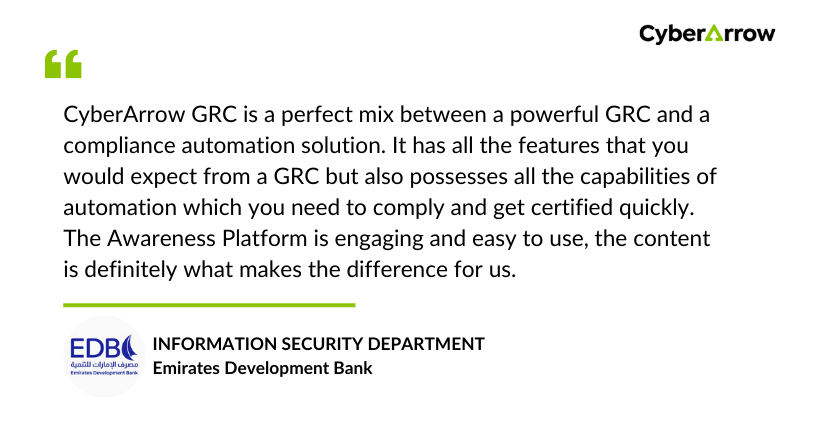
See what the Emirates Development Bank has to say about CyberArrow GRC:
Conclusion
Being GDPR compliant is essential for protecting personal data and avoiding legal penalties. However, compliance can be complex and time-consuming. Organizations must follow strict guidelines, secure their data, and continuously monitor risks.
CyberArrow GRC simplifies GDPR compliance by automating monitoring, risk management, documentation, and reporting. This helps businesses stay compliant without unnecessary effort.
If your company wants an efficient and stress-free way to manage GDPR compliance, CyberArrow GRC is the perfect solution. Start automating your GDPR compliance today and focus on growing your business with confidence.
