


CCPA vs GDPR: A brief comparison
In a world where data is one of the most valuable assets, governments, and regulatory bodies have established laws to protect people’s privacy. Two of the most well-known regulations are the California Consumer Privacy Act (CCPA) and the General Data Protection Regulation (GDPR). While both laws aim to protect individuals’ data, they differ in scope, implementation, and enforcement.
In this blog, we’ll break down the key differences and similarities between CCPA and GDPR, helping you understand how they apply to your business. If you’re wondering how to handle compliance for either or both regulations, we’ll also introduce you to CyberArrow GRC, a powerful tool that simplifies compliance management.
What is CCPA?
The California Consumer Privacy Act (CCPA) is a data privacy law enacted in California in 2018. It was designed to give residents of California more control over their personal information.
Key features of CCPA:
Who it applies to:
Businesses that meet one or more of these criteria:
- Annual revenue exceeds $25 million.
- Processes data of 100,000 or more California residents.
- Earns 50% or more of its annual revenue from selling personal information.
Rights granted to consumers:
- The right to know what personal data is collected and why.
- The right to access personal data.
- The right to delete personal data.
- The right to opt out of the sale of personal data.
Enforcement: The California Attorney General enforces CCPA, and businesses that fail to comply face hefty fines.
What is GDPR?
The General Data Protection Regulation (GDPR) is a European Union law enacted in 2016 and enforced starting in May 2018. It is widely considered the most comprehensive data privacy law in the world.
Key features of GDPR:
Who it applies to:
Any organization that processes personal data of EU residents, regardless of where the company is located.
Rights granted to individuals:
- The right to access data.
- The right to rectify inaccurate data.
- The right to erasure (commonly called the “right to be forgotten”).
- The right to data portability.
- The right to object to data processing.
- The right to restrict data processing.
Enforcement: GDPR is enforced by data protection authorities in each EU member state. Fines for violations can be up to €20 million or 4% of the company’s global annual revenue, whichever is higher.
Key differences between CCPA and GDPR
Although both laws aim to protect personal data, their approaches and requirements differ significantly.
Here’s a closer look:
1. Geographic scope
- CCPA: Applies to businesses operating in California or serving California residents.
- GDPR: Has a global reach, applying to any company processing the data of EU residents.
2. Definition of personal data
- CCPA: Defines personal data broadly but focuses on identifiable information, such as names, email addresses, and IP addresses.
- GDPR: Takes a more comprehensive approach, including information like genetic, biometric, and health data.
3. Consent
- CCPA: Does not require businesses to obtain consumer consent for data collection but mandates that consumers have the option to opt out of data sales.
- GDPR: Requires businesses to obtain explicit, informed consent before processing personal data.
4. Consumer rights
- CCPA: Focuses on rights like data access, deletion, and opting out of data sales.
- GDPR: Offers broader rights, including the right to be forgotten and data portability.
5. Penalties for non-compliance
- CCPA: Fines range from $2,500 per violation to $7,500 for intentional violations.
- GDPR: Penalties are much steeper, with fines up to €20 million or 4% of global annual revenue.
Similarities between CCPA and GDPR
Despite their differences, CCPA and GDPR share some common goals and features:
- Transparency: Both laws require businesses to disclose how they collect, use, and share personal data.
- Data protection: Emphasize the importance of safeguarding personal information against breaches.
- Consumer empowerment: Both laws empower individuals to exercise control over their data.
Challenges businesses face with CCPA and GDPR
Adhering to data privacy laws can be overwhelming, especially for companies handling large volumes of personal data.
Here are some common challenges:
- Understanding the regulations: Both laws are complex, making it difficult to interpret and apply them.
- Managing data: Tracking and categorizing personal data across different systems can be daunting.
- Ensuring compliance: Staying compliant requires continuous monitoring, which can be resource-intensive.
- Avoiding penalties: Failing to comply can lead to significant financial and reputational damage.
How CyberArrow GRC simplifies CCPA and GDPR compliance
Managing compliance doesn’t have to be a headache. With CyberArrow GRC, businesses can automate and streamline their compliance processes for both CCPA and GDPR.
Key benefits of CyberArrow GRC:
- Centralized data management: Keep all compliance-related information in one platform.
- Automated workflows: Save time by automating tasks like risk assessments, reporting, and monitoring.
- Real-time updates: Stay informed about regulatory changes and ensure continuous compliance.
- Customizable templates: Generate policies, reports, and documents tailored to CCPA and GDPR requirements.
- Integration capabilities: Easily connect with your existing systems to streamline data collection and analysis.
Businesses of all sizes trust CyberArrow to handle their compliance needs. Whether you’re a small company focusing on CCPA or a global enterprise dealing with GDPR, CyberArrow GRC adapts to your requirements.
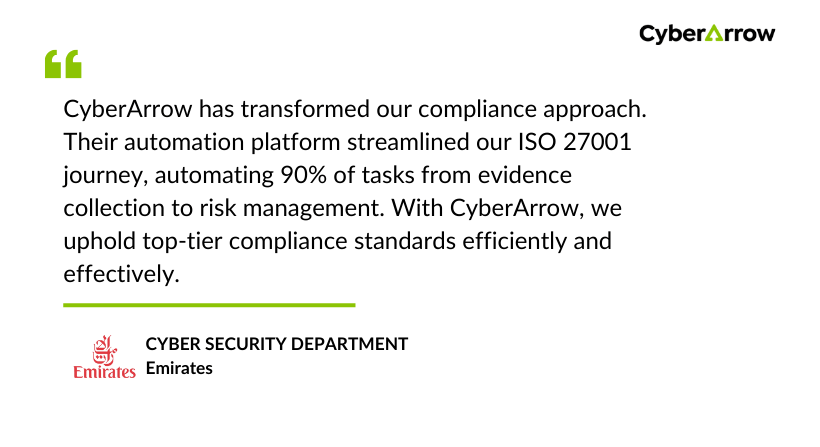
Read how Emirates enhanced information Security with CyberArrow GRC.
See what Emirates has to say about CyberArrow GRC:
FAQs
Do CCPA and GDPR apply to the same businesses?
No, CCPA applies to businesses operating in California or serving California residents, while GDPR applies to any organization, regardless of location, that processes the personal data of EU residents. Some businesses may fall under both laws if they operate in both regions or handle data from California and the EU.
Can a business use the same compliance process for both CCPA and GDPR?
While there are similarities between CCPA and GDPR, businesses typically need to tailor their compliance processes to meet the specific requirements of each regulation. For instance, GDPR requires explicit consent for data processing, while CCPA focuses more on consumer rights like opting out of data sales. Using tools like CyberArrow GRC can help streamline compliance for both laws by automating workflows and centralizing data management.
What happens if a business violates CCPA or GDPR?
The penalties for non-compliance differ between the two laws:
- CCPA: Fines range from $2,500 per unintentional violation to $7,500 for intentional violations.
- GDPR: Penalties can be up to €20 million or 4% of the company’s global annual revenue, whichever is higher.
Both regulations also pose reputational risks for businesses that fail to comply, making adherence essential for long-term success.
