What is CCPA compliance? requirements & practices
The California Consumer Privacy Act (CCPA) is one of the strictest data privacy laws in the United States. It was passed to protect California residents’ privacy rights and ensure that companies handle personal data responsibly.
If your business collects or processes California residents’ data, you must comply with CCPA to avoid penalties and build trust with your customers.
In this blog, we will explore CCPA compliance, its main requirements, and best practices. We’ll also discuss how automating CCPA compliance with a tool like CyberArrow GRC can simplify the process for your business.
What is CCPA compliance?
CCPA compliance refers to a company’s adherence to the rules and regulations set forth by the California Consumer Privacy Act. These rules are designed to protect personal information, giving California residents the right to know how their data is being used, who is collecting it, and who it is being shared with.
Under CCPA, consumers have several important rights, including:
- The right to know what personal information is collected about them.
- The right to delete their personal information.
- The right to opt out of the sale of their personal information.
- The right to non-discrimination when exercising their privacy rights.
Companies that fall under the scope of CCPA must make sure they follow these regulations or face heavy fines and penalties.
Who needs to comply with CCPA?
CCPA compliance applies to any business that collects or processes the personal information of California residents and meets one or more of the following criteria:
- The business has an annual gross revenue of over $25 million.
- The business buys, receives, sells, or shares the personal information of 50,000 or more California residents, households, or devices.
- The business earns 50% or more of its annual revenue from selling California residents’ personal information.
Even if your business is not located in California, if it meets these criteria, it must comply with CCPA. Failure to comply can lead to fines of up to $7,500 per violation.
Key requirements of CCPA compliance
To comply with CCPA, businesses must follow a set of rules and guidelines regarding the collection, processing, and sale of personal information. Let’s break down some of the key requirements for CCPA compliance:
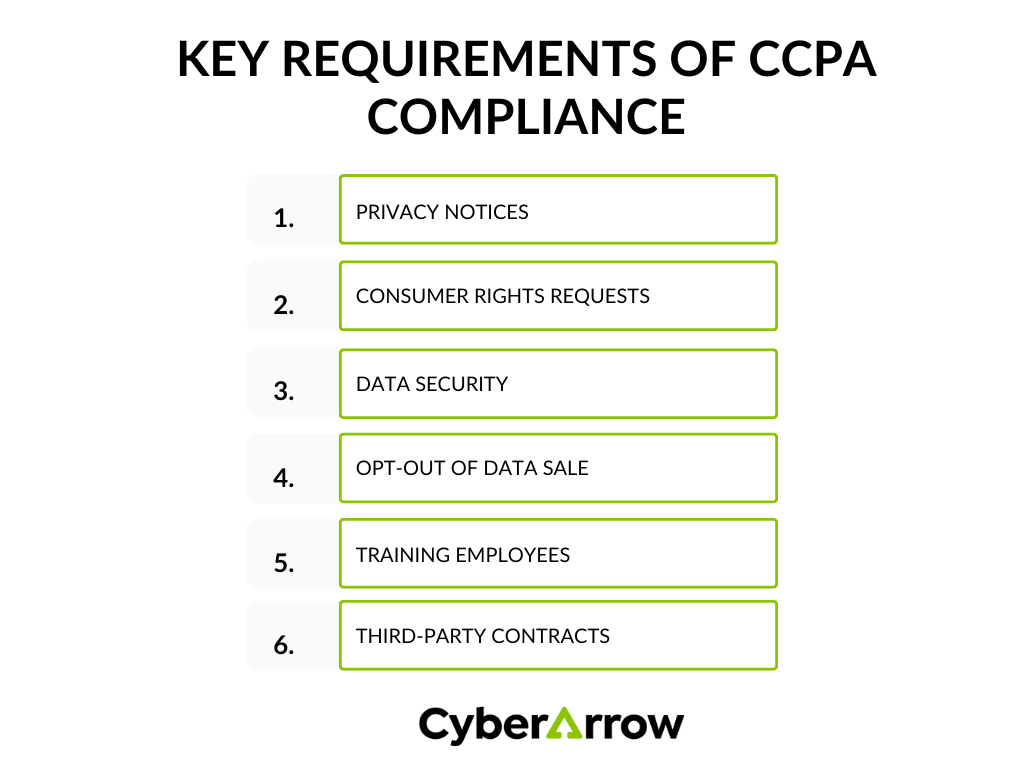
Privacy notices
Companies must provide consumers with clear privacy notices that explain what personal information is being collected, how it’s used, and who it’s shared with. This must be done at or before the point of data collection.
Consumer rights requests
Under CCPA, businesses are required to respond to consumer requests regarding their data. This includes providing access to personal data, allowing for data deletion, and enabling opt-out requests for the sale of data. These requests must be fulfilled within 45 days.
Data security
Companies must ensure that they have reasonable security measures in place to protect the personal information of California residents. This includes implementing encryption, access controls, and other security protocols.
Opt-out of data sale
Consumers have the right to opt out of the sale of their personal information. Companies must provide a “Do Not Sell My Personal Information” link on their website to allow consumers to exercise this right.
Training employees
Employees who handle personal information or deal with consumer privacy requests must be trained in CCPA compliance. This ensures that requests are handled correctly, and personal information is protected.
Quick link: A complete guide to CCPA compliance requirements
Third-party contracts
If your business shares personal information with third parties, it is your responsibility to ensure that those third parties also comply with CCPA. This is usually done by including CCPA compliance clauses in contracts.
Best practices for CCPA compliance
Achieving CCPA compliance may seem complex, but following best practices can help make the process more manageable. Below are some key practices your business should follow to ensure compliance:
1. Perform a data inventory
To comply with CCPA, it’s important to understand what personal information your business collects and how it’s being used. Conduct a thorough data inventory to identify all the personal information you collect, store, and share with third parties. This will help you respond to consumer requests and provide accurate privacy notices.
2. Update your privacy policy
Your business’s privacy policy should clearly explain the types of personal information you collect, how it’s used, and consumers’ rights under CCPA. Make sure your privacy policy is updated regularly and easily accessible on your website.
3. Set up a process for consumer rights requests
Create a streamlined process for handling consumer requests, such as data access, deletion, and opt-out requests. Assign dedicated staff to manage these requests and ensure they are processed within the required 45-day period.
4. Implement robust security measures
Ensure that your business has strong security measures in place to protect personal information. This can include encryption, multi-factor authentication, and regular security audits. Having robust security measures in place not only helps with CCPA compliance but also reduces the risk of data breaches.
5. Train employees on CCPA compliance
Provide regular training to employees who handle personal information or deal with consumer privacy requests. This will ensure that they understand their responsibilities under CCPA and know how to handle consumer requests appropriately.
6. Work with a CCPA compliance tool
Managing CCPA compliance manually can be overwhelming, especially for businesses that handle large amounts of data. Consider using a CCPA compliance tool like CyberArrow GRC to automate key compliance tasks and ensure you’re always meeting CCPA requirements.
Penalties for non-compliance
Failure to comply with CCPA can result in costly penalties for businesses. The California Attorney General has the authority to enforce CCPA and impose fines for non-compliance. Penalties can range from $2,500 per violation for unintentional violations to $7,500 per violation for intentional violations.
In addition to these fines, businesses can face lawsuits from consumers whose privacy rights have been violated. This can lead to further financial losses, damage to reputation, and loss of consumer trust.
Automate CCPA compliance with CyberArrow GRC
Ensuring CCPA compliance is essential for businesses that handle the personal information of California residents. While the requirements may seem complex, automation can help simplify the process and ensure your business stays compliant.
Why choose CyberArrow GRC for CCPA compliance?
With CyberArrow GRC, you can automate up to 90% of your compliance efforts, ensuring you meet CCPA requirements without the need for manual processes.
- Automated consumer rights requests: Easily manage consumer requests for data access, deletion, and opt-out of data sales with CyberArrow’s automated tools.
- Real-time monitoring: Stay compliant with CCPA in real time by tracking your compliance status through intuitive dashboards.
- Data inventory automation: Automatically track and document all personal information your business collects, stores, and shares with third parties.
- Third-party compliance: Ensure that all third-party vendors comply with CCPA by integrating CyberArrow’s third-party risk management features.
- Compliance reporting: Generate audit-ready reports and stay prepared for any legal or regulatory audits with CyberArrow GRC.
A retail company handling data of thousands of California residents used CyberArrow GRC to automate their CCPA compliance efforts. With CyberArrow, they were able to reduce the time spent on compliance by 75%, quickly respond to consumer requests, and stay audit-ready at all times.
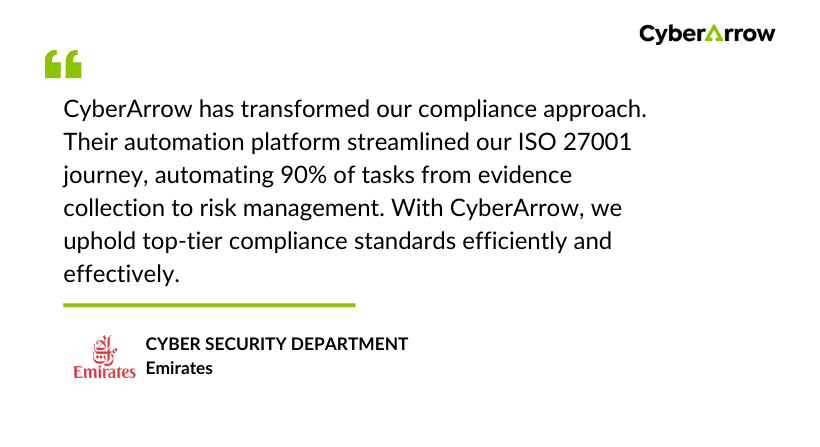
See what Emirates have to say about CyberArrow GRC: