PCI DSS vs. GDPR compliance: Navigating the intersection of data protection
The importance of data protection and compliance can’t be ignored in today’s digital landscape. With the average cost of data breaches reaching $5 million in 2023, organizations must ensure they have robust measures to protect sensitive information and meet regulatory standards.
When it comes to data protection, two prominent regulatory standards come into play: PCI DSS and GDPR. These two standards aim to enhance data protection. PCI DSS vs. GDPR is a hot topic, and we can see that both overlap in some requirements.
In this article, we will explore how these two standards intersect for effectively navigating the complex landscape of data protection.
PCI DSS vs. GDPR: Key differences
Let’s understand the key differences between these two regulatory standards.
The scope of data
The scope of coverage differs significantly between the General Data Protection Regulation (GDPR) and the Payment Card Industry Data Security Standard (PCI DSS). GDPR encompasses a broader range of personal data, making it more extensive than the narrower focus of PCI compliance. GDPR applies to any personal identifying information collected from individuals in the European Union (EU), covering various types of data, from opt-in marketing details to specific order information and user behaviors.
In contrast, PCI DSS has a narrower scope, primarily focusing on specific data related to payment card transactions. If your organization accepts credit cards, you must adhere to PCI compliance. However, if you also accept credit cards from EU users, GDPR compliance becomes an additional requirement.
Impact on security and privacy
While GDPR emphasizes personal data privacy and protection, security is not its primary objective. GDPR empowers individuals to control their data, granting them the right to take back consent, request data erasure, or exercise control over its usage.
On the other hand, PCI DSS primarily centers around security and safeguarding cardholder data. It addresses concerns such as breaches and data loss. However, individuals have limited control over their personal information under PCI. The focus lies on securing cardholder data, maintaining server security, controlling access, and conducting risk assessments and mitigation rather than prioritizing personal information protection.
PCI aims to restrict access to cardholder data and transaction information using various measures, while GDPR focuses on safeguarding user privacy and preventing unauthorized use of sensitive information.
Scope of covered processes
GDPR encompasses the entire data processing lifecycle, requiring compliance at every stage, including data collection, storage, retrieval, analysis, and more. Any process involving personally identifiable information (PII) falls under GDPR’s scope. Its broad scope necessitates compliance with its regulations for almost any conceivable process that utilizes personal data when EU citizens are involved.
On the other hand, PCI DSS has a more targeted scope. It covers processes directly related to payment transactions. This includes collecting cardholder data, processing transactions, and transmitting data to relevant parties. If the cardholder is an EU citizen, GDPR compliance must also be adhered to for these processes.
Law & standard enforcement
GDPR is a law that applies to organizations handling the personal data of EU individuals, imposing strict requirements and severe penalties for noncompliance.
Conversely, PCI DSS, an industry-standard, focuses on securing payment transactions and protecting cardholders from data misuse. Although The Payment Card Industry Security Standards Council lacks legal authority for fines, noncompliance can still result in costly consequences.
In the event of a data breach, noncompliant merchants may face penalties imposed by payment card brands through their acquiring bank. Penalties range from $5,000 to $500,000 monthly, often passed on to the merchant. Repeat offenses can lead to the revocation of transaction privileges.
Learn more about GDPR with our GDPR compliance hub.
PCI DSS vs. GDPR compliance: Where do they overlap?
Although PCI DSS and GDPR have distinct focuses and requirements, there are areas where these two compliance frameworks intersect. Recognizing and addressing these overlapping aspects is crucial for organizations striving to achieve comprehensive data protection and compliance.

- Data security measures: PCI DSS and GDPR emphasize the importance of implementing robust data security measures. While PCI DSS specifically focuses on protecting payment card data during transactions, GDPR requires organizations to implement appropriate technical and organizational measures to safeguard personal data. By aligning their security practices with the requirements of both frameworks, organizations can protect payment card data and personal information.
- Risk assessments: When discussing PCI DSS vs. GDPR compliance, we need to understand they both advocate for conducting regular risk assessments. PCI DSS requires organizations to assess vulnerabilities and potential risks to cardholder data, while GDPR emphasizes the need for a systematic approach to identify and mitigate risks associated with personal data processing.
- Vendor management: PCI DSS and GDPR emphasize vendor management and due diligence. PCI DSS requires organizations to assess and monitor the security practices of their service providers, while GDPR mandates organizations to only engage data processors that provide sufficient guarantees of compliance. By implementing a comprehensive vendor management program that considers the requirements of both frameworks, organizations can ensure that their third-party partners meet the necessary security and privacy standards.
Ensure PCI DSS and GDPR compliance with CyberArrow
Navigating the complexities of both PCI DSS and GDPR compliance can be challenging, especially when the two frameworks intersect in protecting payment and personal data. While PCI DSS focuses on securing cardholder data, GDPR ensures that personal data is handled responsibly across the board.
Managing compliance with both standards doesn’t have to be overwhelming. CyberArrow GRC offers an automated solution to streamline your compliance efforts and ensure you meet the requirements of both PCI DSS and GDPR with ease.
Why choose CyberArrow GRC for PCI DSS and GDPR compliance?
- Automated compliance: CyberArrow GRC automates compliance tasks for both PCI DSS and GDPR, reducing manual effort and minimizing human error.
- Cross-standard mapping: With cross-mapping features, CyberArrow allows you to align controls that overlap between PCI DSS and GDPR, saving time and avoiding duplicate efforts.
- Real-time monitoring: Track your compliance status for both standards with real-time updates and dashboards.
- Audit-ready documentation: Automatically generate and store the necessary documents for audits, ensuring you’re always prepared.
A FinTech company used CyberArrow GRC to manage PCI DSS and GDPR compliance. With the cross-mapping feature, they were able to streamline processes and reduce compliance management time by 60%, allowing them to focus on growing their business.
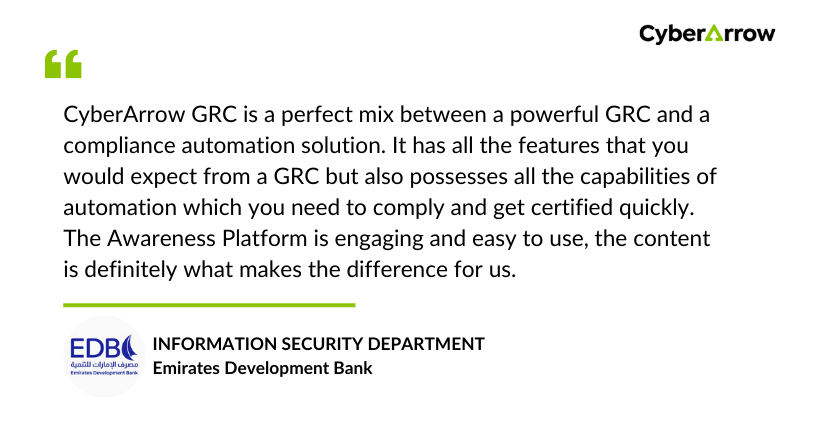
See what Emirates Development Bank have to say about CyberArrow GRC: