


How to comply with Digital Operational Resilience Act (DORA)
The Digital Operational Resilience Act (DORA) is a European Union (EU) regulation that strengthens the cyber security and resilience of financial institutions. It ensures that banks, insurance companies, and other financial entities are prepared for cyber threats and ICT-related disruptions.
DORA was adopted in November 2022, came into force on January 16, 2023, and will apply from January 17, 2025. This means financial institutions must act now to ensure compliance and avoid penalties.
In this guide, we will cover what DORA requires, steps to achieve compliance, and how CyberArrow GRC can simplify DORA compliance.
Why DORA matters for financial institutions
Cyber threats are growing, and financial institutions are prime targets for hackers. A single cyberattack can cause financial losses, reputational damage, and regulatory fines.
DORA is designed to protect financial stability by ensuring firms can withstand, respond to, and recover from ICT-related incidents.
Who needs to comply with DORA?
DORA applies to:
✔️ Banks and credit institutions
✔️ Insurance and reinsurance companies
✔️ Investment firms
✔️ Payment service providers
✔️ Crypto asset service providers
✔️ ICT third-party service providers (e.g., cloud computing firms)
If your business falls under any of these categories, you must comply with DORA.
How to comply with Digital Operational Resilience Act (DORA)
To comply with DORA, financial institutions must follow five key pillars:
1. ICT risk management
Financial institutions must establish a robust ICT risk management framework to identify, assess, and mitigate risks.
✔️ Conduct regular cyber risk assessments
✔️ Implement strong cyber security controls
✔️ Ensure secure data storage and access
✔️ Monitor systems for potential vulnerabilities
2. Incident reporting
Organizations must report major cyber incidents to regulators within tight deadlines. This ensures quick responses to threats and prevents widespread disruptions.
✔️ Detect and classify ICT-related incidents
✔️ Report major incidents to authorities within the required timeframe
✔️ Conduct post-incident analysis to improve security
3. Digital resilience testing
Companies must regularly test their cyber security measures to check for weaknesses. This includes penetration testing and vulnerability assessments.
✔️ Conduct regular stress tests on IT systems
✔️ Perform penetration testing to find security gaps
✔️ Review disaster recovery plans
4. Third-party risk management
Since many financial institutions rely on third-party IT providers, DORA requires businesses to monitor and manage risks from vendors.
✔️ Ensure vendors meet DORA compliance requirements
✔️ Conduct risk assessments of third-party providers
✔️ Establish contractual agreements to protect data security
5. Information sharing
DORA encourages financial institutions to share cyber security information with industry peers to improve threat detection.
✔️ Collaborate with other financial institutions
✔️ Share insights on emerging cyber threats
✔️ Learn from past security incidents
By following these steps, businesses can strengthen their digital resilience and reduce cyber security risks.
Challenges of manual DORA compliance
Many financial institutions struggle with manual compliance processes, which can be:
❌ Time-consuming: Managing compliance with spreadsheets and documents is inefficient.
❌ Error-prone: Manual reporting increases the risk of human mistakes.
❌ Expensive: Hiring compliance teams to track regulations adds to costs.
❌ Difficult to scale: As regulations change, manual processes become harder to maintain.
To stay ahead of DORA requirements, businesses need an automated solution that simplifies compliance.
Quick link: What is the Digital Operational Resilience Act (DORA)?
Automate DORA compliance with CyberArrow GRC
Manually managing DORA compliance is complex, but CyberArrow GRC makes it easy. Our AI-powered platform automates compliance tasks, helping financial institutions meet regulations effortlessly.
How CyberArrow GRC helps with DORA compliance
- Automated risk management: Identify and mitigate ICT risks in real time.
- Incident reporting system: Report security breaches to regulators with one click.
- Continuous compliance monitoring: Stay updated with the latest DORA regulations.
- Third-party risk management: Ensure vendors follow compliance requirements.
- Digital resilience testing: Automate cyber security tests and risk assessments.
See what global brands have to say about CyberArrow GRC:
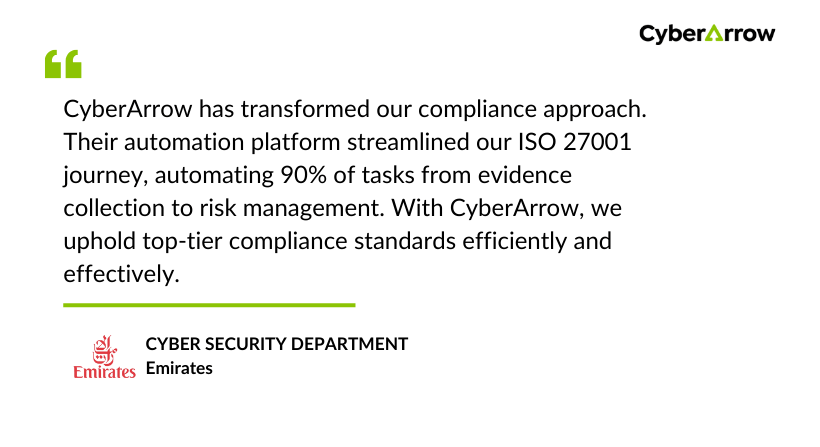
With CyberArrow GRC, you can reduce compliance costs, save time, and avoid regulatory penalties.
Final thoughts
DORA is a game-changer for financial cyber security, ensuring institutions are ready for cyber threats and ICT disruptions.
To comply with DORA, financial institutions must:
✔️ Build a strong risk management framework
✔️ Report cyber security incidents quickly
✔️ Perform regular resilience testing
✔️ Monitor third-party service providers
✔️ Share threat intelligence with the industry
