


What is penetration testing? Best strategies and tools
Cybersecurity becomes more pressing as companies and organizations depend more on technology. According to Cybersecurity Ventures, in the next five years, the cost of cybercrime will go up by 15% every year. This means that by 2025, the annual cost of cybercrime will be around $10.5 trillion, which is a significant increase from the $3 trillion cost in 2015.
It’s crucial for organizations to ensure that their networks, applications, and systems are secure. One of the most effective ways to do this is through penetration testing, also known as pen testing.
This article explains penetration testing, its significance, and some of the methods and tools employed in the procedure.
What is penetration testing?
Penetration testing, commonly known as pen testing or ethical hacking, is a technique for evaluating the security of computer networks, systems, and applications by simulating an attack on them. Penetration testing aims to find security flaws that an attacker could exploit and assess the efficacy of current security measures.
A knowledgeable and certified tester attempts to exploit vulnerabilities in the target system, network, or application while conducting a penetration test. The tester may employ automated tools or human techniques to find vulnerabilities like weak passwords, unpatched software, or improperly configured systems.
Penetration testing is a crucial component of a comprehensive security strategy since it assists businesses in identifying and prioritizing security issues. Additionally, it can assist firms in adhering to security norms and industry legislation.
Types of penetration testing
Depending on the unique aims and objectives of the test, various forms of penetration testing can be carried out. Some of the most typical varieties are listed below:
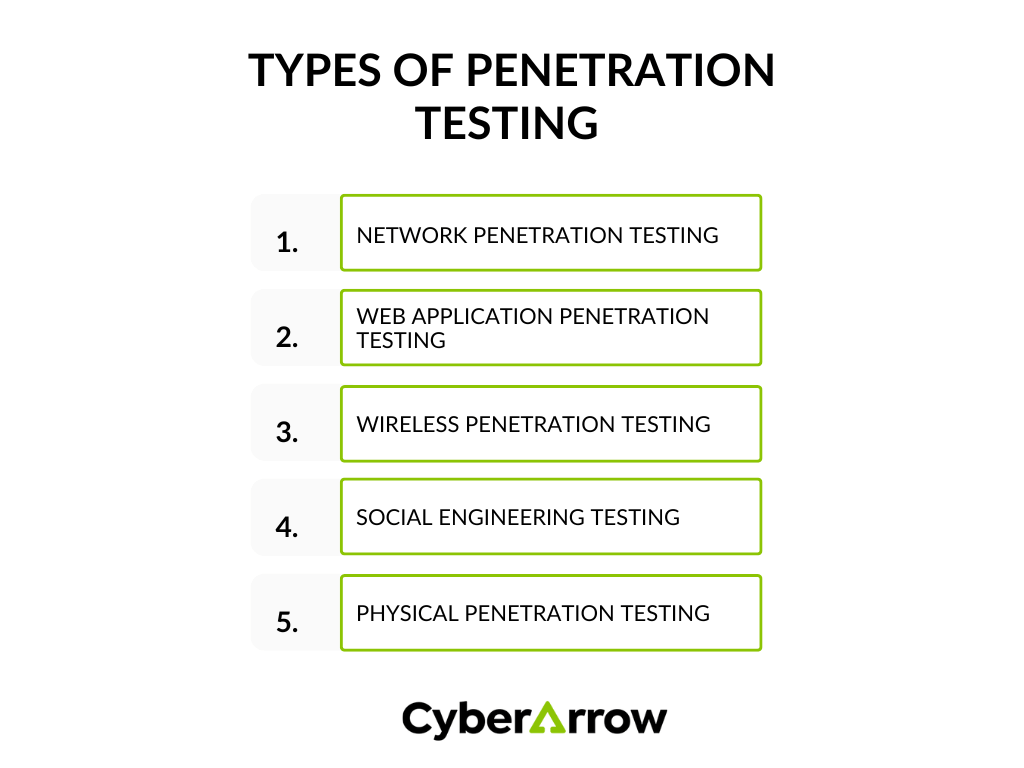
- Network penetration testing: This testing focuses on finding vulnerabilities in network infrastructures, including routers, switches, and firewalls.
- Web application penetration testing: This testing focuses on finding weaknesses in web applications, including e-commerce websites or online banking software.
- Wireless penetration testing: This testing focuses on testing wireless networks, such as Wi-Fi networks.
- Social engineering testing: This testing involves persuading staff members or other people to divulge private information or grant access to a system.
- Physical penetration testing: This testing focuses on circumventing physical security protections to gain illegal access to physical sites like data centers or offices.
Quick link: What is external network penetration testing?
Stages of penetration testing
The five phases of penetration testing are:
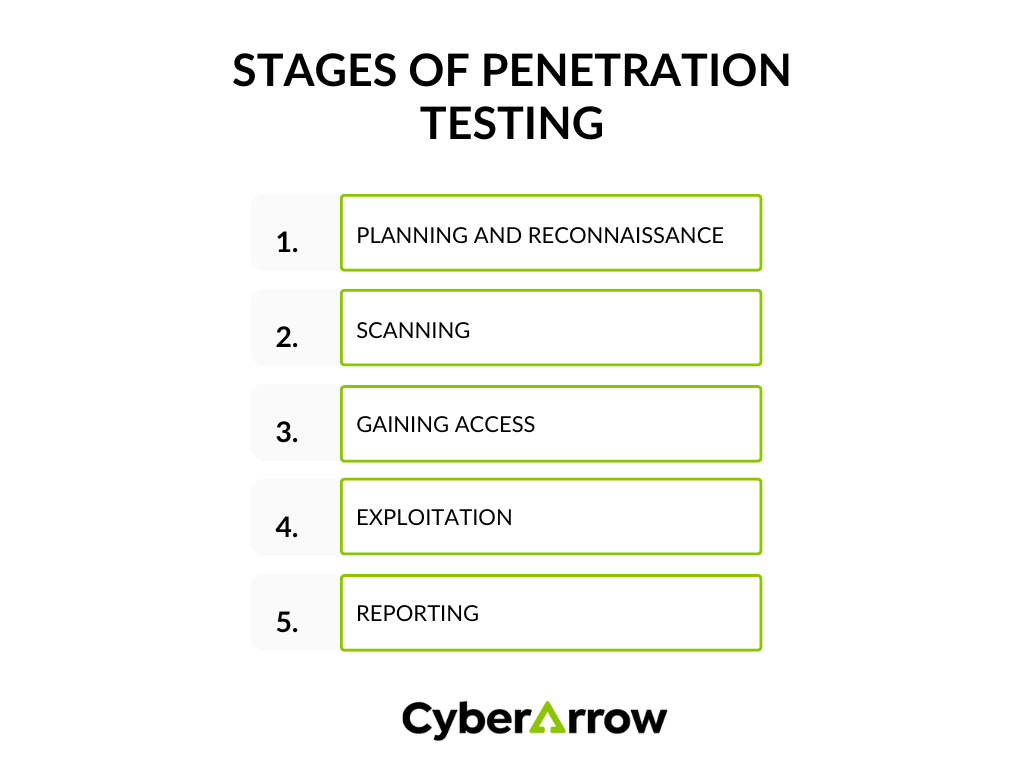
- Planning and reconnaissance: Gathering information about the target system, network, or application to be tested.
- Scanning: Employing tools and methods to check for vulnerabilities in the target system, network, or application.
- Gaining access: Compiling as much data as possible, including user accounts and system configurations, about the target system, network, or application.
- Exploitation: Using system, network, or application vulnerabilities in the target to obtain unauthorized access or carry out other malicious actions.
- Reporting: Writing a thorough report outlining the vulnerabilities found, their effects, and suggestions for fixing them.
Common penetration testing strategies
The precise aims and objectives of the test will determine the specific penetration testing methodologies to utilize, although the following are some of the more popular ones:
Black-box testing
The system, network, or application being tested in this method are all unknown to the tester in advance. The tester must employ a variety of ways to identify vulnerabilities from scratch, just like an inexperienced attacker would.
White-box testing
This method gives the tester complete access to the system, network, or application being tested, the source code, and other technical data. This makes it easier and faster for the tester to find weaknesses.
Gray-box testing
With this method, the system, network, or application under test is only partially known to the tester. Access to restricted technical data or other system specifics may fall under this category.
Quick link: SOC report meaning
Best tools for penetration testing
The ideal tools will rely on the precise goals and objectives of the test. There are many tools available for penetration testing. Some of them are:
- Nmap: Nmap is an open-source and free network exploration and security auditing tool. It is possible to use this tool to find open ports, active services, and other details about network hosts.
- Burp Suite: Burp Suite is a tool for testing the security of online applications. It comes with a web proxy, a scanner, and numerous more tools for locating and taking advantage of holes in web applications.
- Metasploit: Metasploit is a popular framework for vulnerability analysis and penetration testing. It comes with several tools and modules to exploit flaws in systems and applications.
- Wireshark: Wireshark is an open-source, free tool for analyzing network protocols. Network traffic might be captured and analyzed to find security flaws and vulnerabilities.
- John the ripper: John the Ripper is a free and open-source password-cracking tool. It can be used to evaluate the security of user passwords and spot those that are weak or simple to guess.
- Hydra: Hydra is a program used to conduct brute-force assaults on different network services and protocols to crack passwords.
- Nessus: Nessus is a popular vulnerability scanner that may be used to find weaknesses in network hosts and systems.
FAQs
What are the three types of penetration testing?
The three common types of penetration testing are black-box testing, white-box testing, and gray-box testing.
What are the 5 stages of penetration testing?
The five stages of penetration testing involve planning and reconnaissance, scanning, access gaining, exploitation, and reporting.
What tool is used for penetration testing?
Nmap, Metasploit, Burp Suite, Wireshark, John the Ripper, Hydra, and Nessus are some of the tools used for penetration testing. The precise aims and targets of the penetration testing determine the tools selected.
Streamline OWASP TOP 10 compliance with CyberArrow GRC
Penetration testing is a critical component in securing your organization’s systems and data. By identifying vulnerabilities and weaknesses, you can protect your business from potential threats. Implementing the right strategies and tools is essential, but managing the process manually can be overwhelming.
With CyberArrow GRC, you can automate and streamline the process of securing your organization against common vulnerabilities like those identified in the OWASP TOP 10. CyberArrow simplifies compliance by automating up to 90% of the work involved, allowing you to focus on strengthening your security posture rather than managing complex processes.
Why choose CyberArrow GRC for OWASP TOP 10 automation?
- Automate compliance tasks: Automatically track and address OWASP TOP 10 vulnerabilities, reducing manual effort.
- Real-time risk monitoring: Monitor security risks continuously and respond quickly to emerging threats.
- Cross-standard mapping: CyberArrow supports compliance with multiple standards, helping you cover various security frameworks alongside OWASP TOP 10.
- Dedicated support: Receive expert guidance from CyberArrow’s team to ensure smooth implementation and ongoing compliance.
A financial services firm needed to address OWASP vulnerabilities across its applications. With CyberArrow GRC, the company automated risk assessments and mitigations, saving time and improving security across the board.
