SOC report meaning: What is it and why is it necessary?
In today’s business world, safeguarding data and meeting compliance standards are no longer optional; they’re essential. Organizations need to prove they’re handling sensitive information responsibly, especially when dealing with clients and partners. One of the best ways to do this is through SOC reports.
But what exactly does a SOC report mean? In simple terms, SOC reports are tools that help businesses show they have the right systems and processes to manage risks, protect data, and meet compliance requirements. Let’s explore what these reports are, why they’re critical, and how they can benefit your organization.
What does SOC stand for?
SOC stands for Service Organization Control. These reports are a set of standards created by the American Institute of Certified Public Accountants (AICPA). They’re designed to help service organizations showcase how they manage risks related to data security, availability, confidentiality, and privacy.
SOC reports are not just for IT companies; they’re also widely used by financial institutions, healthcare providers, SaaS companies, and other industries handling sensitive information.
Types of SOC reports
SOC reports are categorized into three main types, each serving a unique purpose:
SOC 1 report
- Purpose: Focuses on controls relevant to a company’s financial reporting.
- Audience: Typically requested by clients or auditors to ensure financial data is handled securely.
- Example: Payroll processing companies often need SOC 1 reports to show that financial transactions are accurately managed.
SOC 2 report
- Purpose: Concentrates on the organization’s ability to manage data securely.
- Audience: Businesses and stakeholders concerned about data protection.
- Criteria: Based on the Trust Services Criteria—security, availability, processing integrity, confidentiality, and privacy.
- Example: A cloud storage provider obtaining a SOC 2 report to prove their systems are secure and reliable.
SOC 3 report
- Purpose: Provides a high-level overview of an organization’s compliance with the Trust Services Criteria.
- Audience: The general public, as it is less detailed than SOC 2 and often used for marketing purposes.
- Example: A SaaS provider showcasing a SOC 3 report on their website to assure customers of their commitment to data security.
Why are SOC reports necessary?
SOC reports are crucial for businesses for several reasons. Here’s why they matter:
1. Building trust with clients
In an age where data breaches and cyberattacks are common, businesses want to know that their partners are secure. SOC reports provide a clear demonstration that you take data protection seriously.
2. Meeting regulatory requirements
Industries like finance, healthcare, and tech face strict compliance standards. SOC reports often serve as proof that you’re meeting these legal obligations.
3. Improving internal processes
The process of obtaining a SOC report requires organizations to review and improve their internal controls. This can lead to better operational efficiency and risk management.
4. Winning business deals
Many potential clients may request a SOC report before signing a contract. Having one ready can make your business more competitive.
5. Minimizing risks
By adhering to the controls outlined in SOC reports, companies reduce the likelihood of data breaches, operational failures, and non-compliance penalties.
The SOC reporting process: How it works
Obtaining a SOC report isn’t a simple task. Here’s an overview of the process:
1. Preparation phase
- Identify which type of SOC report you need (SOC 1, SOC 2, or SOC 3).
- Conduct an internal assessment to identify gaps in your current processes.
- Develop and implement necessary controls to meet the requirements.
2. Audit phase
- Work with an independent CPA or auditor to review your systems.
- Provide evidence of your compliance with the required criteria.
3. Reporting phase
- The auditor prepares the SOC report, documenting findings and confirming compliance.
- SOC 2 reports include details about controls for security, availability, processing integrity, confidentiality, and privacy.
4. Maintenance phase
- SOC reports often require periodic updates (annually or as needed) to stay relevant and accurate.
- Continuous monitoring and improvement of controls are essential.
Common challenges in obtaining a SOC report
While SOC reports are valuable, achieving compliance can be challenging:
– Time-consuming process
The process of preparing for and completing an audit can take months.
– Resource-intensive
Gathering documentation, implementing controls, and managing audits require significant resources.
– Understanding complex requirements
The technical nature of SOC criteria can be overwhelming, especially for organizations new to the process.
– Maintaining compliance
SOC compliance isn’t a one-time task. Businesses need to continually monitor and update controls to remain compliant.
Download your free SOC 2 compliance checklist.
How CyberArrow GRC simplifies SOC compliance
If you’re looking for a way to simplify and automate your SOC compliance journey, CyberArrow GRC is the solution. Here’s how it helps:
1. Streamlined processes: CyberArrow GRC eliminates the complexity of manual compliance management. It automates key tasks like control monitoring, documentation, and reporting.
2. Real-time monitoring: Stay ahead with real-time insights into your compliance status. CyberArrow GRC helps you identify and address issues before they become problems.
3. Customizable workflows: Tailor the platform to meet your organization’s unique needs, whether you’re pursuing SOC 1, SOC 2, or SOC 3 compliance.
4. Seamless collaboration: Enable your teams to work together efficiently with centralized data and collaborative tools.
5. Regulatory updates: Stay up-to-date with the latest compliance standards and requirements. CyberArrow GRC ensures your controls evolve as regulations change.
Why CyberArrow GRC is the right choice
With CyberArrow GRC, businesses of all sizes can achieve SOC compliance faster and more efficiently. The platform empowers organizations to manage governance, risk, and compliance seamlessly, reducing the time and effort needed for manual tasks. Whether you’re a startup or a large enterprise, CyberArrow GRC is designed to support your compliance goals.
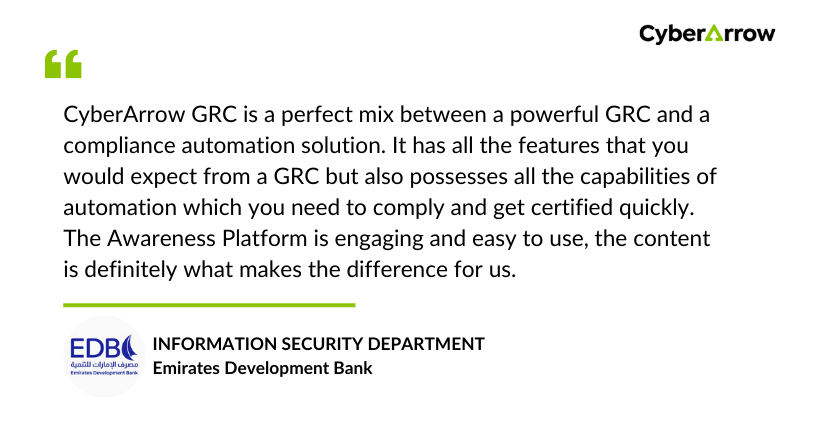
See what EDB has to say about CyberArrow GRC: