What is a risk management framework (RMF)? Best practices to implement an RMF
All businesses operate within a dynamic and complex environment that exposes them to various risks, which, if not well-managed, can lead to failure. Therefore, a risk management framework is essential to any company’s success. A risk management framework allows companies to identify, assess, and prioritize potential risks and take measures to minimize or eliminate them. It enables businesses to balance taking risks and avoiding business failure.
Let’s explore what a risk management framework is, its importance, and best practices to implement an RMF in your organization.
(Also read our blog on the impact of human errors on organization’s security posture.)
What is a risk management framework?
A risk management framework is a set of guidelines, rules, and best practices organizations can use to defend against organizational risks. It provides a structured and systematic approach to identifying, assessing, and managing risks across an organization.
Originally developed by the National Institute of Standards and Technology (NIST) to secure the information systems of the United States government, the RMF has evolved to become a widely adopted framework across various industries. It offers a comprehensive methodology for identifying and prioritizing risks, developing mitigation strategies, and monitoring risk levels to ensure they remain within acceptable limits.
Why does your organization need a risk management framework?
Risk management frameworks are vital in establishing effective data and asset governance systems for businesses to mitigate cyber risks and related threats. Some of the benefits of a risk management framework are given below:
- Asset protection: Risk management frameworks safeguard a business’s assets by identifying and prioritizing risks, empowering organizations to respond quickly and protect their critical resources. By providing a set of standards and an action plan, these frameworks help ensure the security of the business.
- Increased supply chain security: Modern supply chains pose significant risks to businesses relying on them for goods, resources, and product delivery. With effective risk management framework solutions, organizations can enhance the quality and usability of supply-chain-related data streams. This enables them to gain precise insights into factors that may impact essential supply chains.
- Protection of intellectual property: Risk management frameworks also govern intellectual property protection against theft and misuse. With well-defined standards and supporting data, businesses can operate confidently, knowing that their intellectual property is safeguarded and the chances of theft are minimized.
- Enhanced business reputation: A business with a clear and consistent set of security and operational standards across all levels ensures effective risk mitigation and minimizes the risk of data exposure. This protects the company from expensive errors that could harm its public image and reputation.
Components of a risk management framework
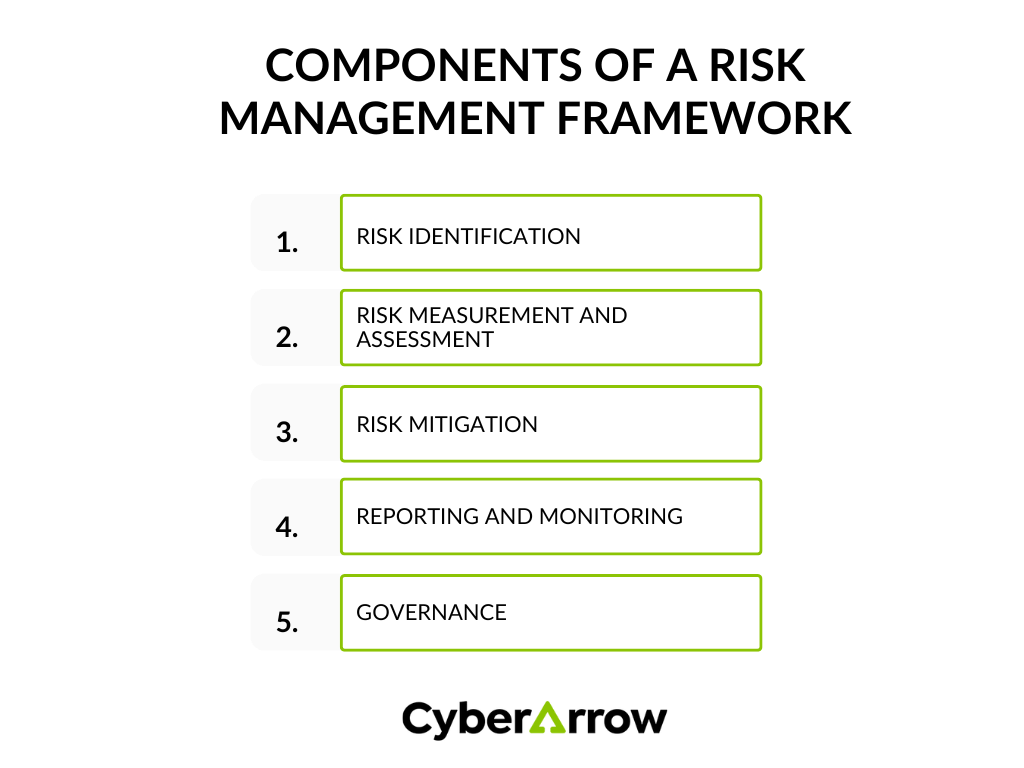
A fundamental component of any strong compliance program, a risk management framework typically consists of the following components. (Learn the difference between compliance and security in our recent blog on security vs. compliance.)
- Risk identification: The initial step is to identify potential risks that can impact the organization, which may include legal, strategic, operational, and privacy risks. It’s essential to recognize that risk identification is an ongoing process as the risks that a business may face are subject to change, and therefore, periodic risk assessments are necessary.
- Risk measurement and assessment: This component aims to create a risk profile for each identified risk. This can be achieved in various ways, such as measuring the potential financial impact of a risk or attempting to quantify the cost of a security breach compared to implementing security controls.
- Risk mitigation: Risk mitigation is the third component of the Risk Management Framework, which involves identifying which risks can and should be eliminated and which are deemed acceptable. Mitigation strategies such as cyber insurance and security controls may be implemented, and baseline security controls may be put in place to address cybersecurity risks.
- Reporting and monitoring: This component involves a continuous evaluation of the effectiveness of the risk mitigation strategies adopted by the organization. This helps ensure that the strategies are still relevant and appropriate in the face of changing circumstances and continue to provide the intended level of protection against identified risks.
- Governance: The final component of the Risk Management Framework is risk governance, which involves implementing and enforcing the organization’s risk mitigation strategies and policies. This ensures that employees comply with these policies and that the overall risk management process effectively mitigates identified risks.
Best practices to implement RMF
Here is a list of best practices for implementing a risk management framework.
- Involve all stakeholders: Make sure all stakeholders, including senior management, IT personnel, legal and compliance teams, and end-users, are involved in the risk management process.
- Regular risk assessments: Perform risk assessments on a regular basis, including after any significant changes to the organization or its environment.
- Document everything: Keep detailed documentation of all risk management activities, including risk assessments, mitigation plans, and monitoring activities.
- Use a consistent methodology: Use a consistent methodology for risk identification, analysis, and response to ensure that all risks are handled consistently across the organization.
- Prioritize risks: Prioritize risks based on their likelihood and potential impact, and focus mitigation efforts on the most critical risks.
- Implement appropriate controls: Implement appropriate controls to mitigate identified risks and periodically review and update these controls to ensure they remain effective.
- Monitor and review: Monitor the effectiveness of risk management controls and regularly review and update risk management plans to reflect changes in the organization or its environment.
- Training and awareness: Provide training and awareness programs to help all employees understand the importance of risk management and their role in the process. (Take advantage of the CyberArrow Awareness Platform for employee training and awareness.)
- Engage external experts: Consider engaging external experts, such as consultants or auditors, to provide independent assessments of your risk management program.
- Continuously improve: Continuously improve the risk management process and program based on lessons learned and changes in the organization or its environment.
Manage your risk management processes with CyberArrow GRC
A well-structured RMF ensures that you manage risks proactively and make informed decisions to protect your organization from potential threats. However, traditional risk management methods can be time-consuming and prone to error.
That’s where CyberArrow ERM module comes into play, offering a seamless, automated way to manage and assess risks. Instead of relying on manual processes, CyberArrow ERM simplifies your risk assessments, helping you focus on making strategic decisions for your organization.
Why choose CyberArrow ERM for risk management?
- Automated risk assessments: Conduct risk assessments with minimal effort using CyberArrow’s automated risk feature or wizard.
- No manual discovery: Say goodbye to manually discovering or adding risks. CyberArrow ERM handles it for you.
- Customizable risk methodology: Apply your own enterprise or cybersecurity risk methodology to ensure the framework aligns with your organization’s unique needs.
- Streamlined reporting: Keep track of risks and compliance with real-time dashboards that simplify monitoring and decision-making.
A large healthcare organization used CyberArrow ERM to automate their risk management process. By eliminating manual data entry and using the automated risk feature, they reduced the time spent on risk assessments by 60%, while ensuring more accurate and timely reports.
See what Emirates have to say about CyberArrow: