Data security compliance: Everything you need to know
Data breaches are becoming more common and dangerous. Businesses of all sizes face increasing risks as hackers target sensitive information. To protect themselves and their customers, companies must follow strict data security compliance standards. These rules ensure that businesses handle data responsibly and minimize security risks. But what exactly is data security compliance, and how can companies meet these requirements effectively?
In this guide, we’ll explain the concept of data security compliance, explore the key standards businesses need to follow, and provide tips for maintaining compliance. We’ll also introduce CyberArrow GRC, a tool that simplifies compliance by automating critical processes.
What is data security compliance?
Data security compliance refers to the practice of following laws, regulations, and industry standards to protect sensitive data. These rules help businesses ensure the confidentiality, integrity, and availability of information. Noncompliance can lead to hefty fines, reputational damage, and even legal action.
Organizations that handle personal, financial, or health-related data are often subject to specific compliance standards. The goal is to create a secure environment for storing, processing, and sharing data.
Why is data security compliance important?
1. Protecting customer trust
Customers expect businesses to keep their personal information safe. A single data breach can damage trust and harm customer relationships.
2. Avoiding financial penalties
Non-compliance can result in fines and penalties from regulatory bodies. For example, under GDPR, companies can face fines of up to €20 million or 4% of their annual revenue.
3. Preventing data breaches
Following compliance standards reduces the risk of cyberattacks. Strong security practices help identify and fix vulnerabilities before hackers exploit them.
4. Ensuring business continuity
A major security incident can disrupt operations. Compliance standards help businesses build a resilient security posture to minimize downtime.
Key data security compliance standards
Businesses must comply with different standards based on their location, industry, and the type of data they handle. Here are some of the most common data security compliance frameworks:
1. General Data Protection Regulation (GDPR)
Applies to: Organizations handling personal data of EU citizens
Focus: Protecting personal data privacy and security
Key requirements:
- Data encryption and anonymization
- Consent for data collection
- Right to access and delete data
2. Health Insurance Portability and Accountability Act (HIPAA)
Applies to: Healthcare organizations in the U.S.
Focus: Safeguarding patient health information (PHI)
Key requirements:
- Regular risk assessments
- Access controls and audit trails
- Data breach notification
3. Payment Card Industry Data Security Standard (PCI DSS)
Applies to: Businesses processing credit card payments
Focus: Securing payment card data
Key requirements:
- Encrypting cardholder data
- Regular security testing
- Monitoring and logging access
4. ISO/IEC 27001
Applies to: Organizations worldwide
Focus: Establishing an Information Security Management System (ISMS)
Key requirements:
- Risk assessment and treatment plans
- Continuous monitoring and improvement
- Documented security policies
5. California Consumer Privacy Act (CCPA)
Applies to: Businesses collecting personal data of California residents
Focus: Giving consumers control over their data
Key requirements:
- Transparency about data usage
- Opt-out options for data selling
- Data access and deletion rights
6. National Institute of Standards and Technology (NIST) Framework
Applies to: U.S. federal agencies and private organizations
Focus: Improving cyber security resilience
Key requirements:
- Identifying and mitigating risks
- Implementing access controls
- Developing incident response plans
Steps to achieve data security compliance
1. Identify applicable standards
Determine which compliance frameworks apply to your organization based on your industry and location. For example, a healthcare provider in the U.S. must comply with HIPAA, while an e-commerce company handling EU customer data must follow GDPR.
2. Conduct a risk assessment
Analyze your organization’s current security posture. Identify vulnerabilities, assess potential threats, and prioritize areas for improvement.
3. Develop security policies
Create clear policies outlining how your organization will handle sensitive data. Include guidelines for access controls, encryption, data retention, and breach response.
4. Train employees
Educate your team on data security compliance requirements. Training helps employees recognize risks and follow best practices.
5. Implement security controls
Deploy technical measures such as firewalls, encryption, intrusion detection systems, and multi-factor authentication. These tools help protect data from unauthorized access.
6. Monitor and audit
Continuously monitor your systems for compliance and conduct regular audits to ensure adherence to standards.
7. Prepare for incidents
Have a response plan in place for data breaches or compliance violations. Quick action minimizes damage and helps you recover faster.
Challenges in data security compliance
1. Complex regulations
Navigating multiple standards can be overwhelming, especially for organizations operating in different regions or industries.
2. Evolving threat landscape
Cyber threats are constantly changing, requiring businesses to adapt their security measures.
3. Resource constraints
Small and medium-sized businesses often lack the resources to manage compliance effectively.
4. Human error
Manual compliance processes are prone to mistakes, increasing the risk of non-compliance.
Quick link: What is security compliance?
How CyberArrow GRC simplifies data security compliance
CyberArrow GRC is a cutting-edge tool designed to automate compliance processes and make data security compliance easier for businesses.
Here’s how it helps:
1. Automated risk assessments
CyberArrow GRC automatically identifies vulnerabilities and assesses risks, saving time and improving accuracy.
2. Centralized compliance management
Manage multiple compliance frameworks, such as GDPR, HIPAA, and ISO 27001, from a single platform.
3. Real-time monitoring
Get real-time updates on your compliance status to stay ahead of potential issues.
4. Seamless integration
CyberArrow GRC integrates with over 80 systems, allowing you to collect evidence automatically.
5. User-friendly dashboards
Simplified interfaces make it easy for non-experts to track compliance efforts and generate reports.
6. Customizable workflows
Tailor workflows to fit your organization’s unique compliance needs.
Conclusion
Data security compliance is no longer optional; it’s essential for protecting sensitive information, maintaining customer trust, and avoiding costly penalties. While meeting compliance standards can be challenging, tools like CyberArrow GRC make the process more manageable.
CyberArrow GRC automates compliance tasks, helping organizations streamline risk assessments, monitor security measures, and meet regulatory requirements with ease. Whether you’re managing GDPR, HIPAA, or PCI DSS, CyberArrow GRC empowers your business to stay secure and compliant.
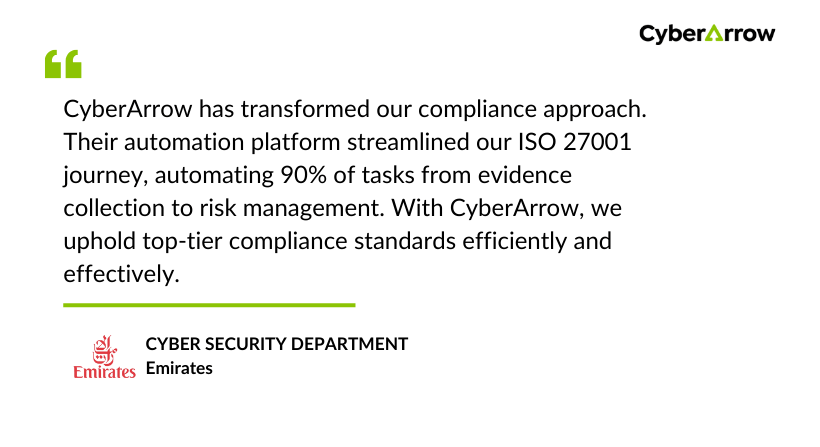
Read How Emirates enhanced Information Security by automating ISO 27001 with CyberArrow.
See what Emirates has to say about CyberArrow GRC: