What is cyber espionage? How to prevent it
Imagine your company’s secrets slipping away without anyone noticing. This isn’t just in spy movies, it’s a real cyber espionage threat. Cyber espionage happens when hackers secretly steal important information from businesses, governments, or people. Unlike other attacks, cyber espionage is about staying hidden and gathering data over time.
If you’re wondering what cyber espionage is, why it’s so dangerous, and how to protect against it, this guide covers it all. We’ll explain how it works, who it targets, and what you can do to keep your information safe from these digital spies.
What is cyber espionage?
Cyber espionage is the act of using computer networks to steal confidential information, often for political, financial, or strategic purposes. This form of espionage is done by hackers who break into computer systems and networks to collect information. The stolen data can include anything from government secrets to business trade information.
Unlike traditional hacking, cyber espionage is usually focused on long-term data theft rather than quick financial gains. Hackers involved in cyber espionage may remain hidden in a system for months or even years, collecting data without detection. Their goal is to gather as much valuable information as possible to benefit whoever hired them, often foreign governments or competing businesses.
How does cyber espionage work?
Cyber espionage attacks are carefully planned and executed. Here’s a look at some common tactics:
- Phishing and spear phishing: Phishing emails trick people into clicking malicious links or attachments. Spear phishing is a targeted form of phishing, aimed at specific individuals who have access to sensitive data. This approach helps hackers gain entry into the organization’s system.
- Malware infections: Malware, such as viruses or spyware, can be used to monitor activities on a computer, record keystrokes, and send data back to the attacker. This enables hackers to gather valuable information without the victim’s knowledge.
- Social engineering: Social engineering tricks individuals into sharing confidential information. Hackers might pretend to be trusted contacts to gain access to restricted areas within the organization.
- Exploiting system vulnerabilities: Many organizations have software weaknesses that can be exploited. Attackers look for unpatched software or outdated systems to access valuable information.
- Insider threats: Sometimes, employees within an organization may be bribed or manipulated into sharing sensitive information. Insiders are one of the most difficult threats to detect because they already have access to the data.
Quick link: What is business email compromise?
Why is cyber espionage dangerous?
Cyber espionage is a major threat because it can result in:
- Loss of sensitive information: Companies may lose valuable intellectual property, trade secrets, and customer information.
- Reputational damage: Customers and partners lose trust in a company that fails to protect its data.
- Financial losses: Cyber espionage often leads to fines, lawsuits, and loss of business opportunities.
- National security risks: For governments, cyber espionage can expose sensitive information that could harm national security.
Industries at high risk of cyber espionage
While any organization can be a target, certain industries are more vulnerable to cyber espionage:
- Government and defense: These sectors hold valuable data about national security, military tactics, and foreign policies.
- Technology: Technology companies often lead in innovation, making them prime targets for competitors looking to steal product ideas.
- Finance: Banks and financial firms handle personal data, transaction records, and other valuable financial information.
- Healthcare: Patient data and medical research are of great interest to hackers who engage in cyber espionage.
- Energy and utilities: Information on energy grids, infrastructure, and resources can be valuable for espionage activities, especially in a global context.
Quick link: What is cloud web security?
How to prevent cyber espionage
Here are some steps organizations can take to protect against cyber espionage:
1. Educate employees on cyber security
Many cyber espionage attacks start with human error. Teaching employees about cyber security best practices reduces the risk of phishing, social engineering, and other tactics hackers use.
Training should cover:
- Recognizing phishing and spear-phishing emails
- Handling sensitive data securely
- Following safe internet practices
- Reporting suspicious activities
2. Implement strong access controls
Not everyone needs access to all information. By implementing access control policies, you can limit the amount of data any one person can view. This approach is effective in preventing insider threats.
- Use multi-factor authentication (MFA)
- Set role-based access permissions
- Regularly review and adjust access controls
3. Keep systems updated
Hackers often exploit outdated systems. Keeping software and systems updated is essential to avoid vulnerabilities.
- Enable automatic updates on software and devices
- Regularly patch systems
- Use firewalls and antivirus software to detect potential threats
4. Monitor networks continuously
Continuous network monitoring helps detect unusual behavior, like large data transfers or access from unknown locations. A good monitoring system can quickly alert security teams to a potential breach.
- Use intrusion detection systems (IDS)
- Regularly review logs and access reports
- Implement threat detection software
5. Encrypt sensitive data
Encryption ensures that even if data is stolen, it cannot be read without the decryption key. It is a crucial layer of defense for sensitive information.
- Encrypt data at rest (stored data) and in transit (data being transferred)
- Use strong encryption standards, such as AES (Advanced Encryption Standard)
6. Develop a cyber security response plan
Having a response plan helps an organization react quickly if a cyber espionage attack is detected. A solid plan will reduce damage and speed up recovery.
- Create a detailed incident response plan
- Conduct regular cyber security drills
- Assign clear roles and responsibilities in case of a breach
The role of CyberArrow Awareness Platform in preventing cyber espionage
One of the best ways to reduce cyber espionage risk is through employee awareness. With cyber threats constantly evolving, organizations need to ensure that their teams are trained to recognize and respond to potential attacks.
The CyberArrow Awareness Platform offers a solution by providing ongoing, automated cyber security training for employees. This platform helps organizations stay on top of the latest threats and ensures employees have the knowledge needed to protect sensitive data.
Key features of CyberArrow Awareness Platform:
- Automated training programs: No need to manually schedule training sessions CyberArrow automates the process.
- Customized modules: Tailor training content to fit your organization’s specific needs and risks.
- Progress tracking: Measure employee understanding and improvement over time.
- Real-world scenarios: Provide practical, hands-on training to help employees recognize and react to cyber threats.
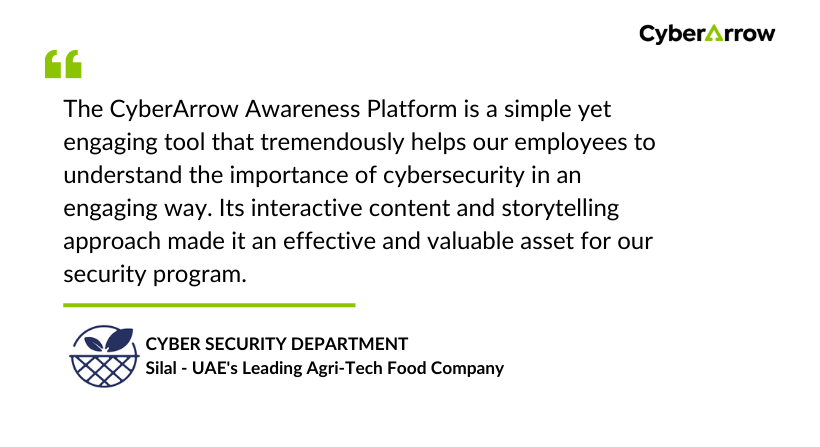
Read how CyberArrow increased security awareness among Silal’s employees.
See what Silal has to say about CyberArrow Awareness Platform: