What is the cyber kill chain? A complete guide
Cyber attacks are becoming more frequent and sophisticated, targeting businesses and individuals alike. It’s crucial to stay ahead of these evolving threats.
One powerful tool to defend against cyber threats is the cyber kill chain. Understanding this framework can help you stop attacks before they cause damage.
In this blog, we’ll explain the cyber kill chain’s seven stages and show how it can improve your security strategy. You’ll also discover how the CyberArrow Awareness Platform can automate cyber security awareness training for your team, keeping them prepared for any cyber threat.
What is the cyber kill chain?
The cyber kill chain was originally developed by Lockheed Martin in 2011 to help businesses identify and stop cyberattacks early in the process. Much like a military kill chain outlines the steps needed to take down a target, the cyber version breaks down the phases of a cyberattack. This allows companies to take action at different stages to block attackers.
Cyber security experts use the kill chain to defend against Advanced Persistent Threats (APTs). These sophisticated, long-term attacks aim to steal data, install malware, or disrupt operations.
Let’s break down each phase of the cyber kill chain to better understand how attacks happen, and how to stop them.
Phases of the cyber kill chain
The cyber kill chain consists of seven stages, each representing a step in a cyberattack.
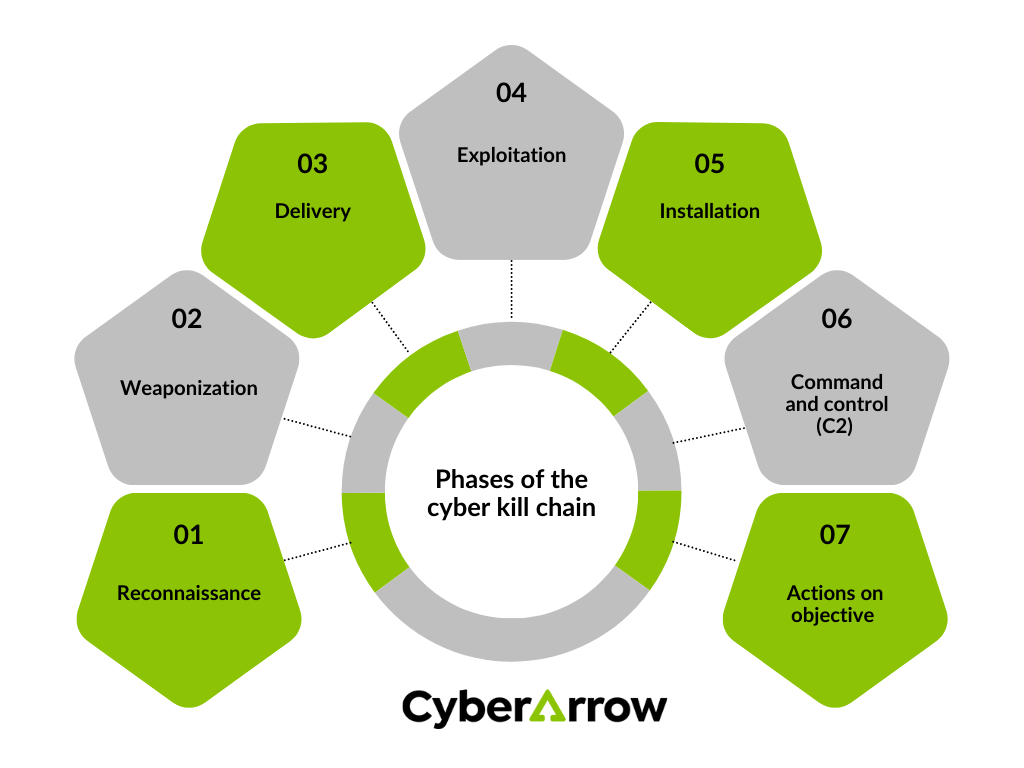
Here’s a look at each one:
1. Reconnaissance
Attackers start by gathering information about their target. This includes researching employees, finding weaknesses in the system, and collecting details about the organization’s IT setup. By understanding the target’s security structure, attackers plan how to breach the system.
2. Weaponization
Once they’ve identified a weakness, attackers create a tool to exploit it. This could be malware like viruses, ransomware, or trojans. The weapon is usually designed to take advantage of known vulnerabilities in the target’s network.
3. Delivery
This phase involves delivering the malicious tool to the target. Attackers may send phishing emails, deliver malicious links, or upload infected files. Social engineering tactics like pretending to be a trustworthy source are often used to trick users into clicking on harmful content.
4. Exploitation
Once the malicious software reaches the target’s system, it starts exploiting the vulnerability. This is the phase where the malware or other attack methods begin to take action, allowing attackers to breach the network.
5. Installation
After exploiting the system, the attacker installs malware, backdoors, or other tools that allow them continued access. This phase ensures that even if the initial breach is detected, the attacker can still maintain control over the system.
6. Command and control (C2)
The installed malware communicates with the attacker’s server, allowing the attacker to control the victim’s system remotely. This phase often involves spreading malware across the network, gathering more information, or preparing to steal sensitive data.
7. Actions on objective
In the final stage, the attacker carries out their goal. This could involve stealing data, encrypting files for ransom, or causing disruptions. Depending on the motive, the attack may aim to cause financial loss, damage reputation, or steal sensitive information.
Evolving cyber kill chain models
The original cyber kill chain has evolved as attackers adopt new techniques. Some models include an additional phase called Monetization, where the attacker profits from the breach by selling stolen data or demanding ransom. As threats grow more complex, security experts often expand the kill chain to cover modern attack methods like insider threats and cloud vulnerabilities.
Importance of early detection
One of the most important aspects of the cyber kill chain is that it highlights the importance of early detection. The sooner an organization can detect and stop a threat, the less damage it will suffer. Preventing an attack in the reconnaissance or delivery phase means stopping the threat before it causes serious harm.
How to defend against cyber kill chain attacks
There are several strategies organizations can use to defend against attacks at different stages of the kill chain:
- Reconnaissance: Implement strong access control measures and train employees to recognize phishing attempts. Monitoring suspicious behavior and unusual network activity can also help detect threats early.
- Weaponization: Use robust vulnerability management tools and regularly patch software to close any known vulnerabilities.
- Delivery: Implement email filtering and scanning to block malicious attachments and links. User education and cyber security awareness training are crucial in preventing human error.
- Exploitation: Utilize endpoint detection and response (EDR) tools to identify and stop malware once it reaches a device.
- Installation: Prevent installation by limiting users’ permissions and utilizing application whitelisting to block unauthorized software.
- Command and control: Employ network monitoring tools to detect unauthorized communication between an attacker and your system.
- Actions on objective: Have a strong incident response plan in place to contain the attack and minimize damage.
The role of human firewalls
Employees play a key role in defending against cyber attacks. Many cyber attacks succeed because attackers trick individuals into giving up sensitive information or clicking on malicious links. By training employees to recognize and respond to potential threats, companies can create a “human firewall.”
A human firewall is a group of well-trained employees who can recognize phishing, avoid clicking on harmful links, and report suspicious activities. Cyber security awareness training is essential to building this human firewall.
Strengthen your cyber security with CyberArrow Awareness Platform
Defending against modern cyberattacks requires a combination of technology and human awareness. While advanced tools can detect and block threats at various stages of the cyber kill chain, employee training is just as critical.
With CyberArrow Awareness Platform, you can easily train your workforce to become part of your defense strategy. Here’s how the platform can help:
- Automate training programs to ensure your employees are up-to-date with the latest threats.
- Track progress and compliance to ensure everyone understands key cyber security principles.
- Reduce human error by preparing your team to recognize phishing and social engineering attempts.
One use case of the CyberArrow Awareness Platform involved a financial firm with over 500 employees. Before using the platform, the company experienced frequent phishing attacks, leading to several data breaches. After adopting CyberArrow’s solution, the firm saw a 70% reduction in successful phishing attempts within six months.
Don’t wait until an attack reaches its final stages, start building your human firewall today with CyberArrow Awareness Platform.
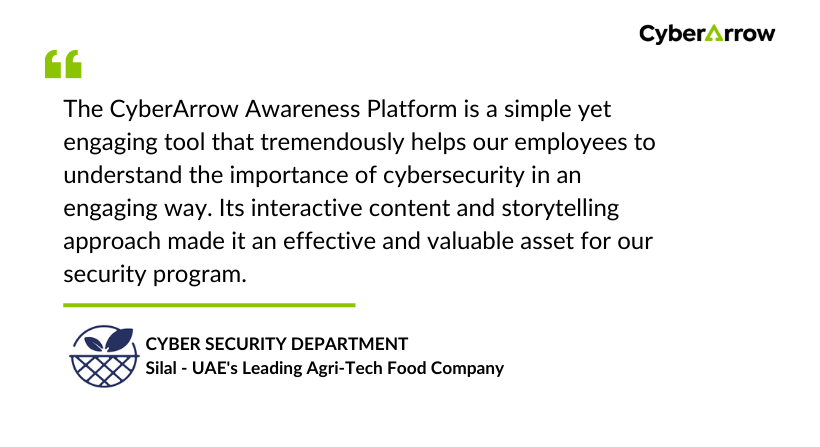
See what Silal has to say about CyberArrow Awareness Platform: