

What is IT asset management? A complete guide
Today, businesses rely heavily on technology, computers, software, servers, mobile devices, and cloud systems. But with all these tools, it’s easy to lose track of what you own, where it is, and how it’s used. That’s why every company needs a smart approach to IT asset management.
In this guide, we’ll explain what IT asset management means, why it’s important, what it includes, and how CyberArrow GRC helps you stay organized and compliant by integrating with your favorite asset management solutions.
What is IT asset management?
IT asset management (ITAM) is the process of tracking and managing all of your company’s technology assets. This includes:
- Hardware (computers, servers, mobile devices, etc.)
- Software (licenses, subscriptions, applications)
- Cloud resources and virtual machines.
- Network equipment and storage.
- Digital tools and services.
Think of it as a complete inventory of your IT environment from purchase to disposal.
A good IT asset management system helps you know:
- What assets you own.
- Where they are located.
- Who is using them?
- How they are being used.
- When they need to be updated, renewed, or retired.
Why is IT asset management important?
Without proper asset management, your business faces a lot of risks:
- You might be paying for unused software licenses.
- Devices could go missing without anyone noticing.
- Old equipment might still be holding sensitive data.
- Unpatched or unapproved software may open security holes.
- You could fail audits due to missing records.
That’s why IT asset management is not just about saving money; it’s also about staying secure, organized, and compliant.
Here are the main benefits of IT asset management:
- Lower costs by removing unused tools.
- Improve security by tracking every device and app.
- Make audits and reports easier and faster.
- Stay compliant with standards like ISO 27001 and NIST.
- Reduce downtime by knowing what’s in your tech environment.
What are the types of IT assets?
In IT asset management, assets are usually divided into these types:
1. Hardware assets
These include physical items like:
- Laptops and desktops.
- Mobile phones and tablets.
- Servers and routers.
- Printers and scanners.
- External drives and USBs.
2. Software assets
These include:
- Licensed software applications.
- Subscribed tools (like Microsoft 365 or Adobe).
- Operating systems.
- Security software.
- In-house developed apps.
3. Cloud assets
These cover your cloud environment, such as:
- Cloud servers (AWS, Azure, Google Cloud).
- SaaS applications.
- Containers and virtual machines.
- Cloud storage and backups.
4. Digital and data assets
These include:
- Databases.
- Digital certificates.
- Encryption keys.
Sensitive business files.
Key functions of IT asset management
A strong IT asset management program includes these core activities:
1. Asset inventory
Keep a complete, updated list of all your IT assets.
2. Asset lifecycle management
Track the full life of each asset:
- Purchase.
- Use.
- Maintenance.
- Upgrade.
- Disposal.
3. License management
Make sure you only use licensed software. Avoid overpaying or violating license terms.
4. Compliance tracking
Link your asset data with compliance frameworks to show you’re meeting standards like:
5. Integration and automation
Connect your IT asset management tools with your risk and compliance systems. This gives you better visibility and control.
How CyberArrow GRC supports IT asset management
CyberArrow GRC is a complete Enterprise Governance, Risk, and Compliance (GRC) platform that helps organizations of all sizes automate their GRC programs, including areas related to IT asset compliance.
Here’s how CyberArrow supports your IT asset management efforts:
1. Integrates with your favorite asset management tools
Already using an asset management solution? No problem.
CyberArrow GRC easily integrates with 80+ systems, including leading IT asset management tools. This means:
- You don’t have to switch platforms.
- You can pull real-time asset data into your GRC workflows.
- You save time and reduce errors by avoiding manual data entry.
CyberArrow becomes the single source of truth for asset-related risks and compliance.
2. Maps IT assets to compliance standards
With CyberArrow, you can map assets to multiple standards, all at once. This includes:
- ISO 27001
- ISO 27005
- ISO 27035 (incident response)
- NIST CSF
- GDPR
- HIPAA
- PCI DSS
Thanks to the cross-mapping feature, you don’t have to apply the same control twice across different standards. Once a control is applied to an asset, it’s automatically aligned with every relevant framework.
3. Manage IT asset-related risks
CyberArrow helps you link IT assets to business processes, owners, and potential risks. You can:
- Identify risks like unapproved software, outdated hardware, or insecure cloud systems.
- Track remediation steps.
- Assign responsibility to the right teams.
- Monitor risk status and effectiveness of controls.
This turns asset management from a passive activity into an active part of your risk strategy.
4. Automate evidence collection and audits
Trying to show an auditor your asset inventory? CyberArrow makes it easy.
- Automatically collect and store evidence of compliance.
- Generate audit-ready reports linked to asset controls.
- Show exactly how each asset meets compliance rules.
No more last-minute document searches. Everything is centralized, up-to-date, and easy to access.
5. Align policy management with asset use
CyberArrow also helps you create and manage policies that guide how IT assets should be used, accessed, or retired.
- Track who reads and accepts asset usage policies.
- Set reminders for updates or reviews.
- Keep policies linked to assets and compliance standards.
This closes the gap between your asset tracking and your GRC goals.
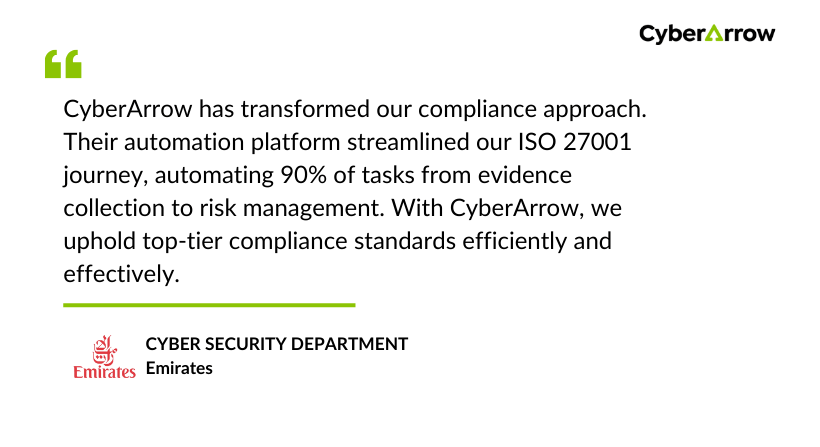
Read how Emirates enhanced Information Security by automating ISO 27001 with CyberArrow GRC.
See what Emirates has to say about CyberArrow GRC:
Final thoughts
IT asset management is more than just tracking laptops and licenses, it’s about understanding and managing every piece of technology your business depends on.
Without proper ITAM, your business risks wasting money, falling behind on security, and failing compliance audits.
But managing assets manually or in silos makes it hard to keep up, especially as your tech stack grows.
That’s why modern companies use CyberArrow GRC to bring everything together.
With seamless integration, cross-mapped compliance, and real-time visibility, CyberArrow helps you connect asset management to your overall GRC program by making it faster, smarter, and fully aligned with standards like ISO 27001, NIST, and more.
