What is hybrid cloud security? A complete guide to keeping your data safe
In a world where businesses rely on technology for nearly every operation, hybrid cloud environments have become the go-to solution for organizations seeking flexibility and scalability. However, with this shift comes an important question:
How do you ensure your data and systems are secure in a hybrid cloud setup?
This is where hybrid cloud security comes into play. It’s more than just a buzzword; it’s a vital framework for protecting your business from cyber threats while meeting regulatory compliance requirements. In this guide, we’ll explore what hybrid cloud security is, why it matters, and how organizations can effectively secure their hybrid environments.
- Understanding hybrid cloud security
- Why is hybrid cloud security important?
- Key components of hybrid cloud security
- Common challenges in hybrid cloud security
- Best practices for hybrid cloud security
- Cyber security standards prioritizing hybrid cloud security
- How CyberArrow simplifies hybrid cloud security
Understanding hybrid cloud security
Hybrid cloud security refers to the practices, tools, and strategies used to protect data, applications, and infrastructure across hybrid cloud environments. A hybrid cloud combines private cloud infrastructure with public cloud services, enabling organizations to balance cost-effectiveness, scalability, and control.
While hybrid clouds offer many benefits, their complex structure creates unique security challenges, such as:
- Data sprawl: Sensitive data is distributed across private and public clouds, increasing the risk of breaches.
- Varying security standards: Different cloud providers have different security protocols, complicating unified protection.
- Increased attack surface: A hybrid environment opens more potential entry points for cyberattacks.
Hybrid cloud security focuses on addressing these challenges through policies, technologies, and best practices to ensure that both public and private cloud components are secure.
Why is hybrid cloud security important?
1. Protecting sensitive data
In hybrid environments, sensitive information may move between private and public clouds. Securing this data is essential to prevent unauthorized access, breaches, or leaks.
2. Meeting compliance standards
Regulatory frameworks such as GDPR, ISO 27001, and HIPAA require organizations to implement robust security measures. Hybrid cloud security ensures compliance across all cloud platforms.
3. Mitigating cyber threats
With cyberattacks becoming more sophisticated, hybrid cloud environments are prime targets. A strong hybrid cloud security strategy minimizes vulnerabilities and strengthens your overall defense.
4. Ensuring business continuity
Downtime caused by security breaches can be costly. Hybrid cloud security ensures that your systems remain operational and that recovery from incidents is swift and efficient.
Key components of hybrid cloud security
Effective hybrid cloud security involves a combination of tools, policies, and practices that work together to protect your hybrid environment.
1. Data encryption
Encrypting data at rest and in transit ensures that sensitive information remains secure, even if intercepted by unauthorized parties.
2. Identity and Access Management (IAM)
IAM tools help manage who can access your hybrid cloud and what they can do. Multi-factor authentication (MFA) and role-based access controls are key features of a strong IAM strategy.
3. Network security
Firewalls, intrusion detection systems (IDS), and virtual private networks (VPNs) are critical for securing the connections between private and public cloud environments.
4. Continuous monitoring
Real-time monitoring helps detect and respond to threats quickly. It also ensures compliance by providing insights into your security posture.
5. Security policies and governance
Clearly defined security policies ensure that all teams and cloud service providers adhere to the same standards, reducing the risk of inconsistencies.
Common challenges in hybrid cloud security
While hybrid cloud security is essential, implementing it can be complex due to several challenges:
1. Lack of visibility
Managing security across multiple environments often leads to blind spots. This lack of visibility can make it difficult to detect and respond to threats.
2. Compliance complexity
Different jurisdictions and industries require compliance with various standards. Aligning your hybrid cloud setup with these requirements can be time-consuming and resource-intensive.
3. Integration issues
Ensuring that security tools and policies work seamlessly across private and public clouds can be challenging, especially when using multiple vendors.
4. Skills gap
Hybrid cloud security requires expertise in both on-premises and cloud-based systems. Many organizations struggle to find skilled personnel to manage this complexity.
Best practices for hybrid cloud security
1. Develop a unified security strategy
Align your security policies and tools across all components of your hybrid environment to ensure consistent protection.
2. Prioritize data protection
Use encryption, data loss prevention (DLP) tools, and secure backup solutions to safeguard sensitive information.
3. Conduct regular security audits
Regularly assess your hybrid cloud setup to identify vulnerabilities and ensure compliance with security standards.
4. Train employees
Human error is a major cause of security breaches. Provide ongoing cyber security training to all employees to reduce risks.
5. Collaborate with trusted vendors
Work with cloud providers that adhere to high security and compliance standards. Ensure they have certifications such as ISO 27001 or SOC 2.
Cyber security standards prioritizing hybrid cloud security
Several industry standards and frameworks address hybrid cloud security, providing guidelines for ensuring robust protection and compliance.
1. ISO/IEC 27001
This standard outlines the requirements for an Information Security Management System (ISMS) and includes specific controls for securing cloud environments.
2. General Data Protection Regulation (GDPR)
GDPR mandates strict data protection measures, including encryption and access controls, for organizations handling personal data within the European Union.
3. National Institute of Standards and Technology (NIST)
The NIST Cybersecurity Framework offers guidelines for managing and reducing cyber security risks in hybrid environments.
4. Health Insurance Portability and Accountability Act (HIPAA)
Organizations in the healthcare sector must implement robust security measures, including those applicable to hybrid cloud setups, to protect patient data.
5. Cloud Security Alliance (CSA)
The CSA provides a Cloud Controls Matrix (CCM) that outlines best practices for securing hybrid cloud environments.
How CyberArrow simplifies hybrid cloud security
Managing hybrid cloud security and compliance can be overwhelming, especially for organizations dealing with multiple standards and providers. This is where CyberArrow makes a difference.
CyberArrow helps organizations:
- Streamline compliance efforts: Automate compliance processes across frameworks like ISO 27001, GDPR, and NIST.
- Gain visibility: Centralize your security and compliance data for a clear view of your hybrid cloud environment.
- Reduce manual effort: Save time with automated reporting, monitoring, and documentation.
- Stay aligned: Ensure your hybrid cloud environment meets the highest security and compliance standards.
With CyberArrow, organizations can focus on their core operations while ensuring their hybrid cloud environment remains secure and compliant.
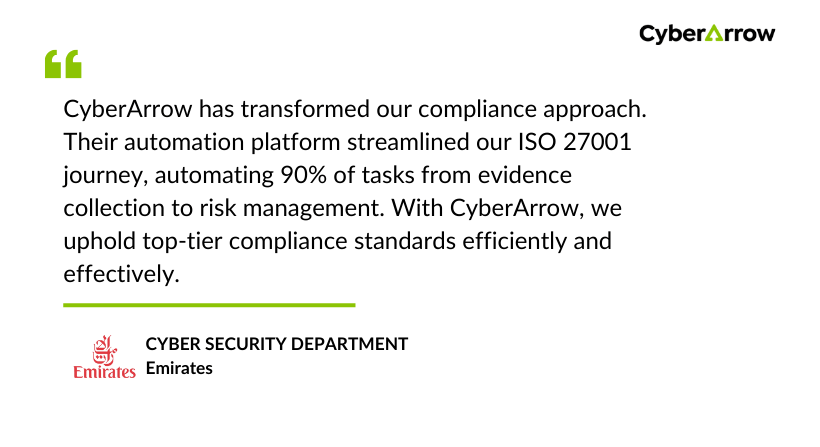
Read how Emirates enhanced Information Security by automating ISO 27001 with CyberArrow GRC.
See what Emirates has to say about CyberArrow GRC: