


What is an incident management system? A complete guide
In today’s digital world, security incidents can occur at any time. A data breach, system crash, cyberattack, or even human error can cause serious damage to a business. That’s why having a good incident management system is so important.
In this guide, we’ll explain what an incident management system is, why it matters, how it works, and how CyberArrow GRC can help your company automate and improve its incident response using global standards like ISO 27035.
- What is an incident management system?
- Why is an incident management system important?
- What happens without an incident management system?
- Key features of a strong incident management system
- What is ISO 27035?
- Steps in an effective incident management process
- How CyberArrow GRC helps automate incident management
- Final thoughts
What is an incident management system?
An incident management system is a tool or process that helps companies find, respond to, fix, and learn from security incidents.
It’s like a fire alarm system for your company’s data and IT systems. When something bad happens, the system helps you respond fast, reduce damage, and prevent it from happening again.
Security incidents may include:
- Malware or ransomware attacks.
- Data breaches or leaks.
- Unauthorized access.
- System failures.
- Phishing attempts.
- Insider threats.
- Lost devices.
Without a proper system, teams may waste time, miss important steps, or respond too slowly.
Why is an incident management system important?
Security incidents are a matter of “when,” not “if.” A strong incident management system helps your company:
- Respond quickly when something goes wrong.
- Limit the damage to your data, systems, and reputation.
- Stay compliant with industry standards.
- Keep customers, partners, and regulators informed.
- Learn from the incident to prevent it in the future.
It’s not just about fixing the issue, it’s about building trust and resilience.
Quick link: What are Intrusion Detection Systems?
What happens without an incident management system?
Companies without a proper incident management system often face:
- Delayed responses to threats.
- Missed alerts or critical information.
- Poor communication between teams.
- Incomplete or lost incident records.
- Audit failures and legal penalties.
- Loss of customer trust.
Manual response plans stored in spreadsheets or shared drives simply don’t work at scale. That’s why more businesses are moving to automated systems like CyberArrow GRC.
Key features of a strong incident management system
Here’s what a good incident management system should include:
1. Incident detection
- Monitors systems for unusual behavior.
- Sends alerts when a possible incident occurs.
- Helps detect problems early.
2. Incident logging
- Records details like what happened, when, and how.
- Tracks affected systems, users, or data.
- Assigns severity levels to each case.
3. Incident response workflow
- Guides your team through response steps.
- Assigns tasks to the right people.
- Sends reminders and status updates.
4. Root cause analysis
- Helps figure out why the incident happened.
- Suggests ways to prevent it from happening again.
5. Reporting and documentation
- Creates clear reports for audits and reviews.
- Stores incident history for future learning.
- Tracks response time and recovery time.
6. Compliance alignment
- Helps you follow standards like ISO 27035, NIST, or SOC 2.
- Shows proof of your response process for regulators.
What is ISO 27035?
ISO/IEC 27035 is a global standard for managing information security incidents. It provides guidelines on:
- Preparing for incidents.
- Detecting and reporting incidents.
- Assessing and responding to them.
- Learning from incidents.
Following ISO 27035 helps your company stay compliant, protect data, and improve its overall cyber security program.
Quick link: 16 billion Apple, Facebook, Google, and other passwords leaked
Steps in an effective incident management process
To run a smooth incident response, follow these five basic steps:
Step 1: Prepare
- Set up your incident response plan.
- Train your team.
- Define roles and responsibilities.
- Set up monitoring and alerts.
Step 2: Identify
- Detect unusual activity.
- Confirm if it’s a real incident.
- Record key details like who, what, when, and how.
Step 3: Contain
- Stop the threat from spreading.
- Limit access to affected systems.
- Keep operations running if possible.
Step 4: Eradicate and recover
- Remove malware or fix security flaws.
- Restore systems from backups.
- Test to make sure everything is clean and working again.
Step 5: Learn and improve
- Run a post-incident review.
- Find out what went wrong.
- Update policies, systems, and training.
- Share lessons with the team.
How CyberArrow GRC helps automate incident management
While CyberArrow GRC is not a dedicated incident management tool, it plays a powerful role in helping organizations meet and maintain compliance with incident response standards like ISO 27035, NIST, ISO 27001, and others.
Instead of managing incident response in isolation, CyberArrow GRC helps you integrate incident handling into your overall GRC strategy, making sure your policies, controls, and evidence are always audit-ready and aligned with global standards.
Here’s how CyberArrow GRC supports your organization’s incident response framework:
1. Align with ISO 27035 and other global standards
- CyberArrow GRC helps your team understand and meet the requirements of ISO 27035, the leading standard for incident response readiness.
- Built-in frameworks support other key standards like NIST CSF, ISO 27001, SOC 2, PCI DSS, and more.
- You can map your policies and controls to the exact clauses or controls required by these standards.
2. Cross-mapping across frameworks
- One of the most powerful features of CyberArrow GRC is cross-mapping.
- Instead of implementing the same control multiple times for different standards, CyberArrow lets you map one control to many frameworks, saving time, effort, and reducing duplication.
- This is ideal for organizations that need to comply with multiple regulations at once (e.g., ISO 27035 + NIST + ISO 27001).
3. Centralized policy and control management
- Create, approve, and distribute your incident response policies inside the platform.
- Track who has read and acknowledged each policy.
- Ensure all policies stay updated and linked to your compliance requirements.
4. Evidence collection and audit readiness
- CyberArrow helps you store and organize incident response documentation (e.g., response plans, post-incident reports, lessons learned).
- The platform automatically links this documentation to the related controls and compliance requirements, making audits faster and easier.
- Generate audit-ready reports mapped to standards like ISO 27035 with just a few clicks.
5. Risk and control visibility
- Although CyberArrow GRC doesn’t detect or respond to incidents directly, it gives your team a complete view of risk ownership, control effectiveness, and incident-related gaps.
- You can link incident response risks to related policies, assets, and business units, making your response more strategic and connected to the overall GRC program.
Read how Areeba automates ISO 27001 and ISO 22301 with CyberArrow GRC.
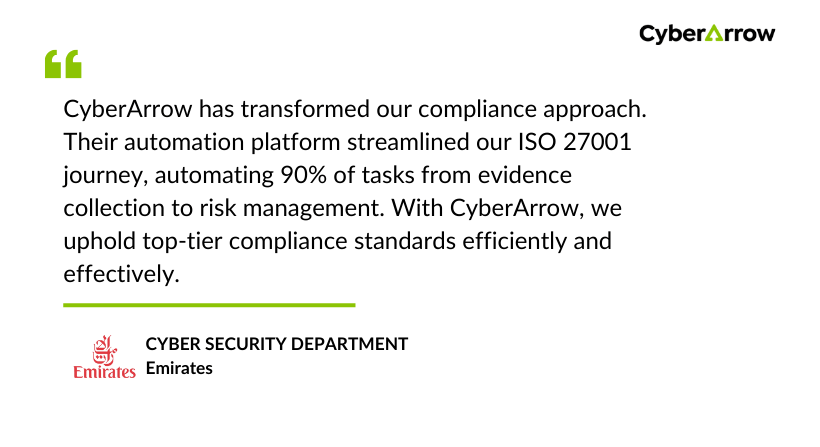
See what global brands like Emirates has to say about CyberArrow GRC:
Final thoughts
In short, CyberArrow GRC acts as the backbone for building and maintaining incident response compliance, helping your organization:
- Align with ISO 27035, NIST, and other frameworks.
- Avoid control duplication through cross-mapping.
- Keep all documentation organized and accessible.
- Prove compliance with clear, mapped evidence.
- Build a mature and integrated GRC program.
