

PCI DSS assessment: A detailed guide
Payment security is under more pressure than ever. Global credit card fraud losses reached $32 billion in 2021 and are expected to surpass $40 billion by 2026. Businesses that store, process, or transmit cardholder data cannot afford weak security practices. That is why the PCI DSS assessment is a critical step for every organization that handles payment card transactions.
A PCI DSS assessment is more than a box-checking exercise. It is a structured process that validates whether your organization complies with the Payment Card Industry Data Security Standard (PCI DSS). Without it, companies risk fines, loss of merchant privileges, and reputational damage.
This guide explains what a PCI DSS assessment is, how it works, why it matters, and how platforms like CyberArrow GRC can help you achieve compliance faster with less effort.
What is PCI DSS?
The Payment Card Industry Data Security Standard (PCI DSS) is a set of requirements designed to protect cardholder data. It was created by the PCI Security Standards Council (SSC), formed by major credit card brands including Visa, MasterCard, American Express, Discover, and JCB.
PCI DSS sets a baseline for technical and operational security controls that all organizations handling payment data must follow. It covers areas like network security, encryption, access management, monitoring, and vulnerability management.
What is a PCI DSS assessment?
A PCI DSS assessment is the process of evaluating whether an organization complies with PCI DSS requirements. It involves identifying gaps in security controls, reviewing policies and procedures, testing systems, and collecting evidence for an auditor or qualified security assessor (QSA).
The goal of the assessment is to ensure cardholder data is adequately protected, reducing the risk of breaches, fraud, and non-compliance penalties.
Why PCI DSS assessments matter
PCI DSS assessments are not optional. Any organization that stores, processes, or transmits cardholder data must comply. Failure to do so can result in:
- Financial penalties from card brands, often ranging from $5,000 to $100,000 per month of non-compliance.
- Higher transaction fees or termination of merchant accounts.
- Loss of customer trust if a data breach occurs.
- Legal liability in cases of fraud or data loss.
Beyond avoiding penalties, a PCI DSS assessment demonstrates commitment to security. According to a Verizon PCI DSS report, organizations that maintained full PCI DSS compliance had a 50% lower chance of suffering a data breach compared to those that did not.
Quick link: PCI DSS certification cost
Levels of PCI DSS assessments
Not every business undergoes the same type of PCI DSS assessment. The level depends on the transaction volume:
- Level 1: More than 6 million card transactions annually. Requires a yearly on-site assessment by a QSA.
- Level 2: 1–6 million transactions annually. Requires an annual self-assessment or QSA-led audit.
- Level 3: 20,000 to 1 million e-commerce transactions annually. Requires a self-assessment.
- Level 4: Fewer than 20,000 e-commerce transactions or fewer than 1 million total transactions annually. Requires a self-assessment.
Large enterprises face strict audits, while smaller firms often rely on the Self-Assessment Questionnaire (SAQ).
Key steps in a PCI DSS assessment
1. Define the scope
The first step is identifying which systems, applications, and processes handle or impact cardholder data. Scope reduction is critical because the fewer systems in scope, the simpler compliance becomes.
2. Conduct a gap analysis
Before the official assessment, many organizations perform a gap analysis to see where they fall short of PCI DSS requirements. This helps prioritize remediation efforts.
3. Implement controls
Controls must be put in place to meet PCI DSS requirements. This includes firewalls, encryption, logging, monitoring, and access management.
4. Collect evidence
Documentation and technical evidence must be gathered to demonstrate compliance. This is one of the most time-consuming parts of the process.
5. Perform internal testing
Vulnerability scans and penetration testing are required to verify that systems are secure.
6. Undergo the audit
For larger organizations, a QSA conducts the assessment. For smaller firms, an SAQ is submitted along with evidence.
7. Receive the report on compliance (ROC)
Upon successful completion, a ROC or Attestation of Compliance (AOC) is issued, which can be shared with banks and card brands.
Challenges with traditional PCI DSS assessments
Many companies struggle with PCI DSS because:
- Evidence collection is manual and scattered across systems.
- Policies are outdated or not enforced consistently.
- Risk assessments are static, not continuous.
- Audit readiness is reactive, not proactive.
According to Verizon’s Payment Security Report, only 27% of organizations maintain full PCI DSS compliance year-round, proving that manual approaches are ineffective.
How CyberArrow GRC simplifies PCI DSS assessments
CyberArrow GRC is an Enterprise GRC platform that automates compliance, governance, and risk management processes. It is designed to make PCI DSS assessments faster, easier, and less resource-intensive.
Zero-touch audit
Instead of spending weeks collecting screenshots and logs, CyberArrow GRC automatically gathers and organizes evidence. Auditors can access everything in real-time, cutting preparation time by up to 90%.
Automated policy management
CyberArrow comes with auditor-approved policy templates aligned with PCI DSS. Policies can be distributed, acknowledged, and tracked digitally.
Continuous monitoring
CyberArrow integrates with your existing tools to provide real-time compliance dashboards. This means you always know your PCI DSS status and can fix gaps before an audit.
Risk management
The platform includes a pre-mapped risk library for PCI DSS, helping businesses identify and mitigate risks efficiently.
Cross-mapping across frameworks
PCI DSS controls are cross-mapped with ISO 27001, NIST, SOC 2, and more. This ensures that efforts to comply with PCI DSS also help with other standards, reducing duplication.
Read how CyberArrow empowered a Fintech startup to automate PCI DSS in 3 weeks.
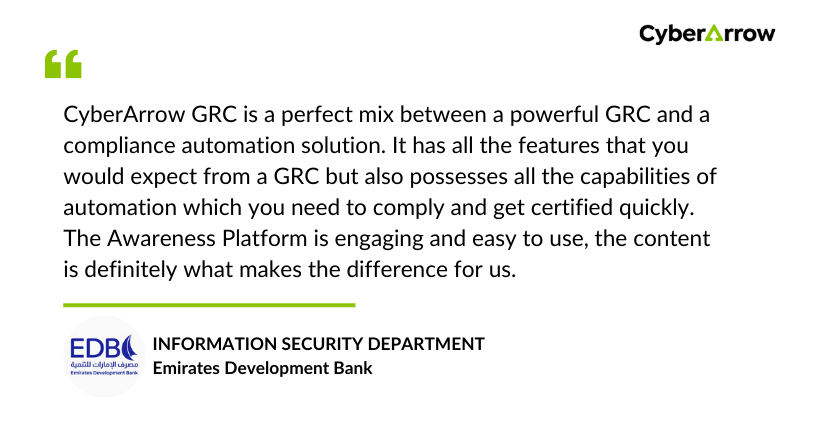
See what our clients have to say about CyberArrow GRC:
Benefits of using CyberArrow GRC for PCI DSS
- Faster compliance: Certification timelines shrink from months to weeks.
- Lower costs: Save on consultant fees and manual labor.
- Audit confidence: Always audit-ready with automated evidence.
- Scalability: Works for small firms and large enterprises alike.
- Multi-framework compliance: One platform for PCI DSS and beyond.
Conclusion
A PCI DSS assessment is not just another regulatory requirement. It is a crucial step to safeguard payment data, protect customers, and maintain trust. But traditional manual approaches to PCI DSS compliance are slow, expensive, and error-prone.
With CyberArrow GRC, organizations can put PCI DSS compliance on autopilot. From automated evidence collection to real-time dashboards and zero-touch audits, CyberArrow GRC helps you achieve compliance faster and maintain it effortlessly.
In a time when payment fraud is on the rise, companies that embrace automation will not only pass assessments but also build stronger resilience and customer confidence.
FAQs
How often is a PCI DSS assessment required?
PCI DSS assessments must be performed annually, and quarterly scans are required by an Approved Scanning Vendor (ASV).
Who conducts a PCI DSS assessment?
For Level 1 merchants, a Qualified Security Assessor (QSA) must perform the assessment. Smaller merchants can complete a Self-Assessment Questionnaire (SAQ).
How long does a PCI DSS assessment take?
Traditional assessments can take months, but with automation tools like CyberArrow GRC, the process can be completed in a few weeks.
What happens if my organization fails a PCI DSS assessment?
Failure can result in fines, higher fees, and even loss of the ability to process card payments until compliance is achieved.
Can CyberArrow GRC help with other frameworks besides PCI DSS?
Yes. CyberArrow GRC cross-maps PCI DSS requirements with ISO 27001, NIST, SOC 2, GDPR, and more, helping organizations manage multiple frameworks in one platform.
