


NIST SP 800-30: A complete guide to risk management
In today’s world, where cyber security threats continue to rise, organizations need a structured way to identify, assess, and manage risks. That is exactly what NIST SP 800-30 helps with.
Developed by the National Institute of Standards and Technology (NIST), NIST SP 800-30 is one of the most important publications for anyone responsible for protecting information systems and sensitive data.
This guide explains what NIST SP 800-30 is, why it matters, and how using a platform like CyberArrow GRC can help organizations automate compliance and risk management with confidence.
What is NIST SP 800-30?
NIST SP 800-30 stands for “Guide for Conducting Risk Assessments.” It is a key part of the broader NIST Risk Management Framework (RMF), which helps organizations build strong cyber security programs through a systematic, step-by-step approach.
The goal of NIST SP 800-30 is to help organizations understand their risks, including threats, vulnerabilities, impacts, and the likelihood of potential incidents.
This framework is not just about identifying risks. It’s about evaluating them in a way that helps organizations make smart, data-driven decisions about where to focus resources and how to strengthen defenses.
Why NIST SP 800-30 is important
Every organization faces risks, whether it’s from cyberattacks, insider threats, or system failures. The NIST SP 800-30 framework gives teams a clear roadmap to manage those risks efficiently.
Here’s why it’s important:
- Provides a structured process: It standardizes how organizations assess risk so everyone uses a consistent approach.
- Improves decision-making: By quantifying and comparing risks, organizations can prioritize what matters most.
- Supports compliance: NIST SP 800-30 aligns with many regulations and standards like ISO 27001, FedRAMP, and FISMA.
- Enhances resilience: Regular risk assessments help organizations identify gaps before they become problems.
In short, NIST SP 800-30 turns risk assessment from a guessing game into a repeatable, measurable process.
Core components of NIST SP 800-30
To make risk management simple and practical, NIST SP 800-30 divides the process into several steps. Each step builds on the previous one to ensure no detail is missed.
Let’s break them down.
1. Prepare for the assessment
The first step is to define the scope and purpose of the risk assessment. This means identifying which systems, processes, or assets will be reviewed.
Organizations also set clear objectives, for example, assessing compliance with specific frameworks like NIST 800-53 or ISO 27001. During this phase, it’s also important to select the right tools and define roles for the assessment team.
2. Identify threats
A threat is anything that can exploit a weakness in your system. NIST SP 800-30 helps teams think broadly about threats not just hackers or malware, but also natural disasters, human errors, and system failures.
Common examples include:
- Malicious insiders.
- Cyberattacks or ransomware.
- Power outages or data center failures.
- Human errors or policy violations.
This stage ensures that every possible risk source is identified and recorded.
3. Identify vulnerabilities
Once threats are known, the next step is to find vulnerabilities, the weaknesses that make those threats dangerous.
Vulnerabilities can include outdated software, weak passwords, poor access controls, or misconfigured systems.
The key is to evaluate how each vulnerability could be exploited and how severe the impact could be if that happens.
4. Determine likelihood
This step involves estimating how likely it is that a particular threat will exploit a given vulnerability.
NIST SP 800-30 provides methods for assigning likelihood ratings, which can be high, medium, or low.
These ratings are based on:
- Historical data.
- System complexity.
- Security controls in place.
- Threat intelligence sources.
5. Determine impact
Here, organizations evaluate what would happen if a threat actually occurred.
For example, what is the financial loss, operational disruption, or reputational damage?
The impact can also be rated as high, medium, or low, depending on how much harm it would cause.
By combining likelihood and impact, organizations can calculate a risk score that determines which areas need urgent attention.
6. Determine risk level
The risk level combines both likelihood and impact into a single value or category.
This helps teams prioritize their actions based on the most significant risks.
For example:
- High likelihood + High impact = Critical risk
- Low likelihood + High impact = Moderate risk
- Low likelihood + Low impact = Minor risk
This step is where data-driven prioritization happens, allowing leaders to allocate resources efficiently.
7. Recommend controls
After determining which risks are most severe, the next step is to identify controls to reduce or eliminate them.
Controls may include:
- Updating access management policies.
- Implementing encryption.
- Improving patch management.
- Training staff on cyber security best practices.
These recommendations are documented in a risk register or mitigation plan for tracking and accountability.
8. Document and communicate results
The final step is to summarize the findings and share them with key stakeholders.
Clear communication ensures that leadership, IT teams, and compliance officers all understand the current risk posture and planned mitigation efforts.
This transparency helps create a culture of accountability and continuous improvement.
Benefits of implementing NIST SP 800-30
Organizations that follow the NIST SP 800-30 framework experience several long-term benefits:
- Improved cyber security posture: Regular risk assessments help detect weak spots early, preventing security breaches before they occur.
- Regulatory compliance: NIST SP 800-30 supports alignment with major compliance frameworks such as ISO 27001, HIPAA, and GDPR.
- Better resource allocation: Risk scoring allows companies to focus budgets and efforts where they matter most.
- Informed decision-making: Leaders get a clearer understanding of their security landscape and can make smarter business decisions.
- Continuous improvement: The cyclical nature of NIST SP 800-30 ensures that risk management evolves alongside changing technologies and threats.
Challenges of manual NIST SP 800-30 compliance
While the NIST SP 800-30 framework is highly effective, implementing it manually can be difficult.
Organizations often struggle with:
- Time-consuming data collection.
- Human errors in risk scoring.
- Poor visibility across departments.
- Difficulty updating reports regularly.
Without automation, maintaining compliance with NIST standards becomes a repetitive and resource-heavy task.
Automating NIST SP 800-30 compliance with CyberArrow GRC
CyberArrow GRC is an advanced governance, risk, and compliance platform designed to make frameworks like NIST SP 800-30 easier to manage and automate.
Instead of handling risk assessments manually, CyberArrow automates the entire process from risk identification to control tracking and reporting.
Here’s how it helps:
- Centralized risk management: View all risks, threats, and controls in one dashboard.
- Automated risk scoring: Assign likelihood and impact automatically based on pre-defined rules.
- Continuous monitoring: Keep your risk posture up to date with live data feeds and alerts.
- Built-in compliance frameworks: Align easily with NIST, ISO, and other global standards.
- AI-powered insights: Get recommendations for improving controls and mitigating high-risk areas.
With CyberArrow GRC, organizations can achieve NIST compliance faster, reduce audit fatigue, and maintain an always-ready security posture.
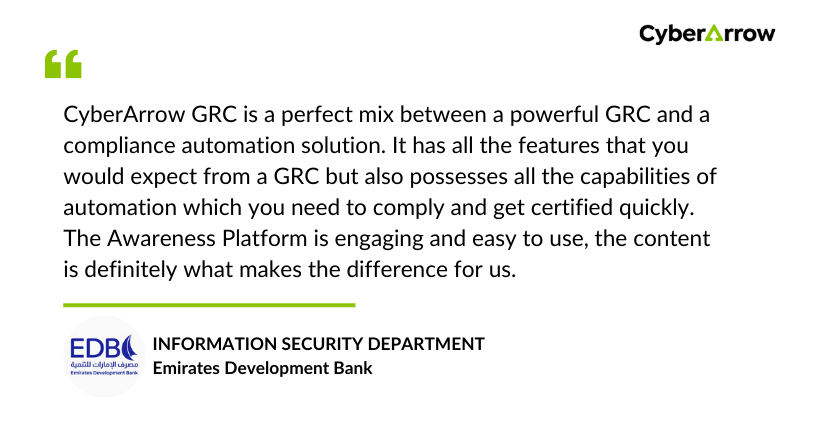
See what our clients have to say about CyberArrow GRC:
Conclusion
NIST SP 800-30 is one of the most essential tools for any organization looking to manage cyber security risks effectively. It offers a clear, structured, and repeatable approach to identifying and mitigating threats.
However, doing this manually is no longer practical in today’s fast-changing threat landscape.
CyberArrow GRC bridges that gap by automating every part of the NIST risk management process, saving time, improving accuracy, and helping companies stay compliant year-round.
By adopting automation with CyberArrow GRC, organizations not only meet NIST SP 800-30 requirements but also strengthen their entire security ecosystem for the future.
FAQs
What is NIST SP 800-30 used for?
NIST SP 800-30 is a guide created by the National Institute of Standards and Technology (NIST) to help organizations perform risk assessments. It provides a step-by-step process to identify, evaluate, and manage cyber security risks. By following NIST SP 800-30, organizations can make smarter decisions about which risks to prioritize and how to protect their systems more effectively.
How does NIST SP 800-30 fit into the NIST Risk Management Framework?
NIST SP 800-30 supports the NIST Risk Management Framework (RMF) by focusing specifically on the risk assessment phase. It helps organizations understand potential threats, vulnerabilities, and their impacts before choosing security controls. This makes it a key starting point for building a strong and compliant cyber security program under the NIST RMF.
Can NIST SP 800-30 risk assessments be automated?
Yes, risk assessments based on NIST SP 800-30 can be automated using tools like CyberArrow GRC. CyberArrow GRC simplifies the entire process by automatically identifying risks, assigning scores, and generating reports. This saves time, reduces human error, and ensures continuous compliance with NIST and other security frameworks.
