

ISO 27001 requirements for SaaS: A practical guide for security and compliance
SaaS companies manage large amounts of sensitive data every day. This includes customer information, business data, user credentials, application logs, and integration data. Because SaaS platforms are internet-facing and cloud-based, they are frequent targets for cyber attacks. Customers, partners, and regulators expect SaaS providers to prove that their systems are secure.
ISO 27001 is one of the most trusted standards for information security. It helps SaaS companies build a structured security program that protects data, manages risk, and supports compliance. This guide explains the ISO 27001 requirements for SaaS, how they apply to cloud and software environments, and how SaaS teams can implement them in a practical way.
- Why ISO 27001 is important for SaaS companies
- What ISO 27001 requires from SaaS organizations
- ISO 27001 Clauses Explained for SaaS
- ISO 27001 Annex A controls for SaaS
- A.5 Information security policies
- A.6 Organization of information security
- A.7 Human resource security
- A.8 Asset management
- A.9 Access Control
- A.10 Cryptography
- A.11 Physical and environmental security
- A.12 Operations security
- A.13 Communications security
- A.14 System development and maintenance
- A.15 Supplier and third-party management
- A.16 Information security incident management
- A.17 Business continuity management
- A.18 Compliance
- How SaaS companies can implement ISO 27001
- Common ISO 27001 challenges for SaaS
- How CyberArrow GRC helps SaaS meet ISO 27001 requirements
- Conclusion
- FAQs
Why ISO 27001 is important for SaaS companies
SaaS companies operate in dynamic and fast-growing environments. They release new features often, rely on cloud infrastructure, integrate with many third-party tools, and serve customers across different regions.
ISO 27001 is important for SaaS companies because it:
- Protects customer and business data.
- Reduces the risk of data breaches.
- Builds trust with enterprise customers.
- Supports sales and security reviews.
- Helps meet regulatory and contractual requirements.
- Improves internal security maturity.
Many SaaS buyers require ISO 27001 before signing contracts.
What ISO 27001 requires from SaaS organizations
ISO 27001 requires organizations to create and maintain an Information Security Management System. The ISMS includes people, processes, policies, and technology controls that protect information assets.
The requirements fall into two main groups:
- ISO 27001 Clauses 4 to 10.
- Annex A security controls.
Both are required for certification.
ISO 27001 Clauses Explained for SaaS
Clause 4: Context of the Organization
SaaS companies must understand their business environment and security risks.
Key SaaS considerations include:
- Cloud infrastructure usage.
- Multi-tenant architecture.
- Customer data sensitivity.
- Regulatory exposure.
- Third-party integrations.
- Remote workforce.
The organization must document internal and external factors that affect security.
Clause 5: Leadership
Leadership must support the ISMS.
Key requirements include:
- Approving an information security policy.
- Assigning security roles.
- Supporting security objectives.
- Promoting a security culture.
For SaaS companies, leadership involvement is important because security impacts growth and customer trust.
Clause 6: Planning
Planning focuses on risk management.
Key requirements include:
- Identifying information security risks.
- Assessing risk likelihood and impact.
- Defining risk treatment actions.
- Setting security objectives.
Common SaaS risks include account takeover, misconfigured cloud services, insecure APIs, and insider threats.
Clause 7: Support
Support includes people, tools, and documentation.
Key requirements include:
- Security training for employees.
- Documented policies and procedures.
- Controlled access to ISMS documents.
- Secure internal communication.
Developers, support teams, and operations staff must understand their security responsibilities.
Clause 8: Operation
This clause covers how the ISMS operates daily.
Key requirements include:
- Running risk assessments regularly.
- Managing security incidents.
- Applying risk treatment plans.
- Maintaining secure operations.
SaaS platforms must balance security with continuous delivery.
Clause 9: Performance evaluation
SaaS companies must measure ISMS performance.
Key requirements include:
- Internal audits.
- Management reviews.
- Monitoring security metrics.
Dashboards and reports help track progress.
Clause 10: Improvement
Organizations must improve security continuously.
Key requirements include:
- Identifying non-conformities.
- Taking corrective actions.
- Updating controls and processes.
Continuous improvement helps SaaS companies stay secure as they scale.
ISO 27001 Annex A controls for SaaS
Annex A contains specific security controls. Many of these are critical for SaaS environments.
A.5 Information security policies
SaaS companies must document security policies that cover:
- Data protection.
- Access management.
- Secure development.
- Incident response.
- Cloud usage.
Policies guide employees and support audits.
A.6 Organization of information security
Clear roles reduce risk.
Key practices include:
- Defined security ownership.
- Separation of duties.
- Secure project management.
A.7 Human resource security
Employees introduce security risk.
Key controls include:
- Background checks.
- Confidentiality agreements.
- Role-based access.
- Secure onboarding and offboarding.
A.8 Asset management
SaaS assets include:
- Cloud services.
- Databases.
- APIs.
- Source code repositories.
- Customer data.
Assets must be inventoried, classified, and protected.
A.9 Access Control
Access control is essential for SaaS platforms.
Key controls include:
- Least privilege access.
- Multi-factor authentication.
- Secure API authentication.
- Regular access reviews.
A.10 Cryptography
Encryption protects SaaS data.
Key areas include:
- Data at rest.
- Data in transit.
- Encryption key management.
Encryption is critical for protecting customer data.
A.11 Physical and environmental security
Even cloud-based SaaS companies have physical risks.
Key controls include:
- Secure offices.
- Device security.
- Data center security through cloud providers.
A.12 Operations security
Operations security keeps SaaS platforms stable.
Key controls include:
- Logging and monitoring.
- Patch management.
- Malware protection.
- Backup and recovery.
Downtime impacts customer trust.
A.13 Communications security
SaaS systems communicate constantly.
Key controls include:
- Secure network connections.
- Protected APIs.
- Encrypted data transfers.
A.14 System development and maintenance
Secure development is essential for SaaS.
Key practices include:
- Secure coding standards.
- Code reviews.
- Testing before release.
- Protecting development environments.
A.15 Supplier and third-party management
SaaS companies rely on many vendors.
Examples include:
- Cloud providers.
- Payment processors.
- Monitoring tools.
Vendors must be assessed and monitored.
A.16 Information security incident management
SaaS companies must respond quickly to incidents.
Key controls include:
- Incident detection.
- Response procedures.
- Communication plans.
A.17 Business continuity management
Availability is critical for SaaS.
Key controls include:
- Disaster recovery plans.
- Backup testing.
- Redundant infrastructure.
A.18 Compliance
SaaS companies must comply with:
- Data protection laws.
- Contractual obligations.
- Industry standards.
ISO 27001 supports structured compliance management.
How SaaS companies can implement ISO 27001
Step 1: Build an ISMS team
Include security, engineering, operations, and leadership.
Step 2: Identify SaaS assets and data
Understand where customer data lives and how it flows.
Step 3: Perform risk assessments
Focus on cloud, API, and access risks.
Step 4: Apply Annex A controls
Match controls to identified risks.
Step 5: Train employees
Security awareness is critical across all teams.
Step 6: Maintain audit evidence
Keep documentation updated throughout the year.
Common ISO 27001 challenges for SaaS
SaaS companies often face:
- Manual evidence collection.
- Scattered documentation.
- Repeated customer security reviews.
- Limited compliance visibility.
- Audit pressure.
Automation helps reduce these challenges.
How CyberArrow GRC helps SaaS meet ISO 27001 requirements
CyberArrow GRC helps SaaS companies manage ISO 27001 requirements through automation and centralization.
Key benefits include:
- Built-in ISO 27001 control library.
- Automated evidence collection.
- Risk assessment workflows.
- Policy management and approvals.
- Vendor risk management.
- Audit-ready documentation.
- Real-time compliance dashboards.
CyberArrow GRC reduces manual work and helps SaaS teams stay audit-ready at all times.
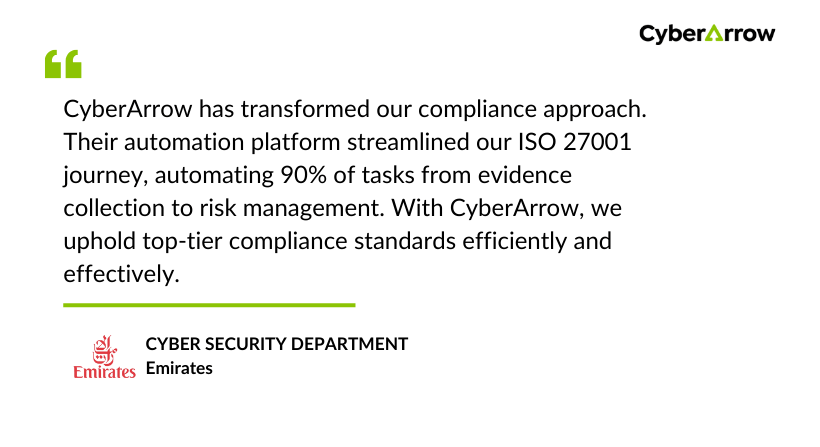
Read how Emirates enhanced Information Security by automating ISO 27001 with CyberArrow GRC.
See what Emirates has to say about CyberArrow GRC:
Conclusion
ISO 27001 is essential for SaaS companies that want to protect customer data, manage security risks, and build trust with enterprise buyers. The standard provides a clear and structured approach to information security that supports growth and innovation.
Managing ISO 27001 manually can slow teams down and increase risk. CyberArrow GRC provides the automation, visibility, and structure SaaS companies need to meet ISO 27001 requirements with confidence.
For SaaS organizations looking to strengthen security and simplify compliance, CyberArrow GRC is the right platform to support long term success.
FAQs
What ISO 27001 requirements are most important for SaaS companies?
The most important ISO 27001 requirements for SaaS companies include risk assessments, access control, encryption, secure development practices, incident response, and vendor risk management. These controls help protect customer data and reduce security risks in cloud-based environments.
Why do enterprise customers ask SaaS providers for ISO 27001?
Enterprise customers want proof that a SaaS provider can protect sensitive data. ISO 27001 shows that the company follows a structured security program, manages risks properly, and maintains strong controls. This helps build trust and supports faster sales decisions.
How can SaaS companies manage ISO 27001 compliance more efficiently?
SaaS companies can improve efficiency by using a centralized GRC platform to manage risks, controls, policies, and audit evidence. Tools like CyberArrow GRC reduce manual work, improve visibility, and keep teams audit-ready throughout the year.
