

ISO 27001 requirements for healthcare: A practical guide for security and compliance
Healthcare organizations handle some of the most sensitive information in the world. Patient records, medical results, billing data, insurance records, and clinical research must all be protected with strong security controls. At the same time, healthcare teams face strict regulations, advanced cyber threats, and technology systems that change fast. Because of this, ISO 27001 has become one of the most trusted frameworks for helping healthcare providers build a complete and mature information security program.
This guide explains the ISO 27001 requirements for healthcare, how they apply to real settings such as hospitals, clinics, labs, telehealth systems, and insurance companies, and how healthcare organizations can meet these requirements in a practical and effective way.
- What is ISO 27001 and why it matters in healthcare
- Why healthcare needs strong ISO 27001 requirements
- ISO 27001 requirements for healthcare: Key areas
- ISO 27001 clauses: Core requirements for healthcare
- ISO 27001 Annex A controls: Healthcare focus areas
- A.5 Information security policies
- A.6 Organization of information security
- A.7 Human resource security
- A.8 Asset management
- A.9 Access control
- A.10 Cryptography
- A.11 Physical security
- A.12 Operations security
- A.13 Communications security
- A.14 System acquisition, development, and maintenance
- A.15 Third-party management
- A.16 Incident management
- A.17 Business continuity
- A.18 Compliance
- How healthcare organizations can meet ISO 27001 requirements
- How CyberArrow GRC helps healthcare meet ISO 27001 requirements
- Conclusion
- FAQs
What is ISO 27001 and why it matters in healthcare
ISO 27001 is a global standard for information security management. It helps organizations build an Information Security Management System, often called an ISMS. The ISMS includes controls, policies, risk processes, and monitoring systems that protect important information.
Healthcare organizations choose ISO 27001 because:
- They handle sensitive medical data.
- They must comply with strict regulations.
- They face growing cyber attacks.
- They use many third-party vendors.
- They depend on complex medical systems.
ISO 27001 also improves trust with patients, partners, insurers, and auditors.
Why healthcare needs strong ISO 27001 requirements
Healthcare data is a high-value target for attackers. Cyber criminals often steal patient records, attack hospital systems, or disrupt medical devices.
Healthcare faces challenges such as:
- Outdated systems and medical devices.
- Many employees with access to sensitive data.
- Shift-based work patterns.
- Remote healthcare and telemedicine.
- Third-party system integrations.
- Cloud platforms used for storage and imaging.
- Ransomware attacks.
These risks make ISO 27001 an essential framework for healthcare security.
ISO 27001 requirements for healthcare: Key areas
ISO 27001 has many requirements that apply across industries, but some are especially important in healthcare. These include both ISMS requirements from Clauses 4 to 10 and technical controls from Annex A.
Below is a detailed breakdown designed for healthcare environments.
ISO 27001 clauses: Core requirements for healthcare
Clause 4: Context of the organization
Healthcare organizations must understand internal and external factors that affect security. This includes patient data risks, number of staff, location of systems, types of medical devices, and regulatory requirements.
Key tasks
- Identify relevant regulations such as HIPAA or national privacy laws.
- Define patient data types and storage locations.
- Identify third-party providers such as labs or telehealth platforms.
Clause 5: Leadership
Healthcare leadership must show commitment to the ISMS.
Key tasks
- Assign a security team.
- Create an information security policy.
- Ensure staff follow security requirements.
Leadership is important because healthcare has many staff members and rotating shifts.
Clause 6: Planning
Healthcare organizations must identify and plan for risks.
Key tasks
- Perform a full risk assessment.
- Identify threats to patient data.
- Create a risk treatment plan.
Common risks include unauthorized access, misconfigured medical devices, and ransomware.
Clause 7: Support
Support includes employees, training, and documented information.
Key tasks
- Train all staff members in data security.
- Keep accurate policies and procedure documents.
- Ensure secure communication practices.
Training is extremely important in healthcare because small mistakes can cause major incidents.
Clause 8: Operation
Healthcare organizations must operate the ISMS in a structured way.
Key tasks
- Run risk assessments regularly.
- Manage incidents such as data breaches.
- Keep records of corrective actions.
Operational security includes everything from access control to equipment maintenance.
Clause 9: Performance evaluation
The healthcare ISMS must be monitored and reviewed.
Key tasks
- Internal audits.
- Management reviews.
- Performance reports.
Hospitals often use dashboards to monitor compliance and security status.
Clause 10: Improvement
Healthcare organizations must fix problems quickly.
Key tasks
- Identify non-conformities.
- Apply corrective actions.
- Improve controls over time.
This helps healthcare teams stay prepared for audits and threats.
ISO 27001 Annex A controls: Healthcare focus areas
Annex A contains detailed security controls. Many of these are especially important for healthcare.
A.5 Information security policies
Healthcare providers must create clear policies that cover:
- Patient data access.
- Device usage.
- Passwords.
- Logging and monitoring.
- Telemedicine security.
Policies must be easy for staff to understand.
A.6 Organization of information security
Healthcare organizations must assign roles and responsibilities.
Examples
- Medical IT teams manage systems.
- Security officers handle incidents.
- Department heads approve access.
- Vendors follow security rules.
A.7 Human resource security
Staff risks are high in healthcare due to large teams.
Key controls
- Background checks.
- Confidentiality agreements.
- Role-based onboarding.
- Termination access removal.
A.8 Asset management
Healthcare has many assets, including:
- Medical devices.
- Patient monitoring tools.
- Imaging systems like MRI and CT.
- Electronic health record platforms.
- Cloud storage systems.
Organizations must track and classify all assets.
A.9 Access control
This is one of the most important ISO 27001 requirements.
Key controls
- Least privilege access.
- Strong authentication for staff.
- Segmentation between departments.
- Secure access for telehealth systems.
Healthcare access control prevents unauthorized viewing of patient data.
A.10 Cryptography
Encryption is required for:
- Patient records.
- Backup data.
- Lab results.
- Billing information.
- Telemedicine sessions.
This protects data in storage and during transmission.
A.11 Physical security
Healthcare facilities are open to many people, which increases risk.
Key controls
- Secured server rooms.
- Access badges.
- CCTV.
- Locked medication and document rooms.
A.12 Operations security
Operations security protects medical systems and infrastructure.
Key controls
- Log management.
- Patch management.
- Malware protection.
- Backup processes.
- Change management.
Hospitals rely on 24-hour uptime, so operations security must be strong.
A.13 Communications security
Healthcare systems share data across many platforms.
Key controls
- Secure network connections.
- Protected APIs.
- Encrypted email for patient data.
- Vendor communication rules.
A.14 System acquisition, development, and maintenance
New medical systems, apps, and tools must follow secure development practices.
Examples:
- Telehealth apps.
- Patient portals.
- Clinical software updates.
Security must be included from the start.
A.15 Third-party management
Healthcare organizations depend heavily on third parties.
Examples:
- Cloud platforms.
- Labs.
- Pharmacies.
- Billing partners.
Vendors must be evaluated and monitored for security risks.
A.16 Incident management
Healthcare must respond to incidents fast.
Examples include:
- Data breaches.
- Mistaken data sharing.
- System outages.
- Ransomware attacks.
Organizations must have a clear incident response plan.
A.17 Business continuity
Medical services cannot stop, even during cyber attacks.
Key controls
- Disaster recovery.
- Redundant systems.
- Backup power.
- Communication plans.
ISO 27001 requires strong continuity planning.
A.18 Compliance
Healthcare teams must comply with:
- Data protection laws.
- Medical regulations.
- Internal policies.
- Contractual obligations.
ISO 27001 helps maintain consistent compliance.
How healthcare organizations can meet ISO 27001 requirements
Below is a step-by-step implementation plan tailored for healthcare providers.
Step 1: Build an ISMS team
Include:
- Security officers.
- IT managers.
- Clinical staff.
- Compliance specialists.
Step 2: Classify healthcare data
Define:
- Patient health data.
- Imaging data.
- Billing information.
- Operational data.
This helps assign the right controls.
Step 3: Perform a risk assessment
Identify risks related to:
- Unauthorized access.
- Medical device failure.
- Cloud storage.
- Vendor systems.
- Outdated equipment.
Step 4: Apply Annex A controls
Match controls directly to healthcare risks.
Step 5: Train staff across all departments
Training topics include:
- Security awareness.
- Data handling.
- Password rules.
- Phishing protection.
- Patient data rights.
Step 6: Prepare for audits
Create evidence folders for:
- Policies.
- Risk registers.
- Logs.
- Incident reports.
- Access reviews.
Manual preparation is time-consuming, which is why many healthcare teams use automation.
How CyberArrow GRC helps healthcare meet ISO 27001 requirements
CyberArrow GRC supports healthcare organizations by providing a fully automated and structured approach to compliance.
Key benefits include:
- Automated evidence collection.
- Ready-made ISO 27001 control library.
- Detailed risk assessment modules.
- Policy management with approvals.
- Workflow automation for tasks.
- Vendor risk management tools.
- Real-time compliance dashboards.
- Cross framework mapping for HIPAA, NIST, and more.
CyberArrow GRC simplifies ISO 27001 compliance while reducing manual work, audit stress, and documentation gaps. It helps healthcare providers stay secure, compliant, and organized throughout the year.
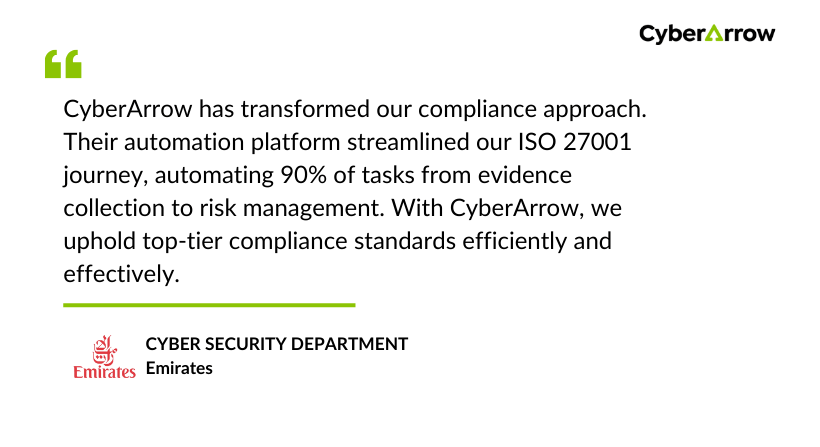
See what our clients have to say about CyberArrow GRC:
Conclusion
ISO 27001 is one of the most effective ways for healthcare organizations to strengthen security, protect patient data, and meet regulatory expectations. The healthcare sector faces high levels of risk from outdated devices, large staff numbers, third parties, and remote care technologies. Implementing ISO 27001 requirements helps reduce these risks and build a secure and trusted environment.
However, managing ISO 27001 manually can be difficult. CyberArrow GRC provides automation, structure, and visibility across the entire healthcare compliance program. It helps teams save time, avoid mistakes, and stay audit-ready at all times.
For healthcare organizations that want to improve security, reduce risk, and achieve ISO 27001 compliance with confidence, CyberArrow GRC is the best platform to support that journey.
FAQs
What are the most important ISO 27001 requirements for healthcare?
The most important ISO 27001 requirements for healthcare include access control, risk assessments, asset management, incident response, vendor management, and protection of patient data. These controls help healthcare providers reduce risks linked to medical systems, staff access, and sensitive clinical information.
How does ISO 27001 help healthcare organizations protect patient data?
ISO 27001 provides a complete set of policies and controls that guide how patient data is stored, shared, accessed, and protected. It helps healthcare teams prevent unauthorized access, secure medical devices, protect cloud systems, and respond to security incidents in a structured way.
Can ISO 27001 work together with healthcare regulations like HIPAA?
Yes. ISO 27001 supports many HIPAA requirements because both focus on protecting health information. Many healthcare organizations use ISO 27001 to strengthen risk management, improve documentation, and stay compliant with both HIPAA and security best practices. It also helps maintain year-round audit readiness.
