

ISO 27001 checklist: Implementation guide + free ISO 27001 checklist
ISO 27001 implementation is a critical step for organizations that want to secure their information systems and ensure the safety of their IT environments. However, the path to ISO 27001 compliance is often daunting. Many organizations feel overwhelmed by the standard’s complexity and scope; some even struggle to figure out where to begin the implementation process.
To address this challenge, we present a comprehensive ISO 27001 implementation checklist. This checklist offers a practical roadmap to guide organizations through the essential steps to achieve ISO 27001 compliance. Whether you are just starting out or looking to streamline your current processes, our checklist will provide a clear and structured approach.
Let’s dive into the implementation steps for the ISO 27001 checklist!
- ISO 27001 checklist: 15 steps for implementation
- 1. Get stakeholder buy-in and support
- 2. Define the scope
- 3. Establish an implementation team and assign roles
- 4. Conduct an inventory of information assets
- 5. Conduct a risk assessment
- 6. Develop a risk treatment plan
- 7. Complete the statement of applicability (SoA)
- 8. Establish an ISMS policy
- 9. Implement ISO 27001 controls
- 10. Develop required documentation
- 11. Provide training and awareness to employees
- 12. Conduct internal audits
- 13. Get management reviews
- 14. Implement corrective actions
- 15. Prepare for ISO 27001 certification audit
- How CyberArrow helped MoIAT achieve ISO 27001 compliance?
- Achieve ISO 27001 certification with CyberArrow
ISO 27001 checklist: 15 steps for implementation
Obtaining ISO 27001 certification is a significant milestone for many organizations, and it can open doors to new business opportunities and markets.
We have compiled a comprehensive checklist to guide you through the ISO 27001 implementation and certification process. Here are the steps for ISO 27001 implementation:
1. Get stakeholder buy-in and support
Secure stakeholder buy-in and support for the successful implementation of ISO 27001. Here’s how you can achieve this:
- Present the benefits: Explain the importance of ISO 27001 certification and highlight benefits such as enhanced information security, compliance with regulations, and improved business reputation.
- Demonstrate the requirements: Outline the resources, time, and effort required for the implementation process to ensure stakeholders understand what is involved.
- Engage key stakeholders: Identify and involve key stakeholders from various departments to gain commitment and support for the ISMS implementation.
2. Define the scope
Each organization’s ISO 27001 certification process will vary depending on the ISMS setup. Follow these steps to establish the scope of your ISMS:
- Decide coverage: Determine which business areas, processes, and assets should be included in the ISMS and which will be excluded.
- Identify information types: Consider the types of data your organization handles and how they are processed, stored, and transmitted.
- Document the scope: Document the boundaries and applicability of the ISMS to provide a focused implementation framework.
- Communicate the scope: Ensure all stakeholders understand the defined scope and their roles within it.
3. Establish an implementation team and assign roles
Form a dedicated implementation team to manage the ISO 27001 process. Steps to establish an effective team include:
- Assemble the team: Gather a cross-functional team with members from different departments such as IT, HR, and legal.
- Assign responsibilities: Clearly define and allocate roles and responsibilities to each team member, ensuring all tasks are covered.
4. Conduct an inventory of information assets
Identify and document your information assets so everyone knows what assets the ISMS will protect. To conduct an inventory:
- List all assets: Create a comprehensive list of all information assets, including hardware, software, data, and personnel.
- Classify assets: Categorize assets based on their importance and sensitivity.
- Assess ownership: Identify the owners and custodians of each asset to establish accountability.
5. Conduct a risk assessment
Perform a thorough risk assessment to identify potential threats and vulnerabilities. Steps to conduct a risk assessment include:
- Identify risks: List potential threats and vulnerabilities related to your information assets. You can also make a risk register to keep information about threats and vulnerabilities.
- Evaluate impact and likelihood: Assess each identified risk’s potential impact and likelihood.
- Prioritize risks: Rank risks based on their severity to focus on the most critical areas.
6. Develop a risk treatment plan
A risk treatment plan outlines how identified risks will be managed. To develop this plan:
- Select controls: Choose appropriate controls from ISO 27001’s Annex A to mitigate identified risks.
- Implement measures: Determine how selected controls will be applied to reduce risks to acceptable levels.
- Document actions: Record the risk treatment measures and how they will be implemented.
7. Complete the statement of applicability (SoA)
The Statement of Applicability (SoA) summarizes the controls chosen for risk treatment. To complete the SoA:
- Identify applicable controls: Review Annex A of ISO 27001 and identify which controls are relevant to your organization.
- Justify exclusions: Provide reasons for excluding any controls from the SoA.
- Document the SoA: Create a document that outlines the selected controls and their applicability.
8. Establish an ISMS policy
An ISMS policy sets the foundation for your information security management. To establish this policy:
- Define objectives: Outline the main objectives and commitments of your ISMS.
- Align with organizational goals: Ensure the policy aligns with the overall goals and values of the organization.
- Communicate the Policy: Make the policy accessible to all employees and stakeholders.
9. Implement ISO 27001 controls
Implementing controls to mitigate risks. Steps to implement these controls include:
- Apply technical controls: Implement encryption, access controls, and network security measures.
- Implement organizational controls: Establish policies, procedures, and training programs.
- Monitor effectiveness: Regularly check the effectiveness of implemented controls and make adjustments as needed.
10. Develop required documentation
Proper documentation is vital for ISO 27001 compliance. To develop the required documentation:
- Create policies and procedures: Develop documents outlining security policies, procedures, and guidelines.
- Maintain records: Keep records of risk assessments, audits, training, and other relevant activities.
- Ensure accessibility: Make documentation easily accessible to relevant personnel.
11. Provide training and awareness to employees
Training and awareness programs ensure employees understand their roles in information security. To provide practical training:
- Conduct regular training sessions: Organize sessions to educate employees on ISO 27001 requirements and security best practices.
- Raise awareness: Implement awareness programs to keep information security in people’s minds.
- Evaluate understanding: Assess the effectiveness of training programs through tests and feedback.
12. Conduct internal audits
Internal audits help evaluate the ISMS’s performance. To conduct internal audits:
- Plan audits: Schedule regular internal audits to review the ISMS’s effectiveness.
- Perform audits: Conduct thorough audits to identify non-conformities and areas for improvement.
- Document findings: Record audit findings and take necessary corrective actions.
13. Get management reviews
Regular management reviews ensure the ISMS remains practical and relevant. To conduct management reviews:
- Schedule reviews: Plan periodic reviews with top management.
- Assess performance: Evaluate the ISMS’s performance, review security incidents, and ensure alignment with organizational goals.
- Implement improvements: Make decisions on necessary improvements and resource allocation.
14. Implement corrective actions
Address non-conformities, improve the ISMS for continuous improvement, and achieve ISO 27001 certification. To implement corrective actions:
- Identify non-conformities: Recognize issues found during audits and reviews.
- Develop action plans: Create plans to correct identified issues and prevent recurrence.
- Monitor progress: Track the implementation of corrective actions and assess their effectiveness.
15. Prepare for ISO 27001 certification audit
Preparing for the certification audit is the final step. To prepare effectively:
- Engage a certification body: Choose an accredited certification body for the ISO 27001 audit.
- Ensure documentation is complete: Verify that all required documents and records are in order.
- Conduct a pre-audit assessment: Perform a final internal review to ensure readiness for the external audit.
- Prepare employees: Ensure employees know the audit process and their roles in demonstrating compliance.
How CyberArrow helped MoIAT achieve ISO 27001 compliance?
MoIAT, a UAE government entity, previously spent 500-600 hours preparing for an audit for one standard. This made the process time-consuming and costly.
CyberArrow’s compliance automation solution reduced MoIAT’s implementation time by 80%, eliminated the need for third-party consultants, and enabled certification without physical audits.
See what MoIAT officials say about CyberArrow:
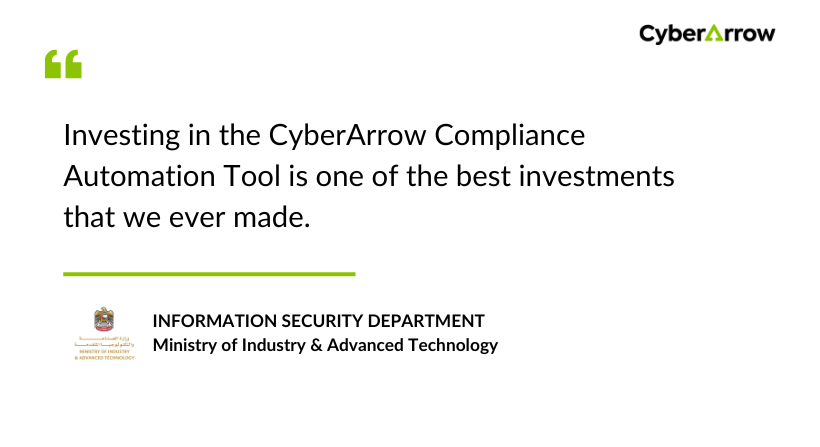
CyberArrow helped MoIAT enhance its cybersecurity resilience and compliance maturity by automating risk identification and treatment based on the latest best practices.
Achieve ISO 27001 certification with CyberArrow
When done manually, the ISO 27001 implementation process can be time-consuming and prone to errors. However, CyberArrow automates the compliance process, making it easier for organizations to achieve ISO 27001 certification.
Here’s what CyberArrow offers:
- Expert chat support.
- Automated KPI tracking.
- Easy risk register generation.
- Real-time security posture sharing.
- Pre-approved auditor templates for faster compliance.
- Automatic evidence collection through technical integration.
Take the first step towards effortless ISO 27001 certification with CyberArrow.
