

ISO 27001 access control policy template: How to write it and what to include
Access control is one of the most important areas in ISO 27001. It ensures that only authorized users can access information, systems, and resources. Weak access controls often lead to data breaches, insider threats, and compliance failures. For this reason, ISO 27001 requires organizations to create and maintain a structured access control policy.
The access control policy explains how users are granted access, how that access is reviewed, how changes are made, and how sensitive information is protected.
This guide explains how to write an ISO 27001 access control policy, what content it must include, and how to use it during audits and certification.
- What is an ISO 27001 access control policy
- Why ISO 27001 requires an access control policy
- Who owns the access control policy
- Key requirements of an ISO 27001 access control policy
- ISO 27001 and Annex A controls for access control
- How to write an ISO 27001 access control policy
- Step 1: Define scope
- Step 2: Define roles and responsibilities
- Step 3: Define access provisioning rules
- Step 4: Define access review rules
- Step 5: Define offboarding rules
- Step 6: Define authentication and authorization rules
- Step 7: Define privileged access rules
- Step 8: Define third-party access rules
- Step 9: Define logging and monitoring expectations
- Step 10: Define approval and review process
- ISO 27001 access control policy template
- Using the policy for ISO 27001 certification
- Common mistakes to avoid
- Why tools help with access control policies
- How CyberArrow GRC helps
- Conclusion
- FAQs
What is an ISO 27001 access control policy
An access control policy is a document that sets rules for managing user access to systems, applications, networks, and data. It defines who has access, how access is granted, and under what conditions access can be changed or removed.
In ISO 27001, every organization must have an access control policy because it ensures that controls are applied consistently across the environment. It also supports the principle of least privilege and reduces the chance of unauthorized access.
Why ISO 27001 requires an access control policy
ISO 27001 is built on risk-based security. Access control plays a major role in reducing risks related to:
- Data breaches.
- Unauthorized access.
- Insider misuse.
- Credential theft.
- Privilege escalation.
A written policy helps organizations:
- Standardize how access decisions are made.
- Remove guesswork and tribal knowledge.
- Show compliance during audits.
- Reduce manual errors.
- Support secure onboarding and offboarding.
- Align with internal and regulatory requirements.
Without a policy, access decisions become inconsistent and harder to justify during certification.
Who owns the access control policy
Ownership depends on the structure of the organization, but most policies are owned by:
- IT managers.
- Information security teams.
- ISMS managers.
- CISOs.
However, other teams participate in the process, including:
- HR
- Application owners.
- Cloud engineering.
- Internal audit.
HR involvement is important because onboarding and offboarding flow through HR systems and processes.
Key requirements of an ISO 27001 access control policy
Although ISO 27001 does not dictate exact wording, it expects the policy to cover specific areas of access control.
The policy should cover topics such as:
- User access provisioning: Defines how access is granted to users based on job roles.
- User access review: Ensures that access is still valid and privileges are correct.
- User deprovisioning: Removes access when users leave or change roles.
- Authentication: Defines how users prove their identity, including the use of passwords or MFA.
- Authorization: Defines what users are allowed to do based on permissions and roles.
- Privileged access management: Controls accounts with higher privileges, such as administrators or super users.
- Least privilege principle: Ensures users only receive access required for their job.
- Segregation of duties: Prevents misuse by splitting critical tasks between different users.
- Third-party access control: Ensures suppliers and external users follow the same rules.
- Logging and monitoring expectations: Tracks user actions for compliance and security.
These areas help ensure the policy reflects real-world access control practices.
ISO 27001 and Annex A controls for access control
Annex A contains several controls related to access control. These controls help organizations implement the policy.
Key Annex A control groups include:
- User access management.
- Privileged access management.
- Authentication.
- Identity governance.
- Logging and monitoring.
- Network access control.
These controls support certification and reduce security risks.
How to write an ISO 27001 access control policy
Writing a policy does not need to be complicated. It should be simple, clear, and actionable. Below are the steps to guide the process.
Step 1: Define scope
Explain what the policy covers, such as:
- Users.
- Systems.
- Applications.
- Networks.
- Cloud environments.
Scope must match the ISO 27001 certification scope.
Step 2: Define roles and responsibilities
Common roles include:
- System owner.
- Access approver.
- Access administrator.
- HR manager.
- Information security manager.
Responsibilities define who can approve, request, grant, or remove access.
Step 3: Define access provisioning rules
This section explains how employees request access, how requests are approved, and how privileges are assigned.
Provisioning often includes:
- HR onboarding notifications.
- Approval workflows.
- Access based on job role.
- Role-based access control (RBAC).
Clarity is important for auditors.
Step 4: Define access review rules
Access reviews help keep privileges current. They ensure that unnecessary access is removed and that users only have what they need.
Reviews may occur:
- Yearly.
- Quarterly.
- Monthly.
- During role changes.
Highly regulated industries review access more often.
Step 5: Define offboarding rules
Offboarding ensures access is removed when users leave the company or move to another department.
Auditors frequently check offboarding cases because they are a common weak point in security.
Step 6: Define authentication and authorization rules
Authentication confirms identity. Authorization defines permissions.
Policies should cover:
- Password rules.
- MFA requirements.
- Session timeout.
- Remote access rules.
These rules apply to internal and external users.
Step 7: Define privileged access rules
Privileged accounts require extra care. Examples include:
- Administrators.
- Database admins.
- Cloud root users.
- Domain administrators.
These accounts have a high impact on the environment.
Step 8: Define third-party access rules
Suppliers and contractors may need access to systems or data. Policies must ensure that:
- Contracts cover security.
- Least privilege applies.
- Access is monitored and time-bound.
Third-party access introduces supply chain risk.
Step 9: Define logging and monitoring expectations
Monitoring helps detect unauthorized behavior. Logs support incident response and audit reviews.
Logs should be stored securely and reviewed regularly.
Step 10: Define approval and review process
Policies must be approved by leadership and reviewed at planned intervals. Most organizations review policies yearly.
ISO 27001 access control policy template
A simple beginner template may include the following structure:
- Introduction.
- Scope.
- Purpose.
- Definitions.
- Roles and responsibilities.
- Access provisioning rules.
- Access review rules.
- Offboarding rules.
- Authentication and authorization.
- Privileged access management.
- Third-party access.
- Logging and monitoring.
- Contractual requirements.
- Enforcement.
- Review frequency.
- Approval.
Organizations can extend this template based on their size and complexity.
Using the policy for ISO 27001 certification
Auditors often review the access control policy during Stage 1 and Stage 2 audits. They check that the policy:
- Exists.
- Is approved.
- Is communicated.
- Aligns with Annex A controls.
- Supports access management processes.
- Matches actual practices.
Auditors may also sample access cases to verify consistency between the policy and reality.
Common mistakes to avoid
Common policy issues include:
- Missing roles and responsibilities.
- Outdated content.
- Policy does not reflect cloud environments.
- No privileged access section.
- No periodic review process.
- No offboarding rules.
- Poor scope definition.
These issues slow down certification and create audit findings.
Why tools help with access control policies
Many organizations write strong policies but struggle with implementation. Manual access reviews and provisioning workflows are hard to sustain.
Tools help by:
- Tracking approvals.
- Managing access reviews.
- Linking evidence to controls.
- Automating onboarding and offboarding tasks.
- Supporting audits.
- Reducing manual work.
This provides consistency and visibility.
How CyberArrow GRC helps
CyberArrow GRC helps organizations create, manage, and implement ISO 27001 policies in a structured and automated way. It provides a central system for controls, evidence, risk, and audits. CyberArrow GRC supports access control requirements by helping teams maintain policy documentation, link Annex A controls, manage tasks, and prepare for certification.
Organizations using CyberArrow GRC can reduce manual effort, improve security, and achieve ISO 27001 compliance faster.
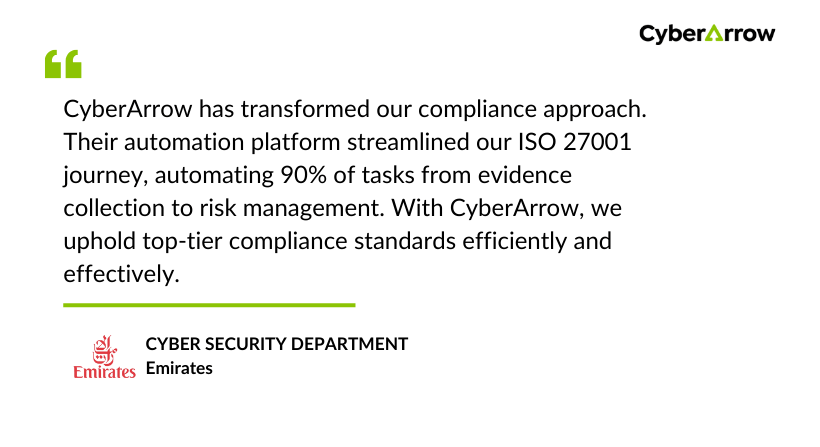
See what our clients have to say about CyberArrow GRC:
Conclusion
Access control plays a critical role in ISO 27001. A clear and well-written access control policy helps organizations protect information, support audits, and maintain consistent security. With the right template and structured approach, risk managers and compliance teams can create policies that align with ISO 27001 while supporting real-world operations.
Manual policy management is possible, but it becomes difficult at scale. CyberArrow GRC helps organizations automate policy documentation, control tracking, and compliance tasks. For ISO 27001 access control and broader security governance, CyberArrow GRC provides a complete solution to make compliance easier and more reliable.
FAQs
What is an ISO 27001 access control policy used for?
It sets rules for how users can access systems, applications, and data. It explains how access is granted, reviewed, changed, and removed. The policy helps reduce unauthorized access and supports ISO 27001 audits.
Is an access control policy required for ISO 27001 certification?
Yes. ISO 27001 expects organizations to define and document access control rules. Auditors check that the policy exists, is approved, and matches real practices.
Who owns the access control policy in an organization?
Ownership depends on organizational structure. It is usually owned by the IT manager, security manager, or ISMS manager. HR and internal audit may also support onboarding and review processes.
What should be included in an ISO 27001 access control policy template?
A good template includes scope, roles, provisioning rules, access review rules, offboarding rules, privileged access rules, third-party access, authentication, monitoring, and approval details.
How often should the access control policy be reviewed?
Most organizations review policies yearly or whenever major changes happen, such as new systems, new cloud environments, or changes to legal or regulatory requirements.
