GRC software for healthcare: Ensuring HIPAA and GDPR compliance
How can healthcare organizations ensure compliance with complex regulations like HIPAA and GDPR without overwhelming their resources? In a sector where patient privacy and data protection are essential, non-compliance can result in heavy fines and damage to reputation.
In H1 2024, 387 data breaches of 500+ records were reported to OCR, an 8.4% rise from H1 2023 and a 9.3% increase from H1 2022.
With regulations becoming more stringent, the need for reliable Governance, Risk, and Compliance (GRC) software has never been greater.
This article explores how GRC software can simplify compliance in healthcare, ensuring adherence to HIPAA and GDPR while minimizing risks and enhancing efficiency.
Understanding HIPAA and GDPR compliance in healthcare
Before discussing how GRC software benefits the healthcare industry, let’s explore HIPAA and GDPR compliance.
What is HIPAA?
The Health Insurance Portability and Accountability Act (HIPAA) protects sensitive patient information in the US. Healthcare providers, insurers, and any entity dealing with protected health information (PHI) must comply with HIPAA standards.
Key components include:
- Privacy Rule: Regulates how PHI can be used or disclosed.
- Security Rule: Sets standards for securing electronic PHI (ePHI).
- Breach Notification Rule: Requires notification in the event of data breaches.
Also read: Why GRC software is essential for financial institutions
What is GDPR?
The General Data Protection Regulation (GDPR) applies to organizations handling the personal data of EU residents, even if the organization is based outside Europe. For healthcare, this includes patient data collected during treatments, research, or other interactions. Key requirements include:
- Data minimization: Only collecting necessary data.
- Transparency: Clearly informing patients about data usage.
- Consent: Obtaining explicit consent before data collection.
- Right to be forgotten: Allowing patients to request deletion of their data.
Why healthcare organizations struggle with compliance
Healthcare organizations face unique challenges when it comes to compliance. Unlike other industries, they deal with highly sensitive patient data, making them a prime target for cyberattacks. The stakes are high—non-compliance can lead to significant financial penalties, legal repercussions, and a loss of patient trust.
Understanding these challenges is key to addressing them effectively.
1. Multiple regulatory requirements
Healthcare organizations often operate across borders, requiring compliance with diverse laws like HIPAA, GDPR, and state-specific regulations. This complexity makes manual tracking difficult and error-prone, increasing the likelihood of compliance failures.
2. Increasing cyber security threats
The healthcare sector is a prime target for cyberattacks. With growing reliance on digital records and remote care, threats like ransomware, phishing, and insider attacks are on the rise. A lack of robust compliance measures increases these risks.
Explore: GRC software vs. traditional compliance management: What’s better?
3. Resource limitations
Managing compliance manually requires significant time, staff, and expertise. Smaller healthcare organizations often face disproportionate challenges due to their limited budgets and workforce. For instance, they might lack in-house legal experts to interpret regulations or IT specialists to implement necessary technical safeguards. This resource gap leaves them vulnerable to compliance oversights and increased risks.
4. Rapid technological advancements
As healthcare adopts new technologies like telemedicine and AI, compliance requirements evolve to address associated risks. Staying updated with these changes can be overwhelming for organizations without dedicated compliance tools.
5. Complex data ecosystems
Healthcare organizations manage vast amounts of data from various sources, such as patient records, research data, and vendor information. Ensuring this data is stored, accessed, and shared in compliance with regulations adds another layer of complexity.
How GRC software helps ensure HIPAA and GDPR compliance
Healthcare organizations face an immense challenge in maintaining compliance with HIPAA and GDPR. These regulations demand rigorous data protection measures, but the complexity of healthcare environments often makes compliance daunting.
GRC software proves invaluable, offering a streamlined, automated approach to managing compliance requirements effectively.
Here’s how GRC software ensures compliance:
1. Centralized compliance management
GRC software consolidates all compliance-related tasks into a single platform, reducing the risk of oversight and mismanagement. Key benefits include:
- Uniform policies: Ensure consistent application of compliance standards across the organization.
- Efficiency improvements: Minimize time spent manually tracking regulatory changes and conducting audits.
- Clear accountability: Assign specific compliance responsibilities to designated team members, fostering transparency.
Also read: The importance of GRC software for government agencies
2. Automated risk assessments
Risk assessments are the foundation of regulatory compliance. GRC tools simplify this process through the following:
- Streamlined evaluations: Automating the identification and prioritization of vulnerabilities.
- Risk scoring systems: Helping teams focus on the most critical areas needing attention.
- Real-time dashboards: Offering actionable insights to maintain compliance health effectively.
For example, Nahdi Medical company transitioned to CyberArrow GRC automated risk assessments and KPI dashboards, reducing risk-related errors.
3. Incident response and breach management
Quick and organized responses to security incidents are crucial for compliance. GRC software facilitates this by:
- Incident tracking systems: Logging security breaches systematically for faster resolutions.
- Notification workflows: Pre-built templates that ensure timely and compliant communication with stakeholders.
- Forensic tools: Root cause analysis features to identify the origin of breaches and mitigate future risks.
4. Enhanced data security
Data security is at the heart of both HIPAA and GDPR. GRC platforms integrate robust security features such as:
- Encryption protocols: Safeguarding sensitive patient data.
- Role-based access controls: Limiting access to critical information based on job responsibilities.
- Comprehensive audit trails: Keeping a log of who accessed or modified data and when.
5. Simplified compliance reporting
Regulatory audits often require detailed documentation. GRC tools simplify this by:
- Automated report generation: Creating reports tailored to HIPAA and GDPR standards.
- Centralized document repositories: Storing all compliance-related documentation in one accessible location.
- Version tracking: Ensuring accurate and up-to-date records for auditors.
By adopting GRC software, healthcare organizations can meet compliance requirements, foster trust, and enhance operational efficiency.
Quick link: How GRC software automates risk assessments for enterprises
Features to look for in GRC software for healthcare
When selecting GRC software for your healthcare organization, prioritize these features:
1. Compliance frameworks
- Pre-built templates for HIPAA and GDPR.
- Regular updates to reflect new regulations.
2. Risk assessment tools
- Automated workflows for identifying and mitigating risks.
- Integration with vulnerability scanners.
3. Document management
- Central repository for policies, procedures, and audit reports.
- Version control to track changes over time.
4. Audit support
- Automated evidence collection.
- Reports tailored to regulatory requirements.
5. User-friendly interface
- Intuitive dashboards and analytics.
- Minimal training required for staff adoption.
Overcome HIPAA and GDPR compliance challenges with CyberArrow
Ensuring compliance doesn’t have to be overwhelming. CyberArrow GRC simplifies the process, empowering healthcare organizations to meet HIPAA and GDPR requirements efficiently. Here’s how:
- Automated evidence collection: Save time during audits with pre-built templates and workflows.
- Comprehensive risk assessment: Identify and mitigate compliance risks proactively.
- KPI monitoring: Keep track of your compliance progress in real time.
- Third-party risk management: Evaluate and monitor the compliance status of vendors.
- Security training: Educate staff on regulatory requirements and best practices.
- Dedicated support: Access expert assistance whenever needed.
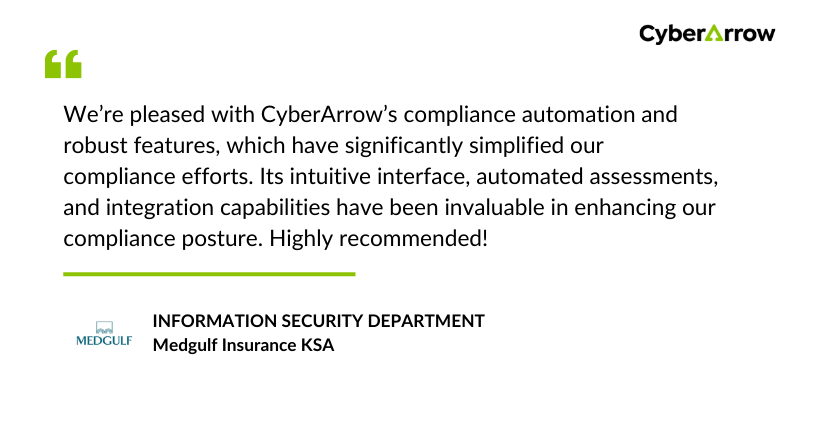
See what healthcare companies like Medgulf Insurance say about CyberArrow: