

5 reasons why you have HIPAA audit in healthcare industry
What is HIPAA?
Health Insurance Portability and Accountability Act (1996), otherwise known as HIPAA, is a federal law for the sensitive data protection of the patient. HIPAA compliance is a process that business associates and other covered entities have to follow to ensure the security and privacy of Protected Health Information (PHI) of patients.
- Protected Health Information (PHI) refers to the healthcare data of any insured person undergoing treatment at a healthcare organization. The content HIPAA intends to secure and keep private is PHI.
- Covered entities refer to the individuals who might use and have access to the PHI, for example, nurses, doctors, and insurance companies.
- Business associates refer to those individuals or services that work with covered entities in a non-healthcare situation and help them maintain HIPAA compliance, such as lawyers, accountants, and IT personnel who work in the healthcare industry.
According to the U.S. Department of Health and Human Services (HHS), the HIPAA Privacy Rule has set national standards to protect the sensitive information of patients. In addition, the Security Rule sets a national standard for protecting certain information that is held or transferred via electronic means.
5 main components of HIPAA
It consists of 5 main components or titles.
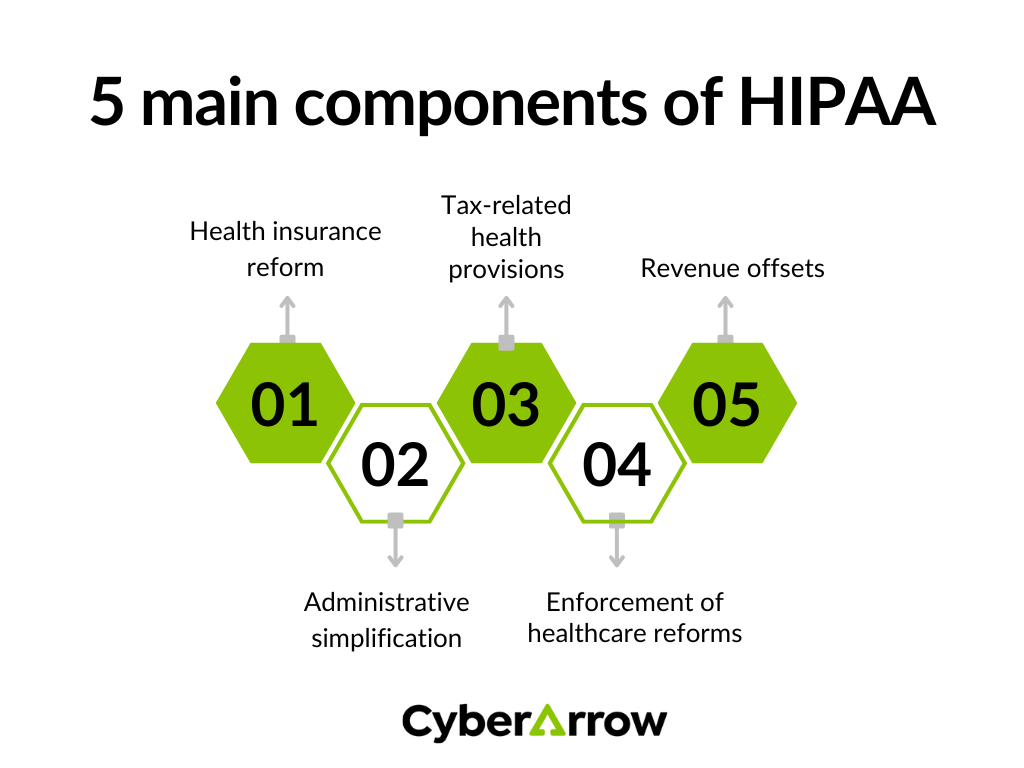
1. Health insurance reform
- This ensures the availability of health insurance to individuals.
- Eliminates the chances of denial of health coverage.
- Prohibits unavailability of lifetime coverage.
2. Administrative simplification
- Secure processing of electronic healthcare transactions.
- Helps in the adoption of HIPAA privacy rules.
3. Tax-related health provisions
- This covers tax-related guidelines issued by HHC.
4. Application and enforcement of group health plan requirements
- This covers the enforcement of healthcare reforms.
5. Revenue offsets
It includes provisions of
- Company-owned health insurance.
- Those who have lost their US citizenship.
Why is HIPAA compliance mandatory in healthcare?
As the health care providers and other entities who deal with Protected Health Information have moved to computerized operations, HIPAA compliance has become more important than ever before. While all these computerized systems provide more efficiency and productivity in the healthcare industry, it has also increased the security risk for healthcare data.
For instance, an insurance company has to store data of its consumers, including their names, addresses, phone numbers, insurance ID numbers, etc. They have to practice HIPAA compliance in order to secure such data. Its practices include:
- Creating policies
- Implementing safeguards
- Risk assessment
- Regular investigations of violations
Consequently, HIPAA compliance is mandatory to maintain the privacy of individuals’ health information. With the increasing trends in technology in the healthcare department, the need for data security has grown.
High-quality health care is required to meet this increased demand for security while complying with the HIPAA regulations. Having HIPAA compliance at healthcare organizations allows them to:
- Ensure security and privacy of PHI for practitioners and patients.
- Have better access, integrity control, device security, and secure data transmission at the organization.
- Have greater control over sensitive data throughout the organization.
Quick link: What is a HIPAA violation?
Reasons to have HIPAA compliance in the healthcare industry
Safety against PHI loss
One of the first reasons to have HIPAA compliance at health care organizations is that it protects against PHI loss. If your organization suffers from PHI loss, you put your patient’s sensitive data at risk.
Members of healthcare organizations have to deal with patients’ personal data countless times making it vulnerable to a data breach. However, having HIPAA compliance in your organization can help reduce this risk.
Development in the patient safety culture
When healthcare organizations develop a safety culture at the organizations, it makes the patient confident about the organization’s facility. This means they have the right tools and knowledge to protect the PHI of patients.
This helps organizations build a patient-centric safety culture throughout.
Greater satisfaction for families and patients alike
Protection against PHI loss and patient-centric safety culture due to HIPPA compliance leads to the satisfaction of patients and their families. This is essential, especially for private sectors, as any data breach at the organization can lead to discontinuity of the services offered by them.
Whenever a patient or a family files a complaint against any organization, HIPAA runs its audit to check if the organization is compliant with the HIPAA regulations or not. Non-compliance with HIPAA can make organizations pay penalties.
Reduced liability for healthcare organizations and executives
Not only do patients get the benefits of HIPAA compliance, but also the organizations and their staff. HIPAA training is mandatory under government regulations to become HIPAA compliant.
Going through training helps organizations and their staff by protecting them against severe fines and penalties. Certain fines and penalties are also reduced if the company can prove it followed HIPAA regulations.
Enhanced awareness of patients’ well-being
We all know how crucial a patient’s well-being is for healthcare workers. While prioritizing their well-being, healthcare workers often forget that protecting a patient’s sensitive data also comes under the area of the patient’s well-being.
HIPAA compliance allows staff members to get training under federal law to protect patients’ PHI, thus resulting in a stronger sense of securing the patient’s PHI as a part of their well-being.
Learn more about HIPAA with our HIPAA compliance hub.
Checklist for HIPAA compliance
Violations of HIPAA compliance can lead to severe penalties for healthcare departments. Consider following the checklist for HIPAA compliance.
Understand HIPAA privacy and security rules
As we move into 2022, you should understand the HIPAA privacy and security rules and the changes being made to them. The Department of Health and Human Services (HHS) will continue to focus more on securing PHI in the fields of psychology, psychiatry, and mental health.
If you follow the right security rules and adhere to the privacy measures and security protocols, you can comply with HIPAA to protect general PHI.
Risk analysis
Risk analysis is an integral part of the system when complying with HIPAA. Perform risk analysis at your organization. Take appropriate measures to help control HIPAA violations. Evaluate and eliminate the chances of potential risks to PHI.
Implement data encryption
Half of nearly all data breaches took place due to unencrypted portable devices. If you want to avoid this HIPAA violation, you must implement data encryption on portable devices at your organization.
Encrypt data that you may transmit via email or other internet methods. Encrypted data is of no use to the data thief.
Identify the right individual to lead your team
Identifying the right individual as the security officer is as necessary as implementing other rules. Though it is not mandatory, the right security officer will help you handle compliance documentation.
Document everything
One of the best things you can do to comply with HIPAA is to document everything and every action you take for HIPAA compliance.
Report breaches
It is equally important to report data breaches at your organization. Compliance with the HIPAA Breach Notification Rule sets rules and regulations for notifying affected parties.
Perform HIPAA training
Perform HIPAA training among your employees and team members. It is essential to have adequate cybersecurity training in your department for HIPAA compliance.
By following this checklist, you can adhere to HIPAA compliance in the healthcare industry.
Advantages of HIPAA compliance
There are several advantages if you follow HIPAA compliance. Some of them are:
Brand reputation
You would certainly maintain a good brand reputation among all your peers and patients if you follow HIPAA compliance. Protection of patients’ data results in their satisfaction which, in turn, enhances brand reputation.
Increase in customers
Customers tend to turn towards those brands that can offer great services while protecting user data. If an organization cares about its customer’s data, it will be trusted by everyone, and more people would want to benefit from it. More trust in an organization will result in an increased number of customers.
Market presence & global expansion
A good brand reputation and increased customers develop a great market presence and global expansion. All this will become possible with HIPAA compliance.
Worry less about fines
It is certain that if organizations follow HIPAA compliance and ensure the use of their best practices, there will be no need to worry about fines from the regulatory bodies.
Financial benefits
According to data, organizations faced heavy fines due to HIPAA non-compliance from the year 2018 to 2021.
Heavy fines can lead to poor financial status for organizations. On the other hand, the organizations that follow HIPAA regulations don’t have to worry about fines which result in many financial benefits. Also, market presence and increased customers will generate great revenue for them.
Download your free HIPAA compliance checklist.
Streamline your HIPAA compliance with CyberArrow GRC
Regular audits are part of the process to verify that healthcare providers are adhering to the stringent rules set out by HIPAA. By understanding the common reasons for HIPAA audits, your organization can better prepare and maintain compliance, ultimately safeguarding sensitive health data and building trust with your patients.
However, keeping up with HIPAA requirements can be challenging and time-consuming, especially when done manually. This is where CyberArrow GRC can make a significant difference. Here’s how CyberArrow GRC helps streamline HIPAA compliance for healthcare organizations:
Automated Compliance: CyberArrow automates up to 90% of the work involved in HIPAA compliance, allowing your organization to quickly implement necessary controls and procedures without the hassle of manual processes.
Expert Guidance: Gain access to a dedicated team and expert privacy security advice from a Virtual Privacy Officer, available through chat and calls, to guide you through the complexities of HIPAA compliance.
Efficient Readiness Assessments: Easily invite third-party assessors to conduct HIPAA readiness assessments through the CyberArrow system, ensuring your organization is always prepared for audits.
Cross-Standard Certifications: Leverage cross-standard mappings to not only achieve HIPAA compliance but also become certified against other important standards, such as ISO, enhancing your organization’s overall compliance posture.
By choosing CyberArrow GRC, healthcare organizations can put HIPAA compliance on autopilot, ensuring the privacy of patient data while freeing up valuable time and resources.
Quick link: CyberArrow vs. SAI Global 360
