The state of GDPR compliance for European countries
Data privacy has become a major concern for individuals around the world, and nowhere is this more evident than in the European Union (EU). As digital interactions increase, EU residents are more aware than ever of how their personal information is being used and stored. To protect their privacy rights, the EU introduced the General Data Protection Regulation, or GDPR, which is considered the toughest privacy law in the world.
But what exactly does GDPR mean for businesses, both in and outside of Europe? This regulation isn’t just for European companies—it affects any organization that targets or collects data from people in the EU. Since its introduction in 2016 and enforcement in 2018, GDPR has set a high standard for how businesses handle personal data, requiring them to take serious steps to protect it.
In this blog, we’ll explore what GDPR is, why it’s so important, and how it impacts businesses globally. We’ll also discuss what steps your organization needs to take to ensure compliance and avoid hefty fines. Whether you operate within the EU or just have customers there, understanding GDPR is crucial to safeguarding your business and respecting your customers’ privacy.
Why is GDPR Compliance mandatory in Europe?

Img src: pixabay
Technology and the way we use the internet have been evolving since it was first created. Moreover, how different organizations process our data is also changing with each passing day.
The more we move towards the future, the more our data becomes insecure. Privacy and security of data have become a major concern for many people nowadays. With this in mind, the EU crafted and passed GDPR in Europe in 2018.
GDPR compliance is mandatory in Europe to provide individuals more control over how their personal data is collected and processed. It has transformed the ways businesses handle data.
What are the GDPR fines?
The fines or penalties that occurred due to GPPR non-compliance are optional, not mandatory. They wholly depend upon the nature of the infringement and are imposed on a case-by-case basis.
- The type of infringement, whether severe or not, how long it lasted
It means whether the nature of breaking of law was severe enough to be punished by the authorities or not. Also, the time the infringement lasted is crucial when determining the penalties for GDPR non-compliance.
- Accidental infringement
There are cases where a company may break the law accidentally. For example, an infringement occurs at a business but they didn’t know it was going to happen in the first place, and it happened accidentally. In this regard, the business may not have to face severe consequences of the infringement.
- The security measures you took
The security measures you take once the law is broken also play an essential role in determining the penalty. You should take security measures on time to save yourself from serious penalties.
- Whether it was your first GDPR infringement
If GDPR non-compliance happens at your business for the first time, it might also make a difference in the severity of the penalty that your company has to face.
- What actions do you take
It is another reason that might reduce the chances of heavy penalties or fines for your organization. Your actions play a major role when it comes to determining fines for GDPR non-compliance.
There are several reasons that a business may or may not face heavy fines. However, the maximum fine could be up to €20 million or 4% of the global financial revenue of the business which is quite higher.
Here are examples of heavy penalties faced by some of the big companies.
Top 5 biggest GDPR fines
- Amazon was fined a gigantic amount of €746 million in 2021.
- Whatsapp faced a penalty of €225 million due to GDPR non-compliance.
- Google LLC faced a penalty of €90 million, somewhat related to cookies consent.
- Facebook Ireland LTD was fined €60 million.
- Google Inc was fined €50 million.
These were some of the biggest fines companies face due to GDPR non-compliance.
Developments in GDPR
GDPR has evolved a lot since it got enforced in 2018. And it is going to evolve further as we move forward into the future.
In 2021, the European Union introduced some changes in the GDPR that further intend to enhance the effectiveness of the law. These developments are given below.
A broadened vision of joint controller
The term joint controller is not new to GDPR. It has been part of the law since 2018. However, some development has been made to its definition as a part of changes to the GDPR.
A joint controller consists of two or more persons or entities who will be held responsible for the collection and protection of consumer data. Ideally, they will share the same objectives and purposes. Also, they will determine how the data will be processed. In the case of GDPR non-compliance, the joint controller will be held responsible and face possible penalties.
Removal of the privacy shield
Previously GDPR used a privacy shield that allowed the European countries to transfer data with their US counterparts. This helped in a smoother relationship between companies and made it easier for tech companies, such as Google, Yahoo, and Apple to share data with their US-based companies.
However, this privacy shield has been removed, and the US-based companies now have to adapt to the new GDPR privacy clauses to use the EU’s customer data.
This development is important because it makes US-based companies abide by the EU’s privacy-related laws and regulations.
Cookie consent
Previously, GDPR was unclear about the way websites use cookies. But now, new regulations have been made. This new regulation requires the explicit consent of site visitors for installing cookies on their system. Additional updates are expected to be made by GDPR in the cookies policy.
Shifting from third-party data tracking
Another development in the GDPR made IoT-based companies shift away from third-party data processing. We all know the risks associated with sharing data with outer companies. Therefore, tech-based companies should shift away from third-party data tracking and processing.
The result of all these developments in the GDPR is making many companies take laws and legislation seriously. Due to GDPR in Europe, European customers are enjoying higher levels of security and privacy of their data than ever before. Also, this is inspiring for other nations to adopt such levels of protection for their citizens.
What is the checklist for GDPR Compliance?
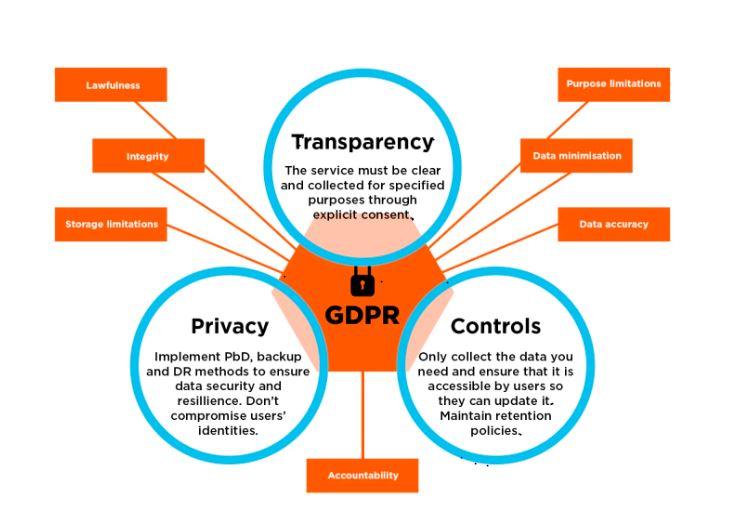
Image credit: smashing magazine
GDPR compliance requirements consist of a checklist. The principles of GDPR compliance fulfill the requirements of the checklist that needs to be followed by companies. According to article 5 of GDPR, there are seven principles related to the processing of personal data.
Lawfulness, transparency, and fairness
GDPR compliance requires companies to have lawful, transparent, and fair processing of data. Processing data lawfully means that it is based on legitimate purposes. Processing data fairly means that companies do not process data other than for legitimate purposes. Transparency shows the way the data is handled is informed by the data subject.
Purpose limitation
Purpose limitation in GDPR compliance forbids the company to process data outside the purpose for which it was collected. And not to keep personal data once the purpose is fulfilled.
Data minimization
The companies are expected to only collect and process data that is necessary. They are forbidden to collect unnecessary amounts of data for legitimate purposes.
Accuracy
Data should be kept accurate and up to date where necessary. Data that is inaccurate shall be erased without any delay.
Storage limitation
According to the GDPR compliance principle, “data shall be kept in a form which permits identification of data subjects for no longer than is necessary for the purposes for which the personal data are processed; personal data may be stored for longer periods insofar as the personal data will be processed solely for archiving purposes in the public interest, scientific or historical research purposes or statistical purposes ”
Integrity and confidentiality
Integrity and confidentiality are essential factors when processing data. Companies must ensure the lawful use and security of personal data.
Accountability
The data controller is held accountable for GDPR compliance. He must abide by all the principles mentioned above to protect users’ data.
There are some other factors that need to be considered in the checklist for GDPR compliance.
Cookie consent
If your website uses cookies and third-party integration, you are obliged to ask for the consent of the end-users under the EU GDPR to track their data, such as IP addresses, Unique IDs, search history, etc.
Add GDPR terms
GDPR compliance checklist consists of adding certain GDPR terms as your adherence to GDPR. Some of them are data subject, the data controller, data processor, consent, etc.
Privacy Policy
The Privacy Policy is an essential part of any website’s requirements. According to GDPR, your privacy policy must contain clear descriptions of how you handle users’ data. Also, it must be easily accessible for users.
Option to accept/reject data tracking
Data tracking is done by websites to collect and process data (often personal data). GDPR compliance requires you to ask for the explicit consent of end-users to accept or reject data tracking.
GDPR compliance requires businesses to follow these principles when making an approach related to processing personal data. If businesses do not comply with the GDPR in Europe, they have to face heavy penalties in the form of fines.
Automate GDPR compliance with CyberArrow GRC
GDPR is a critical regulation for any business that handles the personal data of EU residents, regardless of where the business is located. It sets a high standard for data privacy and protection, ensuring that organizations respect individuals’ rights to privacy. Failure to comply with GDPR can result in severe penalties, making it essential for businesses to take their data protection responsibilities seriously.
However, achieving GDPR compliance can be a daunting task, especially when done manually. That’s where CyberArrow GRC comes in, offering a powerful, automated solution to help organizations meet GDPR requirements efficiently and effectively. Here’s how CyberArrow GRC can simplify your path to GDPR compliance:
- Automated Compliance: CyberArrow automates up to 90% of the work involved in GDPR compliance, allowing you to implement GDPR quickly without the hassle of manual processes.
- Expert Guidance: Get privacy security advice from a dedicated Virtual Privacy Officer who can provide support through chat and calls, helping you navigate the complexities of GDPR.
- Comprehensive Integration: With support for over 50 integrations, CyberArrow makes it easy to connect with your existing systems and automatically gather evidence for compliance, eliminating the need for manual spreadsheets and tracking across multiple platforms.
- Third-Party Assessments: Invite third-party assessors to conduct GDPR readiness assessments through the CyberArrow system, ensuring your organization is fully prepared for any audits or inspections.
- Pre-Approved Templates: Use auditor pre-approved document templates to streamline your documentation process and ensure all required information is accurately captured.
By choosing CyberArrow GRC, you can ensure a smooth, efficient, and thorough approach to GDPR compliance. Say goodbye to the stress of manual compliance tasks and focus on what matters most—protecting your customers’ data and maintaining their trust.
See what our clients have to say about CyberArrow GRC: