


ISO 27001 supplier security policy template: How to write it and what to include
Modern companies rely on outside suppliers more than ever. They use suppliers for cloud services, IT operations, payments, logistics, storage, marketing, legal, finance, and support. This gives speed and flexibility. It also brings new risks. A weak supplier can expose sensitive data and damage trust. This is why ISO 27001 focuses strongly on supplier security. A proper ISO 27001 supplier security policy helps reduce these risks while proving due care during audits.
In this guide, you will learn what an ISO 27001 supplier security policy is, how it works, and how to write one with a usable template. You will also learn what sections auditors expect to see and how to align your policy with ISO 27001 Annex controls.
- What is an ISO 27001 supplier security policy
- Why supplier security matters for ISO 27001
- Key principles of supplier security for ISO 27001
- How to write an ISO 27001 supplier security policy
- 1. Purpose statement
- 2. Scope of the policy
- 3. Definitions
- 4. Roles and responsibilities
- 5. Supplier classification and risk assessment
- 6. Supplier selection and due diligence
- 7. Contractual security requirements
- 8. Supplier onboarding
- 9. Information sharing and data handling
- 10. Monitoring and performance review
- 11. Incident management with suppliers
- 12. Supplier offboarding and access removal
- 13. Compliance and audit requirements
- 14. Policy review and maintenance
- Template for ISO 27001 supplier security policy
- Best practices for a strong supplier security program
- How CyberArrow GRC helps
- FAQs
What is an ISO 27001 supplier security policy
An ISO 27001 supplier security policy is a formal document that explains how a company manages supplier relationships in a safe and structured manner. It tells staff what to do when choosing a supplier, onboarding them, monitoring them, and offboarding them. It also shows how the company protects data that may be shared with suppliers during daily operations.
The goal of this policy is to limit security and privacy risks that come from third-party access, outsourced services, or external dependencies.
A good ISO 27001 supplier security policy supports several Annex A controls, including:
- A.5 Information security policies.
- A.6 Organization of information security.
- A.15 Supplier relationships.
- A.8 Asset management.
- A.12 Operational security.
While suppliers are not always part of the internal system, ISO 27001 makes it clear that the organization is still responsible for the security of its information.
Why supplier security matters for ISO 27001
Supplier breaches are a major cause of data loss today. Many cyber criminals attack smaller suppliers because they can be easier targets. When suppliers hold customer data, sensitive business information, intellectual property, or payment details, a weak link can damage the entire ecosystem.
Supplier security matters for ISO 27001 because:
- It protects confidential data shared with suppliers.
- It controls access and privileges given to external partners.
- It reduces regulatory and contract exposure.
- It helps maintain business continuity.
- It builds trust with customers and regulators.
During an ISO 27001 audit, auditors often ask for evidence of supplier selection, supplier monitoring, risk assessments, and contract requirements. If the company cannot show control over its suppliers, it may fail the audit or face extra remediation tasks.
Key principles of supplier security for ISO 27001
A strong supplier security program should follow these core principles:
- Risk-based selection: Not every supplier has the same level of risk. Critical suppliers need deeper checks.
- Clear responsibilities: Both parties must know who protects what and how obligations are enforced.
- Contractual security controls: Security, privacy, and compliance must be part of supplier contracts.
- Continuous oversight: Supplier security is not a one-time check. It needs ongoing review.
- Secure offboarding: Access must be removed when the supplier relationship ends.
These principles should guide the content of your ISO 27001 supplier security policy.
How to write an ISO 27001 supplier security policy
There is no single format for writing this policy. However, most policies follow a structured set of sections that align with Annex A controls and ISO 27001 practices.
Below is a step-by-step guide that helps you write it in a clear format.
1. Purpose statement
Start by explaining why the policy exists and what you want to achieve. It should mention the protection of information, the reduction of risk, and alignment with ISO 27001.
Example:
The purpose of this policy is to establish a standard approach for managing supplier relationships and controlling the security of shared information.
2. Scope of the policy
The scope sets boundaries and shows what suppliers are covered. This may include:
- IT service providers.
- Data processors.
- Cloud platforms.
- Contractors.
- Consultants.
- Outsourced teams.
- SaaS tools.
- Managed service partners.
Be clear about inclusion and exclusion rules.
3. Definitions
Supply clear definitions for terms like vendor, supplier, data processor, subcontractor, outsourcing, and critical supplier. This helps avoid confusion.
4. Roles and responsibilities
This section assigns accountability. Common roles include:
- Information security officer.
- Procurement team.
- Legal team.
- Compliance officer.
- Business owners.
- Supplier managers.
Auditors look for proof that someone owns supplier risk.
5. Supplier classification and risk assessment
ISO 27001 recommends a risk-based approach. Not all suppliers are equal. Classify suppliers based on:
- Types of data handled.
- Service criticality.
- System access levels.
- Regulatory exposure.
- Availability dependence.
High-risk suppliers require extra checks like audits, security questionnaires, and performance reviews.
6. Supplier selection and due diligence
Before onboarding a supplier, perform due diligence. This may include:
- Security questionnaires.
- Certifications (ISO 27001, SOC 2).
- Pen test results.
- Policy reviews.
- Insurance coverage.
- Sanctions screening.
- Regulatory checks.
Due diligence prevents surprises later in the lifecycle.
7. Contractual security requirements
Contracts must include security and privacy rules that protect both parties. Common contract terms include:
- Data protection rules.
- Confidentiality clauses.
- Security obligations.
- Subcontractor controls.
- Regulatory requirements.
- Breach notifications.
- Audit rights.
- Service levels.
- Incident reporting.
- Termination rules.
ISO 27001 will not pass without proper contract control for suppliers.
8. Supplier onboarding
Document how suppliers join the ecosystem. This includes access provisioning, asset handover, security orientation, and approval workflows.
9. Information sharing and data handling
Explain how data is shared with suppliers and what controls protect it. This may include:
- Encryption standards.
- Storage rules.
- Access limitations.
- Transfer controls.
- Retention rules.
- Disposal rules.
Clear rules reduce the chance of leaks or misuse.
10. Monitoring and performance review
Suppliers must be monitored on a regular schedule. Monitoring may include:
- Control tests.
- Compliance checks.
- Incident review.
- SLA tracking.
- KPI tracking.
- Security reviews.
- Audit reviews.
Auditors will ask for documented evidence of supplier monitoring.
11. Incident management with suppliers
If a supplier causes a breach, both parties must follow coordinated steps. Include:
- Communication channels.
- Notification timelines.
- Root cause analysis.
- Containment plans.
- Reporting duties.
This protects reputation and helps meet regulatory deadlines.
12. Supplier offboarding and access removal
When a supplier relationship ends, remove access, recover assets, and delete shared data. Many incidents occur due to forgotten accounts and leftover credentials.
13. Compliance and audit requirements
Show how compliance is verified. Third-party certifications, audit rights, and attestations are strong evidence.
14. Policy review and maintenance
State how often the policy will be reviewed. Many companies review annually or during major operational changes.
Template for ISO 27001 supplier security policy
Below is a sample outline you can use as a template:
- Purpose.
- Scope.
- Definitions.
- Roles and responsibilities.
- Supplier classification.
- Supplier risk assessment.
- Supplier selection and due diligence.
- Contractual requirements.
- Supplier onboarding.
- Information sharing and handling.
- Monitoring and review.
- Incident management for suppliers.
- Supplier offboarding.
- Compliance verification.
- Policy review and updates.
This template helps ensure consistency and alignment with ISO 27001 expectations.
Best practices for a strong supplier security program
Enhance your supplier policy by adopting these practices:
- Follow least privilege: Only grant the access suppliers need to perform the service.
- Use standardized questionnaires: This speeds up due diligence and gives structured evidence for audits.
- Track certifications: Many suppliers hold SOC 2 or ISO 27001 certificates.
- Review subcontractors: Some suppliers use their own suppliers. This is called fourth-party risk.
- Perform periodic reassessments: Risk levels may change as suppliers grow or shift operations.
- Document everything: Evidence is key for ISO 27001 certification and internal control.
How CyberArrow GRC helps
Writing an ISO 27001 supplier security policy is a major first step toward managing third-party risk. However, policy alone is not enough. Companies also need structured workflows, supplier risk assessments, contract tracking, compliance reviews, and evidence collection. Manual spreadsheets are slow and risky, especially as the number of suppliers grows.
CyberArrow GRC is an enterprise GRC platform that helps organizations build complete governance, risk, and compliance programs. It centralizes supplier management, policy lifecycle, control mapping, audit preparation, and compliance reporting. It also supports multiple frameworks for teams that must comply with ISO 27001, SOC 2, PCI DSS, NIST, and others at the same time. This makes it easier to stay audit-ready while reducing supplier risk.
By using a modern GRC platform like CyberArrow GRC, companies gain faster compliance, better oversight, and a more mature supplier security posture that auditors trust.
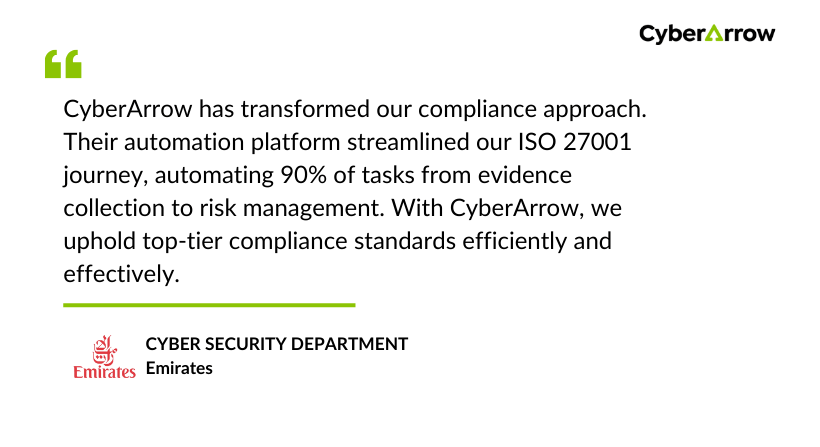
Read how Emirates enhanced Information Security by automating ISO 27001 with CyberArrow.
See what Emirates has to say about CyberArrow GRC:
FAQs
What is an ISO 27001 supplier security policy?
An ISO 27001 supplier security policy is a formal document that explains how an organization manages supplier relationships to protect sensitive data and reduce risk. It supports Annex A controls related to supplier security and compliance.
Why do suppliers matter for ISO 27001?
Suppliers often handle company data or have privileged access to systems. If a supplier has weak security, it can expose the organization to breaches, loss of data, and audit failures. Strong supplier controls are required for ISO 27001 certification.
What should be included in an ISO 27001 Supplier Security Policy?
The policy should include purpose, scope, roles, supplier classification, due diligence, contractual controls, onboarding, data handling, monitoring, incident response, and offboarding.
How often should supplier security be reviewed?
Supplier security should be reviewed on a regular schedule. Critical or high-risk suppliers may require quarterly or annual reviews, while lower-risk suppliers can be reviewed less often. Auditors expect periodic monitoring and documented evidence.
Does ISO 27001 require supplier risk assessments?
ISO 27001 does not name supplier risk assessments directly, but Annex A controls make them necessary by requiring a risk-based approach to supplier relationships. Most auditors will ask for supplier risk assessments during certification.
