

A guide to (NCA) Non-Critical Information Infrastructure Cybersecurity Controls
Cyber security is a growing priority in Saudi Arabia. The National Cybersecurity Authority (NCA) has introduced a new regulatory framework to help organizations across the private sector strengthen their defenses against cyber threats. This framework is called NCA NCNICC.
In this guide, you will learn what NCA NCNICC is, who it applies to, its structure, and how organizations can implement it to protect their information systems while meeting regulatory expectations.
- What is Non-Critical National Information Infrastructure Cybersecurity Controls
- Why Non-Critical National Information Infrastructure Cybersecurity Controls matters
- Who must comply with NCA NCNICC-1:2025
- Structure of the NCA NCNICC-1:2025 controls
- NCA NCNICC’s risk-based approach
- Differences between NCNICC and other Saudi cyber security frameworks
- Common challenges for NCNICC implementation
- How to implement NCA NCNICC controls
- Why automation matters for NCNICC
- Conclusion
- FAQs
What is Non-Critical National Information Infrastructure Cybersecurity Controls
NCA NCNICC stands for Non-Critical National Information Infrastructure Cybersecurity Controls. It is a set of cyber security requirements issued by the National Cybersecurity Authority of Saudi Arabia for private sector organizations that are not classified as Critical National Infrastructure (CNI).
The purpose of NCNICC is to create a baseline set of cyber security expectations for non-CNI organizations. These controls help businesses improve their protection against cyber threats and align with national cyber security goals.
NCNICC is not a certification standard. Instead, it provides a clear and structured set of controls and requirements that organizations are expected to meet. Organizations may be reviewed by regulators, partners, or customers to assess their compliance with these controls.
Why Non-Critical National Information Infrastructure Cybersecurity Controls matters
Saudi Arabia’s digital economy is growing rapidly. As businesses become more digital, cyber threats are also increasing. The NCA launched NCNICC to:
- Strengthen cyber security across the private sector.
- Reduce cyber risk for businesses of all sizes.
- Promote consistent security practices across industries.
- Support the goals of Vision 2030, which aims to improve economic resilience and digital readiness across the Kingdom.
NCNICC helps organizations build stronger security programs that protect data, systems, and customers.
Who must comply with NCA NCNICC-1:2025
NCNICC applies to private sector organizations in Saudi Arabia that are not classified as Critical National Infrastructure. This includes companies across industries such as:
- Technology and SaaS providers.
- Retail and e-commerce companies.
- Manufacturing firms.
- Healthcare service providers.
- Logistics and supply chain companies.
- Service businesses that handle digital systems and data.
The NCA is signaling that cyber security is no longer optional even for organizations that do not meet the CNI classification. Private companies of all sizes should assess whether NCNICC applies to them based on their workforce, revenue, and digital risk profile.
Structure of the NCA NCNICC-1:2025 controls
The NCNICC framework is organized into several key domains that cover cyber security governance, technical defenses, and operational practices.
While the full official document lists specific controls, these core areas are central to NCNICC:
Cyber security governance
This domain focuses on leadership, organizational responsibility, and security strategy.
Organizations must:
- Assign clear cyber security roles.
- Establish policies and procedures.
- Ensure leadership oversight of cyber security activities.
Governance controls help organizations create a strong foundation for cyber security.
Risk management
Effective risk management is essential. This includes:
- Identifying cyber security risks.
- Assessing risk likelihood and impact.
- Applying risk treatment measures.
- Reviewing risk results regularly.
Risk management helps prioritize the most critical security improvements.
Asset and access management
Organizations must know what systems and data they have and ensure that access is controlled properly. This includes:
- Maintaining an inventory of digital assets.
- Defining access rights based on job responsibilities.
- Reviewing access regularly.
Strong access management prevents unauthorized access to sensitive systems.
Operational security controls
Operational security includes daily practices to protect systems:
- System monitoring and logging.
- Vulnerability management.
- Patch updates.
- Malware protection.
These controls help identify and stop threats in real time.
Incident management
Even the best defenses cannot stop all attacks. Incident management ensures that organizations are prepared to respond when breaches occur. Key expectations include:
- Incident response plans.
- Defined roles for incident handling.
- Record keeping and reporting.
- Post-incident improvement reviews.
Incident management supports business resilience.
Third-party and supplier security
Many organizations rely on vendors and cloud services. Supplier security expectations under NCNICC include:
- Assessing vendor risks.
- Defining security requirements in contracts.
- Monitoring vendor compliance.
Third-party risk management helps reduce exposure through external connections.
Quick link: NCNICC vs NCA ECC vs SAMA CSF
Business continuity and resilience
Organizations must plan for disruptions. Business continuity includes:
- Backup procedures.
- Recovery planning and testing.
- Maintaining key services during outages.
Resilience measures ensure continued service delivery.
Compliance and monitoring
NCNICC expects organizations to monitor compliance with the controls and improve their security posture over time. This includes:
- Regular self-assessments.
- Control effectiveness reviews.
- Documented improvement actions.
Continuous monitoring is key to lasting cyber security maturity.
NCA NCNICC’s risk-based approach
Like other national and international cyber security frameworks, NCNICC follows a risk-based approach. This means organizations must:
- Identify risks: Determine what could harm information and systems.
- Analyze risks: Understand likelihood and potential impact.
- Treat risks: Implement controls to reduce or eliminate risk.
- Monitor: Track changes and update risk decisions as needed.
This approach ensures that security efforts are aligned with real company risks.
Differences between NCNICC and other Saudi cyber security frameworks
The NCA also issues other cyber security standards, such as Essential Cybersecurity Controls (ECC) and Cloud or Critical Systems frameworks, but NCNICC is focused on private entities that are not classified as critical.
NCNICC provides a baseline control set that is lighter and more accessible for private companies while still aligning with national goals.
Common challenges for NCNICC implementation
Organizations may face these common issues:
- Lack of clear scope and asset inventory.
- Manual compliance tracking.
- Difficulty collecting evidence.
- Limited visibility across controls.
- Staff uncertainty about responsibilities.
Recognizing these challenges early helps organizations build better plans.
How to implement NCA NCNICC controls
To implement NCNICC:
- Assess applicability of the controls to the organization.
- Define the scope of systems, data, and locations.
- Identify risks using a structured methodology.
- Apply controls based on risk levels.
- Document policies and evidence clearly.
- Train staff on cyber security roles.
- Monitor and improve continuously.
A structured process helps organizations avoid gaps and stay review-ready.
Why automation matters for NCNICC
Manual compliance management often leads to errors, missing evidence, and poor visibility.
For example:
- Spreadsheets get outdated.
- Policies are scattered across folders.
- Risk registers are incomplete.
Automation helps by organizing controls, linking evidence, and tracking progress in real time.
Conclusion
The NCA NCNICC is an important cyber security framework for Saudi private sector organizations that are not classified as CNI. It provides a practical set of controls to improve security posture, reduce risk, and support national cyber security goals.
Implementing NCNICC requires planning, risk assessment, and continuous improvement. Many organizations find manual tracking difficult and error-prone.
CyberArrow GRC provides a centralized platform to manage NCNICC controls, risks, evidence, and compliance status easily. It helps teams stay organized, measure progress, and demonstrate readiness for regulatory reviews with confidence.
By using CyberArrow GRC, organizations can automate and strengthen their NCNICC compliance journey.
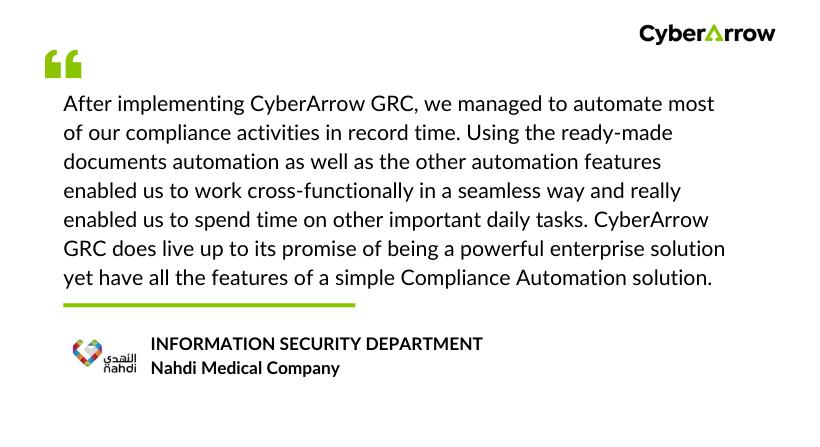
See what our clients have to say about CyberArrow GRC:
FAQs
What does NCA NCNICC stand for?
NCA NCNICC stands for Non-Critical National Information Infrastructure Cybersecurity Controls. It is a cyber security control framework issued by the National Cybersecurity Authority for non-CNI private sector entities in Saudi Arabia.
Is NCNICC mandatory for private sector organizations in Saudi Arabia?
NCNICC applies to private sector organizations that are not classified as Critical National Infrastructure. Organizations are expected to assess applicability and implement the required controls based on NCA guidance.
Is NCNICC a certification standard?
No. NCNICC is not a certification standard. It is a cyber security control framework that defines required practices. Organizations must implement the controls and be ready to demonstrate compliance during reviews or assessments.
How is NCNICC different from NCA Essential Cybersecurity Controls (ECC)?
NCNICC is designed for non-CNI private sector entities and includes a more focused set of cyber security controls. NCA ECC applies to Critical National Infrastructure and includes broader and more detailed requirements.
How can organizations manage NCNICC compliance efficiently?
Organizations can manage NCNICC compliance by using a centralized GRC platform. CyberArrow GRC helps manage controls, risks, policies, and evidence while maintaining ongoing readiness for regulatory reviews.
