

ISO 27001 requirements for FinTech: A practical guide for security and compliance
FinTech companies handle large volumes of sensitive financial data. This includes payment details, personal information, transaction records, banking data, and digital assets. Because of this, FinTech organizations are high-value targets for cyber attacks. Regulators, investors, partners, and customers all expect strong security controls and clear proof of compliance.
ISO 27001 is one of the most trusted standards for building a strong information security program. It helps FinTech companies protect data, manage risks, and prove security maturity. This guide explains the ISO 27001 requirements for FinTech, how they apply in real environments, and how FinTech teams can meet them in a practical way.
- Why ISO 27001 is critical for FinTech companies
- What ISO 27001 requires from FinTech organizations
- ISO 27001 clauses explained for FinTech
- ISO 27001 Annex A controls for FinTech
- A.5 Information security policies
- A.6 Organization of information security
- A.7 Human resource security
- A.8 Asset management
- A.9 Access control
- A.10 Cryptography
- A.11 Physical and environmental security
- A.12 Operations security
- A.13 Communications security
- A.14 System development and maintenance
- A.15 Supplier and third-party management
- A.16 Information security incident management
- A.17 Business continuity management
- A.18 Compliance
- How FinTech companies can implement ISO 27001
- Common ISO 27001 challenges for FinTech
- How CyberArrow GRC helps FinTech meet ISO 27001 requirements
- Conclusion
- FAQs
Why ISO 27001 is critical for FinTech companies
FinTech companies operate in fast-moving and high-risk environments. They rely on cloud systems, APIs, third-party services, and real-time transactions. Any security failure can cause financial loss, legal issues, and loss of trust.
ISO 27001 matters for FinTech because it:
- Protects sensitive financial and personal data.
- Reduces cyber and fraud risks.
- Supports regulatory compliance.
- Builds trust with banks and partners.
- Helps pass customer and investor security reviews.
- Improves audit readiness.
Many FinTech companies also need ISO 27001 to support SOC 2, PCI DSS, GDPR, or regional financial regulations.
What ISO 27001 requires from FinTech organizations
ISO 27001 requires organizations to build and maintain an Information Security Management System. The ISMS includes policies, controls, risk processes, monitoring, and continuous improvement.
The requirements are divided into two main areas:
- ISO 27001 Clauses 4 to 10.
- Annex A security controls.
Both are critical for FinTech compliance.
ISO 27001 clauses explained for FinTech
Clause 4: Context of the organization
FinTech companies must understand their business environment and security risks.
Key FinTech considerations
- Regulatory landscape for financial services.
- Cloud and API based architecture.
- High transaction volumes.
- Third-party dependencies.
- Global user base.
Organizations must document internal and external security factors.
Clause 5: Leadership
Leadership must show commitment to information security.
Key requirements
- Appoint security leadership.
- Approve information security policies.
- Assign roles and responsibilities.
- Support security objectives.
In FinTech, leadership involvement is critical because security affects business growth and partnerships.
Clause 6: Planning
Planning focuses on risk management.
Key requirements
- Identify information security risks.
- Assess likelihood and impact.
- Create a risk treatment plan.
- Define risk acceptance criteria.
Common FinTech risks include account takeover, API abuse, insider threats, and fraud.
Clause 7: Support
Support includes people, skills, tools, and documentation.
Key requirements
- Security awareness training.
- Clear policies and procedures.
- Document control.
- Secure internal communication.
Developers, engineers, and support teams must all understand security responsibilities.
Clause 8: Operation
This clause covers how security processes run daily.
Key requirements
- Perform regular risk assessments.
- Manage incidents.
- Apply risk treatment actions.
- Maintain security operations.
FinTech systems must remain secure while operating continuously.
Clause 9: Performance evaluation
FinTech companies must measure security performance.
Key requirements
- Internal audits.
- Management reviews.
- Performance metrics.
Dashboards are often used to track security and compliance status.
Clause 10: Improvement
Organizations must improve security over time.
Key requirements
- Identify gaps.
- Apply corrective actions.
- Improve controls.
Continuous improvement is essential in fast-moving FinTech environments.
ISO 27001 Annex A controls for FinTech
Annex A includes technical and operational controls. Below are the most important ones for FinTech.
A.5 Information security policies
FinTech companies must document security policies that cover:
- Data protection.
- Payment security.
- API usage.
- Cloud security.
- Access management.
Policies guide employees and support audits.
A.6 Organization of information security
Clear roles reduce confusion.
Key practices
- Defined security ownership.
- Separation of duties.
- Secure project management.
A.7 Human resource security
Employees can introduce risk.
Key controls
- Background checks.
- Confidentiality agreements.
- Role-based access.
- Secure offboarding.
A.8 Asset management
FinTech assets include:
- Transaction systems.
- Databases.
- APIs.
- Cloud services.
- Source code repositories.
Assets must be inventoried and classified.
A.9 Access control
Access control is critical in FinTech.
Key controls
- Least privilege access.
- Multi-factor authentication.
- Role-based permissions.
- Secure API authentication.
Access must be reviewed regularly.
A.10 Cryptography
Encryption protects financial data.
Key areas
- Data at rest.
- Data in transit.
- Key management.
Encryption is essential for compliance and trust.
A.11 Physical and environmental security
Even cloud-based FinTech companies have physical risks.
Key controls
- Secure office access.
- Protected server locations.
- Device security.
A.12 Operations security
Operations security keeps systems stable.
Key controls
- Logging and monitoring.
- Patch management.
- Malware protection.
- Backup and recovery.
Downtime in FinTech can cause serious financial loss.
A.13 Communications security
FinTech relies heavily on data exchange.
Key controls
- Secure network connections.
- API security.
- Encrypted communication channels.
A.14 System development and maintenance
Secure development is essential.
Key practices
- Secure coding.
- Code reviews.
- Testing before release.
- Protection of source code.
A.15 Supplier and third-party management
FinTech companies depend on vendors.
Key controls
- Vendor risk assessments.
- Security requirements in contracts.
- Ongoing monitoring.
A.16 Information security incident management
A fast response is critical.
Key controls
- Incident detection.
- Response procedures.
- Reporting workflows.
A.17 Business continuity management
FinTech services must remain available.
Key controls
- Disaster recovery plans.
- Backup testing.
- System redundancy.
A.18 Compliance
FinTech companies must follow:
- Financial regulations.
- Data protection laws.
- Contractual obligations.
ISO 27001 supports structured compliance management.
How FinTech companies can implement ISO 27001
Step 1: Build an ISMS team
Include security, engineering, compliance, and leadership.
Step 2: Perform a risk assessment
Focus on transaction security, fraud risks, and system abuse.
Step 3: Apply Annex A controls
Match controls to identified risks.
Step 4: Train employees
Security awareness is essential across all teams.
Step 5: Prepare for audits
Maintain evidence and documentation throughout the year.
Common ISO 27001 challenges for FinTech
FinTech companies often face:
- Manual compliance tracking.
- Evidence scattered across tools.
- Repeated security questionnaires.
- Limited visibility for leadership.
- High audit pressure.
Automation helps reduce these problems.
How CyberArrow GRC helps FinTech meet ISO 27001 requirements
CyberArrow GRC supports FinTech companies by automating and centralizing compliance tasks.
Key benefits
- ISO 27001 control library.
- Automated evidence collection.
- Risk assessment workflows.
- Policy management.
- Vendor risk management.
- Audit-ready documentation.
- Real-time dashboards.
- Cross framework mapping.
CyberArrow GRC helps FinTech teams save time, reduce risk, and stay audit-ready all year.
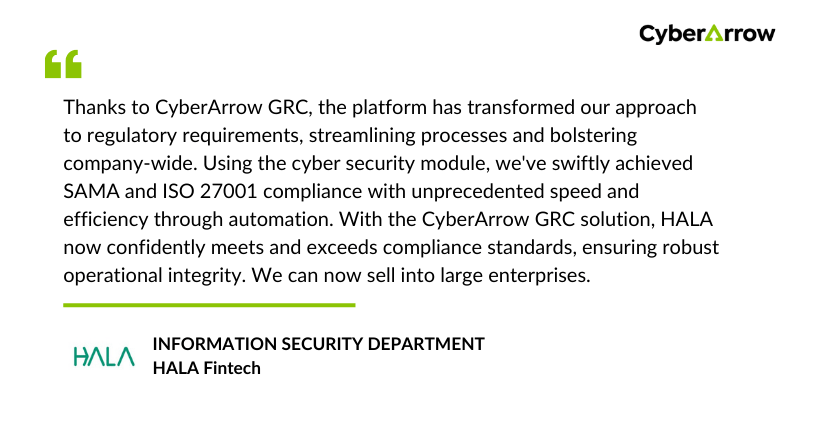
See what HALA has to say about CyberArrow GRC:
Conclusion
ISO 27001 is essential for FinTech companies that want to protect financial data, manage cyber risks, and build trust with regulators and customers. The standard provides a structured approach to information security that supports fast growth and innovation.
However, managing ISO 27001 manually can slow teams down and increase risk. CyberArrow GRC provides the automation, visibility, and structure FinTech companies need to meet ISO 27001 requirements with confidence.
For FinTech organizations that want strong security without unnecessary complexity, CyberArrow GRC is the right platform to support long term compliance and growth.
FAQs
What ISO 27001 requirements are most important for FinTech companies?
The most important ISO 27001 requirements for FinTech include risk assessments, access control, encryption, secure development, third-party risk management, incident response, and business continuity. These controls help protect financial data and reduce fraud and cyber risks.
How does ISO 27001 support FinTech regulatory compliance?
ISO 27001 provides a structured way to manage information security risks and controls. This helps FinTech companies meet many regulatory expectations related to data protection, operational security, and audit readiness. It also supports alignment with standards like PCI DSS and SOC 2.
How can FinTech companies manage ISO 27001 compliance more efficiently?
FinTech companies can improve efficiency by using automation tools to manage risks, controls, policies, and evidence in one place. Platforms like CyberArrow GRC help reduce manual work, improve visibility, and keep teams audit-ready throughout the year.
