


Stop manual risk assessments: How CyberArrow automates your GRC program
Every company with a security, compliance, or governance function knows one major problem. Manual risk assessments take too much time and slow everything down. Teams spend hours searching through old spreadsheets, updating scores, reviewing long lists of risks, and trying to connect them to controls, assets, and mitigation plans. As companies grow, release new features, and expand their systems, these manual processes become even harder to manage.
A strong GRC program needs clear visibility, accurate risk scores, and a simple way to track updates. It cannot depend on scattered files, outdated spreadsheets, or tasks that only one person understands. This is why more organizations are moving toward automation.
Automated risk assessments help companies work faster, stay aligned, and build stronger compliance programs.
CyberArrow GRC is a modern platform built for companies that want to stop manual risk assessments and run a cleaner, smarter, and more organized GRC program. This blog explains why manual work creates problems, how automation improves security and compliance, and how CyberArrow GRC gives teams a better way to manage risks.
Why manual risk assessments create problems
Manual risk assessments may feel simple at the beginning. A small team can manage a few risks using a spreadsheet or shared folder. But this approach fails as soon as the company grows. New systems are added. New employees join. New vendors are onboarded. New audits begin. New assets appear. The old method breaks quickly.
Here are the biggest problems companies face with manual risk assessments:
- Risk information is scattered: Teams store risk details in spreadsheets, chat messages, notes, and outdated documents. When someone needs the latest update, they spend valuable time searching through different locations.
- Scores are inconsistent: Manual scoring leads to mistakes. Different people use different formulas or rating scales. This makes reports unreliable and confusing.
- Updates are slow: Risk assessments must be reviewed often. Manual reviews take long hours and create delays because teams forget deadlines or lose track of tasks.
- Risk treatments are difficult to follow: Once a mitigation plan is assigned, it becomes hard to track its progress manually. This leads to missed deadlines and unresolved risks.
- No real-time visibility: Leaders cannot see the current risk posture. They depend on manual reports that are often outdated by the time they are shared.
- Audits become stressful: Auditors ask for updated risk registers, treatment evidence, review logs, and approval trails. Manual systems make this difficult to provide.
- Work repeats every year: Because spreadsheets do not scale, teams rebuild risk registers each time a new audit or certification begins.
All these problems show that manual risk assessments hurt the GRC program. They slow down compliance, reduce visibility, and increase risk.
Why automation is the future of every GRC program
Today’s companies need a GRC program that runs smoothly throughout the year. Automation helps achieve this by removing repeated manual steps and making processes more predictable.
Here is how automation helps:
- Faster workflows: Automated tasks move quickly because the system organizes, assigns, and tracks all risk-related work.
- Clear ownership: Every risk has a clear owner and reviewer. Teams know who is responsible for what.
- Consistent scoring: Automated scoring ensures all risks follow the same method. This improves accuracy and clarity.
- Accurate information: Risk updates are stored directly in the system. No one has to worry about outdated spreadsheets.
- Better documentation: Automated platforms keep a full record of reviews, approvals, comments, and risk history.
- Year-round readiness: Automation supports continuous risk management, which helps companies stay ready for audits at any time.
- Higher trust: Partners, customers, and auditors trust companies with structured risk processes.
Automation also makes it easier for companies to scale. When new projects or systems are added, the GRC program stays organized because the platform handles much of the heavy work.
How manual work slows down a GRC program
Risk assessments are not the only part affected by manual work. Manual steps slow down the entire GRC program. Controls, policies, audits, and compliance tasks all depend on accurate risk information. When risk assessments are slow or outdated, the full governance and compliance system becomes weaker.
Here are common examples:
- Teams do not know what risks need attention: Without clear risk information, teams work blindly. They may focus on low risks while high risks remain unresolved.
- Leaders cannot make quick decisions: Management needs real-time visibility. Manual systems create delays because reports take time to prepare.
- Risk treatments are not completed on time: Many mitigation plans depend on multiple teams. Without automated reminders, tasks fall behind schedule.
- No proof of who approved what: Manual tracking does not record proper audit trails. This causes problems during certification audits.
- Difficult onboarding for new employees: When risk processes depend on personal knowledge instead of clear workflows, new team members struggle to understand the system.
Manual risk management creates confusion. A modern GRC program cannot function with such gaps. This is why automation is necessary for accurate and reliable risk assessments.
How CyberArrow GRC automates risk assessments
CyberArrow GRC helps organizations automate risk assessments and build a strong and predictable GRC program. It is designed for teams that want simple navigation, fast onboarding, and clear workflows.
Here is how CyberArrow GRC solves the biggest problems created by manual risk assessments:
Centralized risk register
All risks stay in one organized place. Teams can add, update, or review risks without searching through spreadsheets.
Guided risk creation
CyberArrow uses simple forms that help teams create risks with the right details, categories, and fields. Nothing is missed or forgotten.
Automatic scoring
Risk scores are calculated using structured rating systems. This ensures accuracy and consistency.
Clear treatment plans
Each risk can be linked to a mitigation plan with assigned owners, deadlines, and documentation.
Automatic reminders
CyberArrow sends reminders for review dates, open tasks, and overdue treatments. Teams stay on track without manual follow-ups.
Real-time dashboards
Leaders can view the full risk posture instantly. They can see high risks, open risks, trends, and treatment progress at a glance.
Connected frameworks
Risks can be linked to controls, assets, and compliance frameworks, including ISO 27001, SOC 2, PCI DSS, NIS2, HIPAA, and others.
Audit-ready reporting
CyberArrow keeps a record of all updates, comments, approvals, and changes. This makes audits faster and stress-free.
CyberArrow GRC replaces manual work with a clean and efficient risk workflow.
How automated risk assessments improve the GRC program
Here is how automation strengthens the full GRC system:
Better collaboration: Teams work in the same platform and share updates easily.
Fewer repeated tasks: Risks can be mapped across frameworks, reducing duplicate work.
Stronger decision-making: Leaders view accurate, real-time risk data to make smart decisions.
Better control testing: Controls can be linked to risks, helping teams focus on what matters most.
Improved reporting: Compliance managers generate reports in minutes instead of hours.
Higher security maturity: Automation supports continuous improvement and reduces human error.
CyberArrow GRC turns risk assessments from a stressful manual process into a smooth and reliable workflow.
Why CyberArrow GRC is the best tool for automated GRC programs
CyberArrow GRC is built for companies that want to simplify risk assessments and run a stronger GRC program. It reduces manual work, speeds up reviews, and helps teams stay compliant with global standards.
CyberArrow GRC supports companies by offering:
- Simple navigation.
- Fast onboarding.
- Centralized risk and compliance tools.
- Clear workflows for every team.
- Consistent and automated scoring.
- Complete visibility for leaders.
- Ongoing audit readiness.
CyberArrow GRC is more than a compliance tool. It is a complete GRC solution that helps companies improve their security, reduce risk, and stay organized all year long.
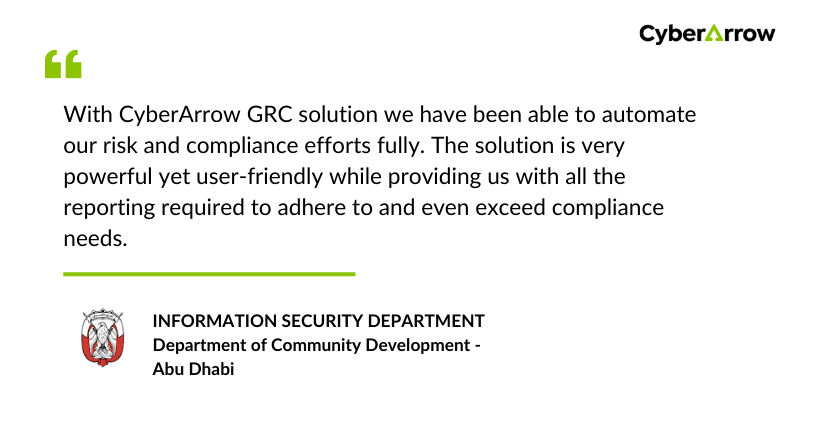
Read how DCD Abu Dhabi improved risk assessments with CyberArrow GRC.
See what DCD Abu Dhabi has to say about CyberArrow GRC:
FAQs
Why are manual risk assessments a problem for companies?
Manual risk assessments are slow and confusing. Information is spread across spreadsheets, emails, and folders. Scores become outdated, teams miss deadlines, and leaders cannot see the real level of risk. This makes audits harder and weakens the GRC program.
How does automation improve a company’s GRC program?
Automation helps by keeping all risks in one place, creating consistent scoring, sending reminders, and tracking updates in real time. It removes repeated work, reduces human mistakes, and gives teams a clear view of their risk posture.
How does CyberArrow GRC support automated risk assessments?
CyberArrow GRC provides a simple platform for adding risks, updating scores, tracking treatment plans, and reviewing progress. It includes automatic reminders, real-time dashboards, and audit-ready records. This helps companies run a strong and organized GRC program without manual work.
