

SOX controls: A detailed guide to SOX compliance
When companies talk about financial integrity, transparency, and investor trust, one regulation stands tall, the Sarbanes-Oxley Act (SOX). Passed in 2002 after corporate scandals like Enron and WorldCom, this law transformed how public companies handle financial reporting and internal controls.
But most people struggle to understand SOX controls, what they are, how they work, and how to manage them efficiently.
This guide breaks it down in simple terms.
- What are SOX controls?
- Why SOX controls matter
- The key sections of the Sarbanes-Oxley Act
- Types of SOX controls
- Key SOX controls every company should have
- SOX IT controls and cyber security
- How to identify SOX controls
- Testing SOX Controls
- SOX reporting requirements
- Common challenges in SOX compliance
- How CyberArrow GRC simplifies SOX compliance
- Final thoughts
- FAQs
What are SOX controls?
SOX controls are the internal rules, procedures, and checks a company puts in place to make sure financial information is accurate and reliable. They are part of the Sarbanes-Oxley Act of 2002, which protects investors from fraudulent financial practices.
Think of SOX controls as the guardrails that keep financial reporting on track. They help ensure that no false numbers, errors, or misstatements end up in your company’s financial statements.
In short, these controls exist to answer one key question:
Can we trust the numbers?
Why SOX controls matter
SOX compliance is not optional for publicly traded companies, it’s a legal requirement. The consequences for failing to comply are serious, ranging from multi-million-dollar fines to criminal penalties for executives.
Beyond avoiding penalties, SOX compliance builds credibility with:
- Investors, by showing transparency and accountability.
- Auditors, by simplifying financial reporting.
- Boards of directors, by ensuring risks are properly managed.
A 2024 Deloitte survey found that over 80% of public companies view SOX compliance as a core part of corporate governance, not just a legal requirement. That’s because good controls also help identify inefficiencies and reduce the risk of fraud.
The key sections of the Sarbanes-Oxley Act
SOX has 11 sections, but three are especially important for compliance teams:
Section 302: Corporate responsibility for financial reports
- CEOs and CFOs must personally certify the accuracy of financial reports.
- They must confirm that internal controls are designed, maintained, and tested.
- Any weaknesses must be disclosed.
Section 404: Management assessment of internal controls
- Requires both management and external auditors to evaluate internal controls over financial reporting (ICFR).
- Companies must provide an internal control report as part of their annual filings.
Section 906: Criminal penalties for false certification
- Executives who knowingly certify false reports can face fines up to $5 million or 20 years in prison.
These sections collectively ensure financial accountability from top to bottom.
Types of SOX controls
Not all internal controls are equal. In SOX compliance, there are three main categories:
1. Preventive controls
These stop errors or fraud before they happen.
Examples include:
- Segregation of duties between accounting staff.
- Access restrictions for sensitive financial systems.
- Authorization protocols for large transactions.
2. Detective controls
These identify problems after they occur.
Examples include:
- Regular reconciliations of accounts.
- Audit logs and system monitoring.
- Review of financial statements by management.
3. Corrective controls
These fix issues once they’re detected.
Examples include:
- Incident response plans for financial errors.
- Policy updates and retraining of staff.
- Corrective journal entries.
Together, these three types form a balanced and strong internal control environment.
Key SOX controls every company should have
While SOX does not specify a fixed list of controls, some are considered best practices:
- Access controls: Ensure only authorized employees can access financial systems.
- Change management controls: Review and document every software or process change that may affect financial data.
- Data backup and recovery: Maintain reliable data backups to prevent loss or tampering.
- Segregation of Duties (SoD): Split critical tasks (like approving and processing payments) to prevent conflicts of interest.
- Reconciliation controls: Regularly verify that system records match actual financial activity.
- Financial review controls: Management should review and sign off on all key reports.
Each control serves as part of a broader framework known as ICFR (Internal Control over Financial Reporting).
SOX IT controls and cyber security
Today, most financial data lives in digital systems, which means IT controls are essential for SOX compliance.
SOX IT controls ensure that financial data within IT systems is accurate, complete, and secure. These include:
- Access management (who can log in and what they can do).
- Change management (who modifies code, configurations, or databases).
- Backup and disaster recovery.
- Incident response and monitoring.
With the rise of ransomware and data breaches, cyber security has become deeply tied to SOX. A 2023 IBM report found that 82% of financial reporting systems now include automated cyber security controls as part of their SOX framework.
How to identify SOX controls
To determine if a control is “in scope” for SOX, ask these questions:
- Does this process affect financial reporting?
- Does it involve data that feeds into financial statements?
- Would failure in this process create a material misstatement?
If the answer is yes, then it likely qualifies as a SOX control.
Testing SOX Controls
Testing is where compliance teams ensure that controls work as designed. This is done through:
- Walkthroughs: Understanding how a control operates from start to finish.
- Sampling: Reviewing specific transactions to confirm consistency.
- Evidence Gathering: Collecting documentation, screenshots, or audit logs.
- Evaluation: Determining if the control is effective or needs improvement.
Internal audit teams test controls throughout the year, while external auditors validate results during annual reviews.
SOX reporting requirements
SOX reporting involves both internal and external disclosures:
- Internal reports document testing results, issues found, and remediation steps.
- External reports (filed with the SEC) include management’s assessment of controls and auditor opinions.
Companies must also report any material weaknesses, control failures that could lead to inaccurate financial reporting. Transparency is key.
Common challenges in SOX compliance
Even after two decades, SOX compliance remains complex. The most common challenges include:
- Manual testing that consumes time and resources.
- Lack of visibility into control performance across departments.
- Difficulty maintaining documentation for audits.
- Frequent regulatory updates requiring continuous change.
According to PwC, 54% of organizations spend over 1,000 hours annually just preparing for SOX audits. This is where automation can transform the process.
How CyberArrow GRC simplifies SOX compliance
Managing hundreds of controls manually is overwhelming. That’s why forward-thinking organizations are shifting to GRC (Governance, Risk, and Compliance) automation.
CyberArrow GRC is built to make SOX compliance effortless.
Here’s how it helps:
- Automated control tracking: Map, assign, and monitor all SOX controls in one dashboard.
- Real-time risk assessment: Identify weak controls before auditors do.
- Zero-touch audits: Automatically collect evidence from integrated systems with minimal manual effort.
- Audit-ready reports: Generate accurate compliance reports instantly.
CyberArrow GRC reduces the workload, improves audit accuracy, and ensures continuous compliance with zero stress.
With automation, companies can shift from reactive compliance to proactive governance, saving both time and money.
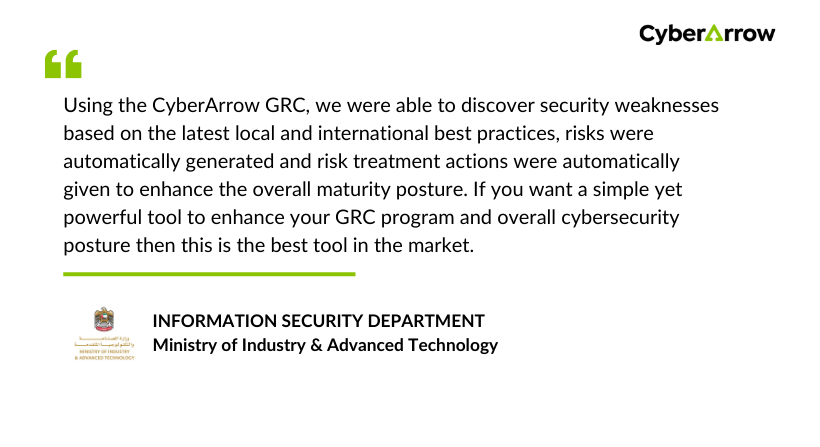
See what our clients have to say about CyberArrow GRC:
Final thoughts
SOX controls are not just about ticking regulatory boxes. They are about trust, trust in numbers, leadership, and the financial ecosystem.
By automating repetitive tasks and centralizing control management, companies can maintain compliance, boost efficiency, and focus on growth.
CyberArrow GRC helps you do exactly that. Turn compliance chaos into clarity. Automate your SOX program today.
FAQs
What are SOX controls and why are they important?
SOX controls are the internal procedures and safeguards that ensure the accuracy, integrity, and reliability of a company’s financial reporting. They were introduced under the Sarbanes-Oxley Act (SOX) to prevent fraud and restore investor confidence after major corporate scandals. These controls help protect stakeholders, improve transparency, and ensure compliance with the U.S. Securities and Exchange Commission (SEC) regulations.
Who needs to comply with SOX controls?
All publicly traded companies in the United States and companies planning to go public must comply with SOX controls. This includes their subsidiaries and any third-party vendors whose systems impact financial reporting. Private companies can voluntarily adopt SOX-style controls to strengthen their internal governance and prepare for future IPOs.
What are examples of key SOX controls?
Key SOX controls include access management, segregation of duties, change management, data backup, and financial reporting reviews. These controls ensure that only authorized personnel can modify financial data, prevent conflicts of interest, protect data integrity, and verify that financial statements are accurate and complete.
How are SOX controls tested and reported?
SOX control testing is performed by internal audit teams and external auditors to verify that controls work as designed. Testing includes walkthroughs, documentation review, and evidence validation. The results are then reported to the SEC as part of the company’s annual 10-K filing, confirming the effectiveness of its internal control framework over financial reporting.
How can automation help with SOX compliance?
Automation reduces manual work, human error, and audit fatigue in SOX programs. Tools like CyberArrow GRC automate evidence collection, map controls across frameworks, and maintain continuous monitoring. This makes compliance faster, easier, and more reliable by turning traditional audits into zero-touch audits that save time and cost.
