

GDPR countries: What countries are covered by GDPR?
The General Data Protection Regulation (GDPR) is one of the most important privacy laws in the world. Since it came into effect in May 2018, it has changed how businesses collect, use, and protect personal data. While it started in the European Union (EU), its impact reaches far beyond European borders.
One of the most common questions businesses ask is: Which countries does GDPR apply to? The answer is not as simple as just saying “Europe.” In this guide, we will explore GDPR countries, their global reach, and what it means for businesses trying to stay compliant.
- What is GDPR?
- GDPR countries: Who does it cover?
- Why does GDPR apply beyond Europe?
- How many countries are covered by GDPR?
- Key GDPR requirements for covered countries
- The business impact of GDPR countries
- How to stay compliant in GDPR countries
- Why CyberArrow GRC is the best partner for GDPR Compliance
- Final thoughts
What is GDPR?
GDPR is a regulation created by the European Union to give people more control over their personal data. It sets strict rules on how companies handle personal data such as names, email addresses, phone numbers, or even IP addresses.
The law applies to both data controllers (who decide how data is used) and data processors (who handle data on behalf of controllers). Non-compliance can lead to heavy fines of up to €20 million or 4% of annual global revenue, whichever is higher.
According to the European Data Protection Board, billions of euros in fines have already been issued since GDPR was enforced, showing how serious regulators are about protecting personal data.
GDPR countries: Who does it cover?
At its core, GDPR applies to all 27 countries in the European Union (EU). But its reach does not stop there. It also applies to the European Economic Area (EEA) and affects businesses outside Europe if they process the data of EU citizens.
EU countries covered by GDPR
Here is the full list of EU countries where GDPR applies:
- Austria
- Belgium
- Bulgaria
- Croatia
- Cyprus
- Czech Republic
- Denmark
- Estonia
- Finland
- France
- Germany
- Greece
- Hungary
- Ireland
- Italy
- Latvia
- Lithuania
- Luxembourg
- Malta
- Netherlands
- Poland
- Portugal
- Romania
- Slovakia
- Slovenia
- Spain
- Sweden
EEA countries covered by GDPR
In addition to the EU, GDPR also covers the European Economic Area (EEA), which includes:
- Norway
- Iceland
- Liechtenstein
Non-EU countries affected by GDPR
Here is where things get interesting. GDPR is extraterritorial, meaning it applies outside Europe too. If your business is based in the United States, the Middle East, Asia, or anywhere else but processes or stores data of EU citizens, you must comply with GDPR.
For example:
- A US-based e-commerce website selling products to France must follow GDPR.
- A marketing company in Dubai running campaigns for EU customers must comply.
- A software business in India storing EU user data in the cloud must meet GDPR standards.
This makes GDPR not just a European law, but a global benchmark for data privacy.
Why does GDPR apply beyond Europe?
The European Union wanted to ensure that the personal data of EU citizens remains protected, no matter where it travels. Data today is global, crossing borders instantly through the internet.
To address this, GDPR uses two principles:
- Establishment principle: If your business has a presence in the EU, you must comply with GDPR.
- Targeting principle: Even if you do not have offices in the EU, but you target EU customers (through websites, apps, or services), GDPR still applies.
This is why GDPR has become a worldwide standard, influencing new laws in countries like Brazil (LGPD), South Africa (POPIA), and even US states like California (CCPA).
Quick link: GDPR audit: A complete guide for businesses
How many countries are covered by GDPR?
To sum it up:
- 27 EU countries
- 3 EEA countries (Norway, Iceland, Liechtenstein)
- Any country in the world that processes data of EU citizens
That means GDPR can potentially cover almost every business globally, as long as they interact with EU residents.
Key GDPR requirements for covered countries
Whether you are in Germany, Norway, or the United States, if GDPR applies to you, here are the main requirements:
- Data protection principles: Personal data must be processed lawfully, fairly, and transparently.
- User rights: Individuals have the right to access, correct, delete, and restrict use of their data.
- Data protection officers (DPOs): Certain businesses must appoint a DPO.
- Data breach notification: Organizations must report data breaches within 72 hours.
- Data transfers: Sending data outside the EU/EEA requires safeguards such as Standard Contractual Clauses (SCCs).
Failure to meet these requirements can lead to large fines and loss of customer trust.
Quick link: UK GDPR: Everything you need to know
The business impact of GDPR countries
GDPR has created challenges for companies, but it also offers benefits.
Challenges include:
- Increased compliance costs.
- Need for new technology and processes.
- More complex audits and reporting.
Benefits include:
- Improved trust and transparency.
- Stronger data protection systems.
- Better global reputation.
A PwC survey found that 92% of US companies consider GDPR compliance a top priority, showing how important it is even outside Europe.
How to stay compliant in GDPR countries
If your business operates in GDPR countries, here are some steps to follow:
- Understand the law: Know exactly what GDPR requires.
- Map your data: Identify what personal data you collect and where it is stored.
- Update policies: Make sure your privacy policies are clear and transparent.
- Use secure technology: Protect data with encryption, firewalls, and secure storage.
- Train employees: Ensure staff know how to handle data properly.
- Automate compliance: Use GRC platforms to reduce manual work.
Why CyberArrow GRC is the best partner for GDPR Compliance
Managing GDPR across multiple countries can feel overwhelming. This is where CyberArrow GRC helps.
CyberArrow GRC is a full enterprise GRC platform that simplifies GDPR compliance by:
- Automating evidence collection and reporting.
- Offering cross-mapping of GDPR with other frameworks like ISO 27001 and NIST.
- Reducing manual work through ready-to-use templates.
- Keeping you audit-ready with real-time dashboards.
With CyberArrow GRC, you can put GDPR compliance on autopilot and focus more on your business. It is built for organizations of every size, from startups to global enterprises.
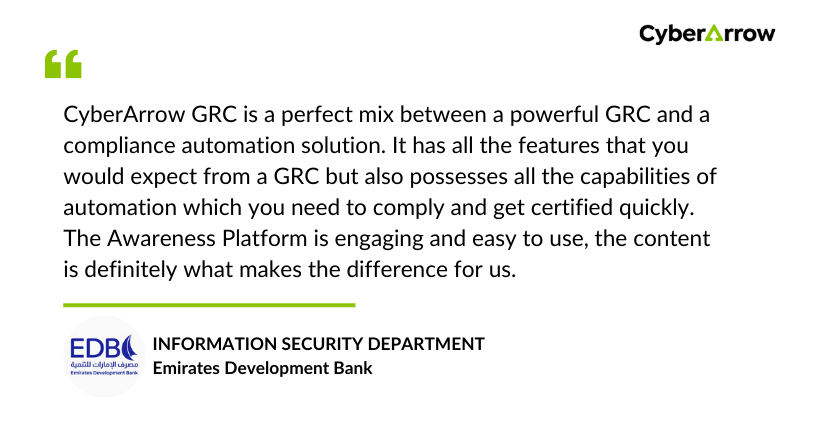
See what Emirates Development Bank has to say about CyberArrow GRC:
Final thoughts
GDPR is one of the strictest privacy laws in the world, and it applies to 30+ European countries plus any business that touches EU citizens’ data. That makes GDPR countries a global concept, not just a European one.
While the law can be complex, the right tools make it manageable. Instead of relying on spreadsheets and manual work, companies can use CyberArrow GRC to automate GDPR compliance, simplify audits, and prove trust to customers.
Compliance is no longer just about avoiding fines. It is about showing your customers that their privacy matters. With CyberArrow GRC, you can achieve this faster and smarter.
Quick link: CyberArrow GRC recommended to security leaders by Gartner
