

GDPR audit: A complete guide for businesses
When the European Union introduced the General Data Protection Regulation (GDPR) in 2018, it changed how companies handle personal data. Compliance is not a one-time project but a continuous process. A GDPR audit is one of the best ways to confirm that your business is following the rules and protecting personal data responsibly.
According to Statista, over 1,600 GDPR fines were issued across Europe in 2023 alone, proving that regulators continue to take data protection seriously. For businesses, a GDPR audit is no longer optional. It is necessary for avoiding fines, protecting reputation, and keeping customer trust.
This guide explains what a GDPR audit is, its requirements, and the best strategies for success.
- What is a GDPR audit?
- Why is a GDPR audit important?
- Key Areas of a GDPR Audit
- Steps to conduct a GDPR audit
- Internal vs external GDPR audits
- Common GDPR audit challenges
- GDPR audit best practices
- Statistics that show the importance of GDPR audits
- Why CyberArrow GRC is the best solution for GDPR audits
- Final thoughts
- FAQs
What is a GDPR audit?
A GDPR audit is a structured review of an organization’s policies, procedures, and systems to make sure they comply with the GDPR. The goal is to check whether personal data is collected, processed, and stored in line with the regulation.
Unlike financial audits, a GDPR audit is not just about checking records. It looks at how people, processes, and technology work together to protect sensitive data.
Audits can be internal, carried out by the company itself, or external, led by independent auditors or regulators. Both serve the same purpose: to identify gaps, reduce risks, and show evidence of compliance.
Quick link: GDPR countries: What countries are covered by GDPR?
Why is a GDPR audit important?
Avoiding penalties: GDPR allows fines of up to €20 million or 4% of annual global turnover, whichever is higher. Even small mistakes can lead to significant penalties.
Building trust with customers: Research shows that 81% of consumers lose trust in a company after a data breach. A GDPR audit proves your business takes privacy seriously.
Staying competitive: Many partners and clients require GDPR compliance as part of vendor contracts. Audits make it easier to prove compliance and win deals.
Improving security: Audits highlight weak spots in systems and processes, giving organizations the chance to strengthen data protection before problems occur.
Key Areas of a GDPR Audit
A GDPR audit covers several areas, including:
Data inventory and mapping: Knowing what personal data you collect, where it is stored, who has access, and how long you keep it.
Lawful basis for processing: Confirming that all personal data has a legal reason for being collected, such as consent or contract fulfillment.
Privacy policies: Reviewing whether privacy notices are clear, accurate, and accessible.
Data subject rights: Ensuring customers can exercise their rights to access, correct, or erase their data.
Security measures: Checking technical and organizational controls like encryption, access control, and monitoring.
Third-party risk management: Confirming that vendors and partners also comply with GDPR.
Breach management: Making sure the business has a clear process for detecting, reporting, and responding to breaches within 72 hours.
Steps to conduct a GDPR audit
Step 1: Plan the audit
Define the scope. Decide if the audit will cover the entire organization or just certain departments. Assign roles and responsibilities to team members.
Step 2: Gather information
Collect policies, data flow diagrams, contracts, and records. Document how personal data is handled across the organization.
Step 3: Review data processing activities
Check whether data collection has a lawful basis. Verify that only necessary data is collected and stored.
Step 4: Evaluate policies and notices
Review privacy notices, consent forms, and internal policies. Make sure they align with GDPR requirements.
Step 5: Assess security controls
Test technical safeguards such as firewalls, encryption, and access controls. Review employee training and awareness programs.
Step 6: Check vendor compliance
Evaluate third-party contracts. Ensure they contain GDPR clauses for data protection and breach reporting.
Step 7: Document findings
Summarize strengths, weaknesses, and risks. Provide recommendations for improvement.
Step 8: Take action
Address gaps by updating policies, adding security measures, or improving training. Assign deadlines for corrective actions.
Internal vs external GDPR audits
- Internal audit: Conducted by in-house teams, usually once or twice a year. It is faster and less costly but may lack objectivity.
- External audit: Led by independent experts or certification bodies. It provides unbiased results and adds credibility but is more expensive.
Many businesses combine both approaches, using internal audits for regular checks and external audits for certification or client assurance.
Common GDPR audit challenges
- Manual recordkeeping: Relying on spreadsheets and emails creates errors.
- Complex data systems: Large organizations struggle to track data across multiple platforms.
- Limited resources: Small businesses often lack dedicated compliance teams.
- Overlapping regulations: GDPR often overlaps with ISO 27001, SOC 2, and other frameworks, creating duplication.
These challenges highlight why automation is becoming central to GDPR audit success.
GDPR audit best practices
- Automate data mapping: Use tools to identify and track personal data across systems automatically.
- Adopt continuous monitoring: Instead of waiting for annual audits, monitor compliance year-round.
- Train employees regularly: Human error is a leading cause of breaches. Ongoing training reduces risks.
- Cross-map compliance frameworks: Save time by mapping GDPR controls with other standards like ISO 27001.
- Use technology for evidence collection: Automation ensures audit trails are complete, accurate, and always ready for review.
Statistics that show the importance of GDPR audits
- More than 70% of organizations believe compliance automation reduces risk and audit fatigue (Gartner).
- Over 90% of companies that experience a breach face regulatory investigations within 12 months (IBM).
- Businesses that use automation cut compliance costs by 30% on average compared to those using manual processes (PwC).
These numbers show why relying only on manual audits is risky and costly.
Why CyberArrow GRC is the best solution for GDPR audits
CyberArrow GRC is built to make GDPR audits simple, fast, and reliable. Instead of spending weeks on spreadsheets and manual evidence gathering, businesses can manage the entire process in one platform.
With CyberArrow GRC, you get:
- Zero-touch audit approach: Automates evidence collection and reporting, so audits are faster and less stressful.
- Cross-mapping with other frameworks: Align GDPR with ISO, SOC 2, and more without duplication.
- Continuous monitoring: Always stay audit-ready with real-time compliance checks.
- Risk management features: Identify and address data protection risks before they become breaches.
- Scalability for all businesses: Whether you are a startup or an enterprise, CyberArrow GRC adapts to your needs.
By automating GDPR audits, CyberArrow GRC saves time, reduces errors, and ensures ongoing compliance.
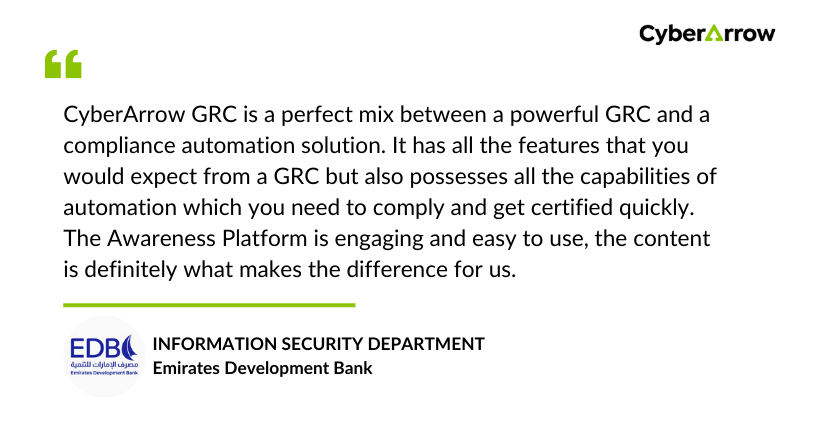
See what Emirates Development Bank has to say about CyberArrow GRC:
Final thoughts
A GDPR audit is not just a regulatory requirement. It is a chance for businesses to strengthen security, build trust, and show responsibility. With rising fines and customer expectations, ignoring GDPR is no longer an option.
Manual processes may have worked in the past, but they cannot keep up with modern challenges. CyberArrow GRC transforms GDPR compliance and audits with its zero-touch audit approach, making it the smarter and faster choice for organizations of every size.
If you want to pass GDPR audits with confidence, reduce costs, and avoid risks, CyberArrow GRC is your solution.
FAQs
How often should a company conduct a GDPR audit?
Most businesses conduct internal audits once or twice a year, while external audits are recommended every 2 to 3 years or when entering new markets.
What happens if a GDPR audit finds non-compliance?
The company must take corrective actions. If regulators find issues, they may issue warnings, corrective orders, or financial penalties.
Can CyberArrow GRC help with GDPR audits for small businesses?
Yes, CyberArrow GRC is designed for organizations of all sizes. It helps startups, SMEs, and enterprises automate GDPR audits with less effort and cost.
