


What is data compliance? Data compliance standards explained
Data is one of the most valuable things a company owns. From customer information to financial records, businesses collect and store a lot of data every day. But with great data comes great responsibility. That’s where data compliance comes in.
In this blog, we’ll explain what data compliance means, why it’s important, what standards you need to follow, and how to stay compliant using smart tools like CyberArrow GRC.
Let’s make it simple and clear.
- What is data compliance?
- Why is data compliance important?
- What happens if you don’t follow data compliance?
- Common data compliance standards
- 1. GDPR (General Data Protection Regulation) – Europe
- 2. CCPA (California Consumer Privacy Act) – United States
- 3. HIPAA (Health Insurance Portability and Accountability Act) – United States
- 4. PCI DSS (Payment Card Industry Data Security Standard) – Global
- 5. ISO/IEC 27001 – Global
- 6. NIST Privacy Framework – United States
- How to stay compliant with data standards
- Challenges of manual compliance
- How CyberArrow GRC makes data compliance easier
- Final thoughts
What is data compliance?
Data compliance refers to adhering to the laws and regulations governing the collection, storage, use, and protection of data. These rules are made to protect personal and business information from misuse, leaks, and cyberattacks.
If your company collects any kind of personal or sensitive information, like names, emails, credit card numbers, or health records, you need to follow data compliance rules.
Think of it like traffic laws for data. Break the rules, and you could face fines, lawsuits, or damage to your reputation.
Why is data compliance important?
There are many reasons why data compliance matters for your business:
- Protects customer and employee information.
- Builds trust with clients and partners.
- Helps avoid fines and legal trouble.
- Prepares you for audits.
- Reduces the risk of data breaches.
- Improves your company’s reputation.
Without data compliance, you may not even know your business is at risk until it’s too late.
What happens if you don’t follow data compliance?
Ignoring data compliance rules can lead to:
⚠️ Heavy fines (some in the millions).
⚠️ Loss of customers.
⚠️ Lawsuits or legal actions.
⚠️ Damage to your brand and public trust.
⚠️ Trouble getting contracts or partnerships.
For example, under the GDPR (a major data law in Europe), companies have been fined for not protecting personal data, even if the mistake was unintentional.
Common data compliance standards
There isn’t just one rule for everyone. Different industries and countries have different data compliance standards. Here are some of the most common:
1. GDPR (General Data Protection Regulation) – Europe
- Applies to any company that handles data from people in the EU.
- Gives users control over their personal data.
- Requires consent before collecting data.
- Businesses must report data breaches within 72 hours.
2. CCPA (California Consumer Privacy Act) – United States
- Applies to businesses that collect personal data from California residents.
- Requires transparency about what data is collected and how it’s used.
- Gives users the right to delete or opt out of data sales.
3. HIPAA (Health Insurance Portability and Accountability Act) – United States
- Applies to healthcare providers and companies that deal with health records.
- Requires strong protection of personal health information (PHI).
- Sets rules for how health data can be shared or accessed.
4. PCI DSS (Payment Card Industry Data Security Standard) – Global
- Applies to any company that handles credit card information.
- Requires strong security measures for storing, processing, and transmitting card data.
- Includes rules for encryption, access control, and regular testing.
5. ISO/IEC 27001 – Global
- An international standard for managing information security.
- Helps businesses build an Information Security Management System (ISMS).
- Covers policies, controls, and risk assessments.
6. NIST Privacy Framework – United States
- A voluntary framework for improving privacy practices.
- Often used by government agencies and large enterprises.
- Helps organizations identify, protect, and respond to data privacy risks.
Quick link: What is the Access Control List (ACL)?
How to stay compliant with data standards
Here are some simple steps to help your business stay data compliant:
Step 1: Know what data you collect
Make a list of all the personal or sensitive data your business collects. This includes:
- Customer names and emails.
- Employee records.
- Financial data.
- Health or insurance info.
- User location or browsing data.
Step 2: Understand which laws apply to you
Laws depend on where your customers are and what kind of data you collect. You may need to follow one or more data compliance standards like GDPR, HIPAA, or CCPA.
Step 3: Get proper consent
Always ask users before collecting their data. Let them know:
- What you’re collecting.
- Why you’re collecting it.
- How it will be used or shared.
This is called “informed consent.”
Step 4: Protect the data
Use tools and practices like:
- Strong passwords and encryption.
- Access control (only the right people can view or edit the data).
- Firewalls and antivirus software.
- Regular backups and updates.
Step 5: Train your employees
Most data leaks happen because of human error. Train your team on:
- How to handle personal data.
- How to spot phishing emails.
- What to do in case of a data breach.
Step 6: Review and audit regularly
Compliance isn’t a one-time job. Laws change, and so do your systems.
Set a schedule to:
- Review data collection methods.
- Update policies.
- Conduct internal audits.
- Fix any problems quickly.
Challenges of manual compliance
Trying to manage data compliance manually can be:
- Time-consuming.
- Prone to mistakes.
- Hard to track across departments.
- Stressful during audits.
- Difficult to scale as you grow.
That’s why businesses are now turning to automated GRC platforms like CyberArrow GRC.
Quick link: What is digital forensics in cyber security?
How CyberArrow GRC makes data compliance easier
CyberArrow GRC is a full-fledged Enterprise GRC platform that helps organizations of every size automate their Governance, Risk, and Compliance (GRC) programs, including compliance with data standards.
Here’s how CyberArrow supports your data compliance efforts:
Automate compliance workflows
No more chasing down spreadsheets or documents. CyberArrow automates your compliance process from start to finish, mapping your activities to frameworks like GDPR, HIPAA, ISO 27001, and more.
Track real-time compliance status
With live dashboards and alerts, you always know where your organization stands. Get notified if any control is failing or needs review.
Built-in templates for faster policy creation
Use auditor-approved templates to create, update, and distribute data protection policies. No need to start from scratch.
Risk assessments made easy
CyberArrow helps you identify, evaluate, and manage data privacy risks automatically. This saves hours of manual effort and makes sure nothing slips through the cracks.
One-click audit reporting
Preparing for a compliance audit? CyberArrow generates audit-ready reports in seconds, saving you from last-minute stress.
Compliance with 100+ standards
CyberArrow comes pre-mapped with 3000+ risks and controls across 100+ global standards and frameworks. Whether you’re working on ISO, GDPR, NIST, or PCI, you’re covered.
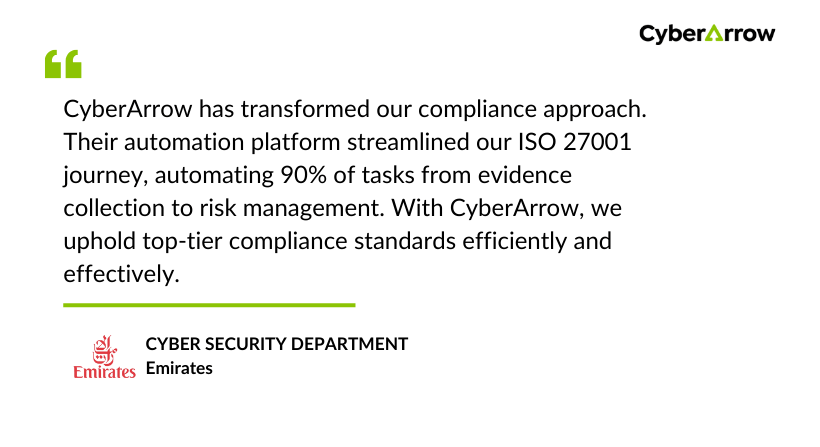
See what a global brand like Emirates has to say about CyberArrow GRC:
Final thoughts
Data compliance is not just a legal requirement; it’s a business essential. It protects your customers, your reputation, and your bottom line. But doing it manually is hard, time-consuming, and risky.
That’s why smart businesses trust CyberArrow GRC.
CyberArrow automates your entire GRC process from compliance and risk assessments to policy management and reporting, so you can focus on what matters most: growing your business with confidence.
