


How to strengthen insider threat awareness across your workforce
Insider threats don’t always wear a black hoodie. Sometimes, they wear a company badge. And often, they don’t even know they’re a threat.
You can have all the firewalls in the world, but if someone on your team clicks a malicious link, leaks confidential data, or misuses access, those technical defenses mean very little. That’s where insider threat awareness becomes not just a box to check, but a business-critical practice.
So, how do you strengthen insider threat awareness across your workforce in a way that sticks? Let’s break it down.
Quick read: How to identify vishing scams over the phone
- What is insider threat awareness?
- Common types of insider threats you should know
- How to strengthen insider threat awareness across your workforce
- 1. Focus on real-world, role-based training
- 2. Promote a culture of transparency and accountability
- 3. Keep security policies visible and practical
- 4. Integrate insider threat awareness into onboarding
- 5. Share real incidents and lessons learned (anonymized)
- 6. Conduct regular phishing simulations and awareness checks
- 7. Collaborate with department heads to localize awareness
- 8. Use tools to reinforce awareness continuously
- Strengthen insider threat awareness with CyberArrow
What is insider threat awareness?
Insider threat awareness is helping employees recognize, understand, and respond to potential security risks that originate from inside the organization, whether intentional or accidental.
It’s not about malicious insiders stealing data. Awareness training covers a wide range of behaviors, like weak password habits, falling for phishing scams, or oversharing sensitive information. The goal is to reduce human error, increase vigilance, and build a workforce that actively contributes to the organization’s security posture.
Why is insider threat awareness important?
Cyberattacks are evolving, but so are internal risks. According to recent industry reports, over 90% of data breaches now involve insiders, whether through negligence, compromised credentials, or deliberate actions.
And with hybrid work, shared devices, and third-party integrations becoming the norm, the attack surface is only getting wider. That’s why building strong insider threat awareness is essential.
Also, regulators and compliance standards like SOC 2, ISO 27001, HIPAA, etc., increasingly expect organizations to implement security awareness training. Without it, organizations are exposed to threats and at risk of falling short of compliance.
Common types of insider threats you should know
Understanding the types of insider threats helps teams spot the signs early. Here are the three most common ones:
Malicious insiders
These are individuals who intentionally harm the organization: disgruntled employees, contractors, or partners who misuse access for personal gain or revenge. They may steal intellectual property, sell data to competitors, or sabotage systems.
Example: An employee about to resign downloads sensitive client lists to take to a competitor.
Negligent employees
These are the most common insiders, not malicious, just careless. They may leave devices unlocked, use weak passwords, or forward sensitive emails to personal accounts without realizing the consequences.
Example: An employee accidentally sends a confidential PDF to the wrong client.
Compromised accounts
Sometimes, it’s not the person, it’s their credentials. Attackers may gain access to an employee’s account via phishing, social engineering attacks, or malware, and then move within your network as if they belong there.
Example: A finance manager clicks a phishing link and unknowingly gives attackers access to payment systems.
How to strengthen insider threat awareness across your workforce
A one-time training video isn’t enough. Building real insider threat awareness takes a thoughtful, ongoing approach.
1. Focus on real-world, role-based training
Generic content won’t stick. Tailor training to specific roles; what a developer needs to know differs from what an HR manager should watch for.
Use real-world scenarios, not scare tactics. Make it relatable. If you’re showing how a phishing email works, show one that actually fooled someone in the same industry.
2. Promote a culture of transparency and accountability
Employees shouldn’t be afraid to report mistakes or suspicious behavior. Make it clear that security is a shared responsibility and that it’s okay to ask questions or flag potential issues.
One simple step: reward good behavior. If someone spots a phishing attempt or reports a misdirected email, thank them publicly. It reinforces a healthy, proactive mindset.
3. Keep security policies visible and practical
Policies don’t help if no one reads them. Use plain language and break key policies into bite-sized, easy-to-access formats like short PDFs, internal wikis, or even posters in common areas.
Also, revisit policies regularly. If you add a new SaaS platform or change remote work guidelines, your awareness efforts need to keep up.
4. Integrate insider threat awareness into onboarding
First impressions matter. Introduce the importance of insider threat awareness as soon as someone joins the organization. This sets expectations early and helps normalize conversations around security.
You don’t need to overload new hires. Just include awareness in your standard onboarding checklist alongside IT and HR topics.
5. Share real incidents and lessons learned (anonymized)
People learn best through stories, especially real ones. Sharing anonymous insider incidents (internal or from the industry) can be a powerful way to show how easily mistakes happen and what the consequences can be.
Instead of relying only on hypothetical examples, show the human side of what went wrong and how it could have been prevented. This makes the training stick.
6. Conduct regular phishing simulations and awareness checks
Testing awareness helps reinforce it. Anti-phishing systems or phishing simulations, for example, can reveal which employees may need additional guidance. It’s not about catching people off guard but building muscle memory and reducing risky click behavior over time.
Combine simulations with mini-quizzes or scenario-based refreshers throughout the year to keep security top of mind.
7. Collaborate with department heads to localize awareness
Different departments face different risks. Work with department leaders to identify relevant threat scenarios and tailor awareness materials accordingly.
For instance, your finance team should be extra alert to invoice fraud and wire transfer scams, while your marketing team may need guidance on protecting brand reputation and customer data. Localization makes awareness more effective and easier to relate to.
8. Use tools to reinforce awareness continuously
Technology can support awareness without overwhelming teams. Consider using platforms that offer microlearning, simulations, or even gamified security challenges. Just-in-time reminders, for example, a pop-up when someone tries to share a file externally, can also help correct risky behavior in real time.
And for compliance and reporting purposes, it’s helpful to track training progress and identify areas where employees might need more guidance.
Strengthen insider threat awareness with CyberArrow
Many organizations know insider threat awareness is essential, but struggle to deliver consistent, practical training that truly sticks. CyberArrow makes it easier.
The CyberArrow Awareness Platform helps reduce human-related security risks with simple tools, yet powerful enough to support large, diverse teams.
Key features include:
- Interactive, region-specific training content tailored to your team’s culture and language.
- Fully customizable platform with seamless Active Directory integration.
- Powerful reporting dashboards to monitor training progress across users and departments.
- Built-in phishing simulator for running realistic, trackable campaigns.
- User-friendly awareness dashboard showing individual course progress and completion.
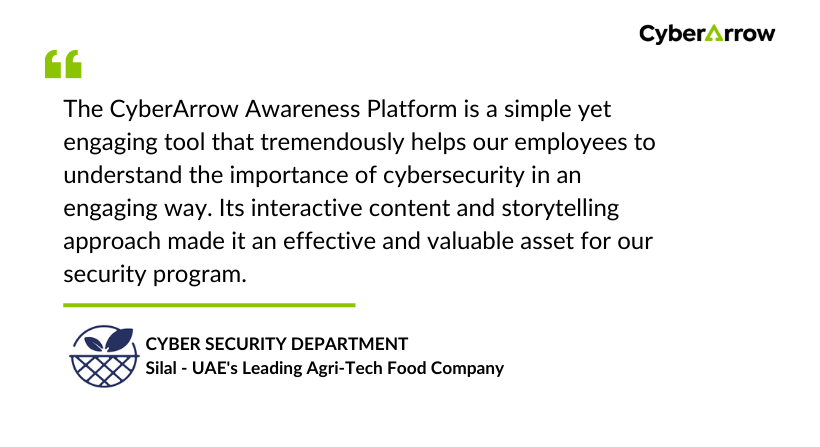
See what companies like Silal has to say about CyberArrow:
If you’re ready to build a culture of security from the inside out, CyberArrow can help you turn awareness into lasting behavior change.
